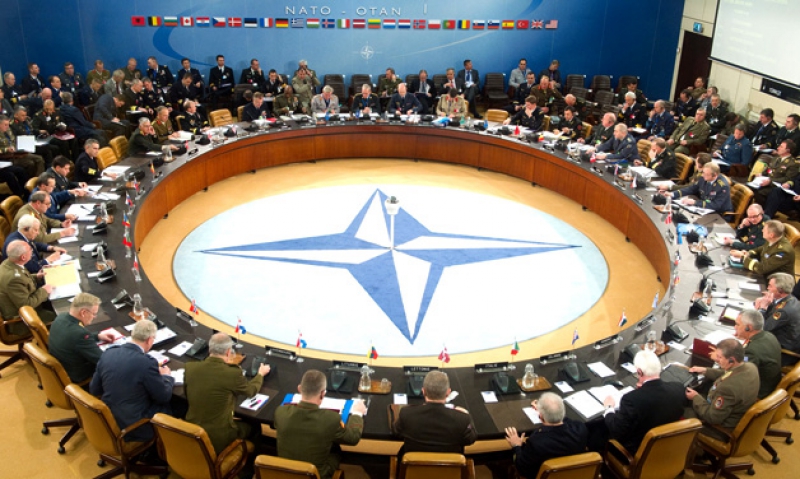
NATO is being pushed to the breaking point by a most surprising foe. It isn't Russian troops, Iranian nukes or a ragtag collection of Afghan tribes that threaten to overwhelm the most powerful military alliance in history, but rather a lack of will – and the eagerness of virtually every NATO member to balance their budgets by slashing their militaries. Next month's NATO summit in Chicago offers alliance leaders an opportunity to either ensure NATO's future, or shove it toward its Waterloo.
Fellow NATO nations generally follow Washington's lead, which is cause for deep concern given that Washington is engaged in massive defense cuts:
The rest of NATO is following suit:
These cuts might make sense if peace were breaking out all around the world. But we know that the very opposite is true.
NATO is still at war in Afghanistan (at least, some of NATO). Iran is racing ahead with its nuclear-weapons program. North Korea is less stable and more paranoid than ever. Terrorist networks like al-Qaida still have the ability to strike targets in the United States and Europe; indeed, the group is gaining ground in Yemen. Nuclear-armed Pakistan is under assault from within, as is oil supplier Nigeria. The Arab Spring revolution has triggered a civil war in Syria; what happens if, or when, the revolution spreads to oil-rich Saudi Arabia or Kuwait? And what path will the new governments in Egypt and Libya choose?
Then there are the big worries. While NATO declaws itself, China is boosting military spending by 11 percent this year, capping double-digit increases in nine of the past 10 years. That unparalleled buildup has empowered Beijing to bully its neighbors, launch cyberattacks, conduct provocative military operations in space, and deploy huge arsenals of missiles, submarines and warplanes to project its power and limit Washington's. Likewise, Russia – in the midst of a 65-percent increase in military spending over five years – is making claims in the Arctic, occupying parts of Georgia, blocking international action in Iran and Syria, and deploying nuclear missiles to areas bordering NATO states.
It's no wonder that Norwegian Defense Minister Espen Barth Eide worries about NATO's ability "to deliver if something happens in the trans-Atlantic theater of a more classical type of aggression." Think Iranian missile salvos, a Russian lunge at Estonia, an EMP blast or a 9/11-style siege.
Speaking of 9/11, then-Defense Secretary Robert Gates noted last summer that total European defense spending fell by 15 percent in the decade after 9/11, meaning that Europe's deficit of will predates the Great Recession. Most NATO nations essentially stopped investing in defense after the Cold War and instead relied on the United States to carry the burden. In fact, the United States now accounts for 75 percent of NATO's defense spending – far above the U.S. share of 50 percent during the Cold War – and just five NATO members meet the alliance's standard of investing 2 percent of GDP on defense.
The consequences are on full display in Afghanistan, where the United States is contributing 71 percent of all forces; where non-NATO members Australia, Georgia and Sweden have more troops deployed than several founding members of the alliance; and where NATO has been exposed as a "one for all" public good rather than an "all for one" alliance.
In Libya, without the United States in the lead, NATO was found woefully lacking in munitions, targeting and jamming capabilities, midair refueling planes, reconnaissance platforms, drones, and command-and-control assets – just about everything needed to conduct a 21st-century air war. After Libya, NATO Secretary General Anders Fogh Rasmussen called on the alliance to "aim at narrowing the economic and technological gap between the United States and Europe." That seems unlikely given the massive military retrenchment now under way. Equally unlikely is NATO engaging in another Libya-style policing mission any time soon, let alone another open-ended, Afghanistan-style nation-building campaign.
A year ago, Gates openly worried about NATO's "lack of will" and "lack of resources." In a very real sense, the United States has supplied both, especially in recent years. As America's will (see Libya and Afghanistan) tapers and its resources (see the 2013 defense budget) shrink, it stands to reason that NATO's global reach and role will follow a similar trajectory.
Where that trajectory ultimately leads the alliance – back to focusing on deterrence or into irrelevance – remains to be seen.
Links:
[1] http://www.legion.org/print/163130
[2] http://www.legion.org/landingzone/162366/hard-questions-afghanistan
[3] http://www.legion.org/landingzone/161507/threatening-skies