

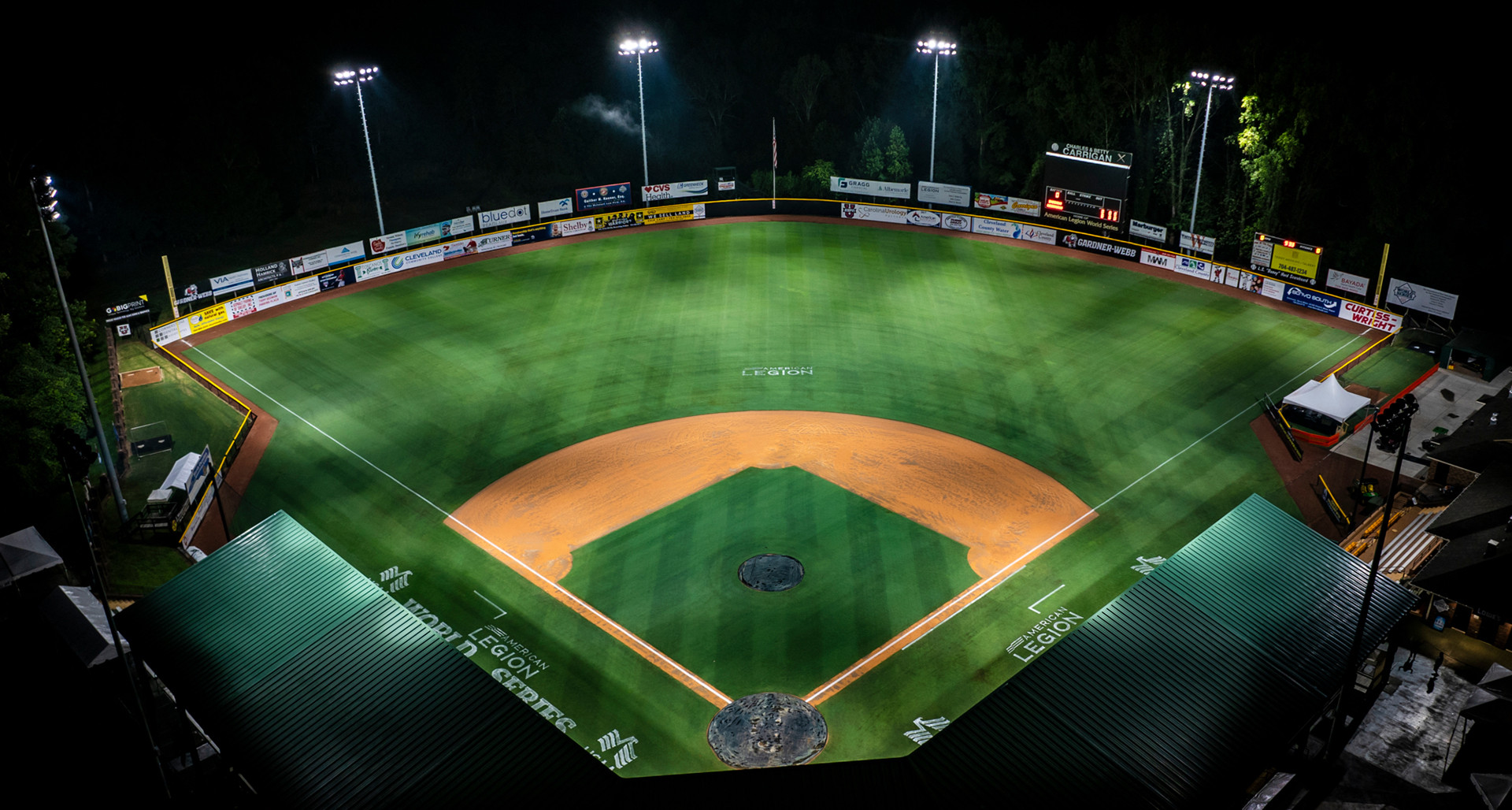
Originally built to draw minor league baseball, Shelby’s Veterans Field at Keeter Stadium hosted its first game on March 17, 1976.
Fifty years ago this March, Shelby, N.C., built a venue that eventually helped make the city the permanent home of the American Legion World Series.
However, the venue was built to attract minor league baseball back to the town with a push from then-Kings Mountain mayor and old Western Carolina League president John Henry Moss. Shelby had fielded minor league teams in 25 years at either old Kerr Park or the old Sumter Street ballpark from 1923 to 1969.
In 1976, a year before the city cut three consecutive two-year contracts with the Cincinnati Reds, Pittsburgh Pirates and New York Mets to host Western Carolinas League and later South Atlantic League teams from 1977 to 1982, Shelby High School and Shelby American Legion Post 82 were the first two teams to call the venue home.
Then called Veterans Field — it was renamed Veterans Field at Keeter Stadium in 2002 — it replaced two fields that are no longer used for baseball.
The old Sumter Street ballpark behind old Shelby High School and Shelby Junior High was opened in 1940 and used exclusively by Shelby High School and Post 82 Legion Baseball until it moved to its current location on Dixon Boulevard in 1960. The field, which was Shelby Post 82’s home from 1940 to 1975, remained in use until 2011 when Shelby Middle School was opened on Dekalb Street.
The original Shelby Post 82 home field from 1931 to 1939 was the old Kerr Park that opened in 1923 located behind the current Alston-Bridges Barbecue restaurant on Grover Street.
After Shelby High moved to Dixon Boulevard in 1960, Golden Lions teams played many of their baseball games at an on-campus field that is now a football practice field and back at the Sumter Street location.
But after a groundbreaking in November 1974, excitement began to build for a stadium located behind the high school that was going to be impressive enough to host minor league baseball.
However, those who played in the facility’s early games couldn’t have imagined what it has become.
“Oh my goodness, there’s no comparison between when I played and now,” said Arey Poston, who played for Crest High when it visited Shelby in the spring of 1976 and was an outfielder for the Shelby Post 82 team in 1976. “It’s definitely worthy of professional ball.”
Added Mark Weaver, who played for both Shelby High and Post 82 in 1976: “I thought it was great. We needed a new stadium. That other stadium had served its purpose. Now I like the old stadium, but it was just ancient and antiquated.”
Poston, now a member of the ALWS committee as co-coordinator of security, parking and emergency services, and Weaver were among a talented group of returnees for Post 82 that summer.
The head coach was new, but was familiar to local fans. Tommy Pruett was a 1965 Shelby High graduate and a three-year Post 82 standout who played for Gardner-Webb Junior College’s 1967 World Series team and Appalachian State’s 1969 NAIA World Series team before returning to the area as a coach.
The 1976 Post 82 team came in the early years of his record-setting coaching career at Burns High School. Pruett would coach at Burns from 1973 to 1997 and remains the school’s winningest girls basketball coach with 353 victories (highlighted by a 1978 state 3A state runner-up finish), guided the Bulldogs’ baseball team to more than 100 victories and their first 12 postseason appearances and was a football assistant who was on Ron Greene’s coaching staff when Burns won the 3A 1994 state title.
“There’s a lot of great memories there for me,” Pruett said of his time coaching Shelby Post 82. “I wouldn’t trade them for anything.
“The ballpark was really nice and it was bigger than any other that we played in. It was rare to see home runs.”
How rare were home runs? Weaver, Poston and a Burns player, Phil Beaver, are still remembered for their historic home runs at the ballpark whose original dimensions were 330 feet down the lines, 360 feet in the alleys and 395 feet to straightaway center.
Shelby High School opened the facility on a frigid March 17, 1976, afternoon against Kings Mountain. The Golden Lions won 8-2.
The first home run wasn’t hit until the fifth game, by Beaver, in a 4-3 Shelby victory on April 1.
Shelby’s first home run was hit by Weaver in an 8-0 win over Chase that coincided with a May 3 stadium dedication ceremony.
And Poston hit the first Legion Baseball home run.
The Shelby High team finished with a 14-7 overall record after losing the Southwestern Conference championship series to an East Rutherford team featuring future minor league player and coach Randy Ingle.
When Post 82’s season began 10 days later on May 27, Pruett had a roster of four Burns players (David Clay, Joe Seagle, David Williams and Mike Williams), five Crest players (Poston, Bill Daves, Ray Frederick, Mike Greene and Britt Mills) and 10 Shelby players (Weaver, Mike Bankhead, Hicks Beam, Rick Crotts, Marcus Jamerson, Ron Klosterman, Francisco Loaces, Steve McKee, Dennis Riley and Mike Styers).
Shelby split a doubleheader with the Kings Mountain A’s semipro team to open the season then won nine straight Area IV games that included a come-from-behind 6-5 win over Cherryville Post 100 in the first Area IV game played at Veterans Field.
After losing at Hickory, Poston set history with a two-run home run and Greene pitched a shutout in a 5-0 win over Cherryville.
“Cherryville was a huge rivalry,” Poston said. “I think there was probably 3,000 fans in the stands that night.”
Post 82 would finish 10-2 in Area IV League 2 action to take the regular season title.
In the playoff opener, Ingle threw a five-hitter with nine strikeouts as Forest City Post 74 won the opener of a best-of-five series. After Forest City took a 2-0 lead the next day, Shelby made a historic comeback with three straight wins that included a 4-3 victory in the finale. The comeback was only the fourth of its kind in Area IV history, and second for Shelby.
“It was really special,” Poston said. “Because we knew he was a really talented player.”
Ingle would go on to become Southern Conference Player of the Year in 1979 at Appalachian State, then was drafted and played nine years for Atlanta Braves minor league teams before winning 1,000 games as a manager in the Braves’ organization.
After eliminating Forest City, Hickory beat Shelby three games to two in the next round.
“There were a lot of great players that came through there,” Pruett said of the Post 82 program. “A lot of them went on to play college baseball. David Williams from Burns played college and professional baseball.
“It was a joy to coach them because taking players from three high schools and combining the best players can be challenging.”
- Baseball