
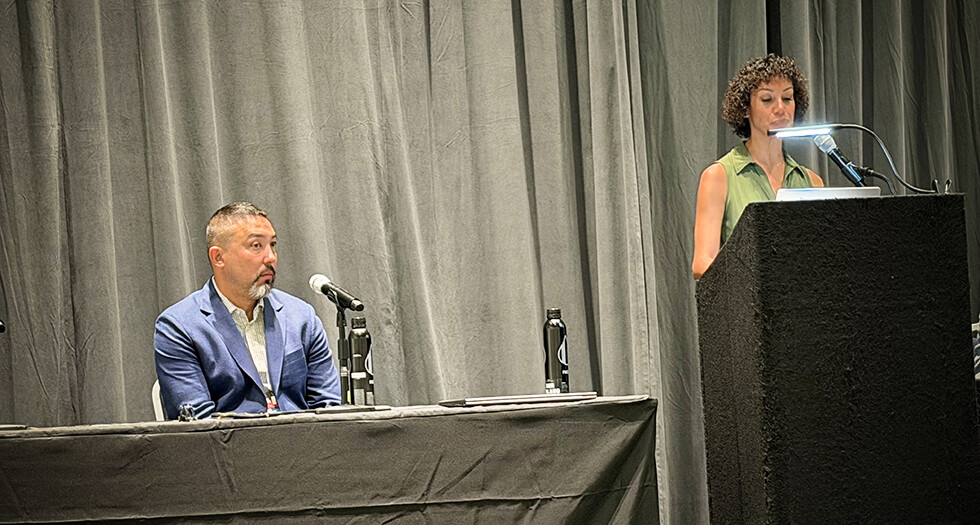
Juliana Mercer of Healing Breakthrough shares the success of treating post-traumatic stress disorder with psychedelics during the Legion’s Be the One Mental Wellness Committee meeting.
Juliana Mercer struggled with her own post-traumatic stress disorder following her military service in the U.S. Marine Corps, which included multiple deployments to Iraq and Afghanistan, and working with wounded servicemembers at the Wounded Warrior Battalion West in San Diego, Calif.
But when she got to a point when she felt she could no longer help her fellow veterans, she began to seek help.
It was then she came across the nonprofit Heroic Hearts Project, which works with leading medical researchers to improve veterans access to psychedelic programs for the treatment of PTSD.
Leaving the country for one of Heroic Hearts’ retreats, she underwent a psychedelic experience that “in one night allowed me to process all the collected trauma and grief that I had bottled up inside,” she said.
It changed her life. And now, she’s working to provide similar experiences for other veterans, including working with policymakers and legislators to make those treatment programs both legal and available to veterans in the United States.
Now the executive director of the nonprofit Healing Breakthrough, Mercer shared updates on the success of MDMA and psilocybin in clinical trials with The American Legion’s Be the One Mental Wellness Committee Aug. 28 during the organization’s national convention in Louisville, Ky.
“I knew that day I needed to help other veterans get access to this,” said Mercer, commander of American Legion Post 426 in Montana. “These treatments are going to change mental health as we know it. This is the light at the end of the tunnel for a lot of veterans. It’s a real solution that’s going to be medically available for them.”
Mercer explained why the psychedelics are successful in treating PTSD. “One of the reasons that this works so well is because the chemical process that happens when you take these medications, it opens up neuroplasticity in your brain,” she said. “What neuroplasticity is, if you think about when you were a child, children’s brains are very neuroplastic, which means that they can learn easily … which allows you to create new neuropathways inside of your brain. It also enables you to end old habits and begin new habits.”
And the results are quickly recognizable. “When you take these treatments, we’re seeing immediate relief,” she said. “And there’s also a clinical component, so it’s not just the medication. It’s the medication in conjunction with therapy.
“It’s really important to stress that this isn’t just a drug. You’re not just taking a pill. You are doing the really hard work of the therapy that you maybe weren’t able to do previously and maybe we’re able to go as deep. During that medication session, you are able to process the trauma, the grief, the things that come up for you. You’re able to process them in a way that doesn’t trigger your trauma response, which is fight, flight, freeze or fawn.”
The U.S. Department of Veterans is conducting multiple trials on the efficacy of both MDMA and psilocybin treatments for PTSD.
“The reason they’re focused on those two is they’re in their final stages of FDA approval,” Mercer said. “We’re expecting to see FDA approval by the end of this year or maybe (Quarter 1) of next year. And what FDA approval means is it’s going to be medically available. None of this conversation is around decriminalization or legalization. This conversation is around a medicine that’s going to be approved.”
In trials testing MDMA – a four-month treatment window – two thirds of the participants no longer qualified for their PTSD diagnosis. Those that still did showed an 87% reduction in symptoms.
“That means if you’re a veteran and you have that chronic complex PTSD and you can’t leave the house, you can leave the house now,” Mercer said. “You can show up for a job now. And if you continue with your therapy, you maybe get to that 100-percent free and clear.”
For psilocybin, she said, 39% of patients had a six-month improvement after just two doses, while 25% of those had an improvement after just one dose. And an added benefit is neither MDMA nor psilocybin have any dangerous side effects, and neither is habit-forming.
Mercer praised the efforts of the Legion in advocating for alternate treatments for PTSD and urged the organization to continue with those. “Continuing to do so is really incredibly important because once FDA approval happens, it doesn’t create access. So we have to keep beating that drum,” she said.
Healing Breakthrough Policy Director Jason Moore-Brown, Post 426’s second vice commander, shared his own success story. Moore-Brown has authored two resolutions that were approved at the national level: Res. No. 5, Emerging Therapies to Address Veteran Suicides; and Res. No. 13, Opioid Treatment Research.
Moore-Brown said in 2023 he still was struggling following his service in the U.S. Army – to the point “a radical change” was needed. He attempted cognitive behavioral therapy through the VA, waiting six months for his first treatment. He also reached out to Heroic Hearts and was given the opportunity to attend a retreat in Peru with seven other veterans and two other individuals.
“I think the therapy, in addition to the integration program that Heroic Hearts developed – and the medicine I took in Peru – changed my life so drastically that when I came home, it was visible to my wife. She could see it,” he said. “It wasn’t like we talked about it. She could just see it.
“Is my life perfect now? No. But did it change the trajectory of my life? It was transformative.”
Merging Vets & Players, and a Future D-Day Documentary. The committee also heard from Nate Boyer of Merging Vets & Players (MVP). Boyer and the Fox NFL Sunday’s NFL Insider Jay Glazer – a past recipient of the Legion’s James V. Day Good Guy Award – founded MVP to bring together military veterans with former professional athletes to help each other through the transition into their new lives away from battlefields and playing fields.
Boyer joined the U.S. Army in 2005 and went on to become a Green Beret, serving multiple tours in Iraq and Afghanistan, and completing various Joint Command Exchange Training missions in Israel, Bulgaria and Greece.
In 2010, he walked on to the University of Texas and two years later locked down the starting long snapper position for his final three years. He went undrafted but signed with the Seattle Seahawks as a free agent at age 34, playing in the preseason before being cut.
He went on to co-found MVP and also has been busy in the film industry.
“None of that would have been possible, on the football side at least, without my veteran community, to be completely honest,” Boyer said. “Without my time in the military, where I learned about sacrifice and discipline and all the things that you know very well about. But also the desire, I guess, chasing my American dream and playing football.”
After finishing with football, Boyer said, “I needed to have a mission. I needed to have this sense of purpose or direction. And that’s how MVP came about. It was a personal need. It was something I just recognized in myself.
“You have that sense of something bigger than you (in the military) that really matters. People look up to you … and you have a lot of responsibility. And all of the sudden you don’t have any of that. It’s that odd feeling that a lot of us can probably relate to.”
Boyer said MVP’s focus is bringing veterans and athletes together. “We’ll meet up in the gym in our chapters around the country on a weekly or biweekly basis, sometimes once a month,” he said. “And we tailor it to the individual, whether they have different disabilities or where they’re at in their fitness journey.
“But what really matters is the huddle afterward. That’s the part that really helps some of those that kind of feel a little bit lost and maybe disconnected. We’ll gather around … and it’s an open forum, peer-to-peer. Anything is on the table. It’s a safe space where you can share anything, and it doesn’t leave the gym afterwards. And it’s good stuff, too. It’s not always dread.”
Boyer also used his time before the committee to share information about his latest project, D-Day+80. The documentary, co-directed by Boyer and Laura Kulik, chronicles the 80th anniversary of the D-Day invasion, with interviews with some of the last remaining veterans who took part in the offensive. Those veterans share their memories of the war and their view of America today.
The film will make its premiere with a screening on Sept. 5 at the Miracle Makers International Film Festival at the Regal Edwards Big Newport in Newport Beach, Calif.
“I was fortunate to be able to go back to Normandy two years ago and spend some time with these legends, these centenarians,” Boyer said. “Some of them are 106. The young ones are 98, 99. There’s about a quarter of a percent of World War II veterans still with us, and only a fraction of those that fought on D-Day.
“I think it’s an interesting story. Those people, those veterans – and all veterans – we need to listen to them more and hear more about what they have to share, especially in these divisive times in our country.”
- Be the One