
American Legion, Columbia Lighthouse Project and Robert Irvine Foundation team up for first time to reduce number of veterans lost to suicide.
A new ally joined The American Legion and the Columbia Lighthouse Project in the effort to prevent veteran suicide as part of the Be the One mission.
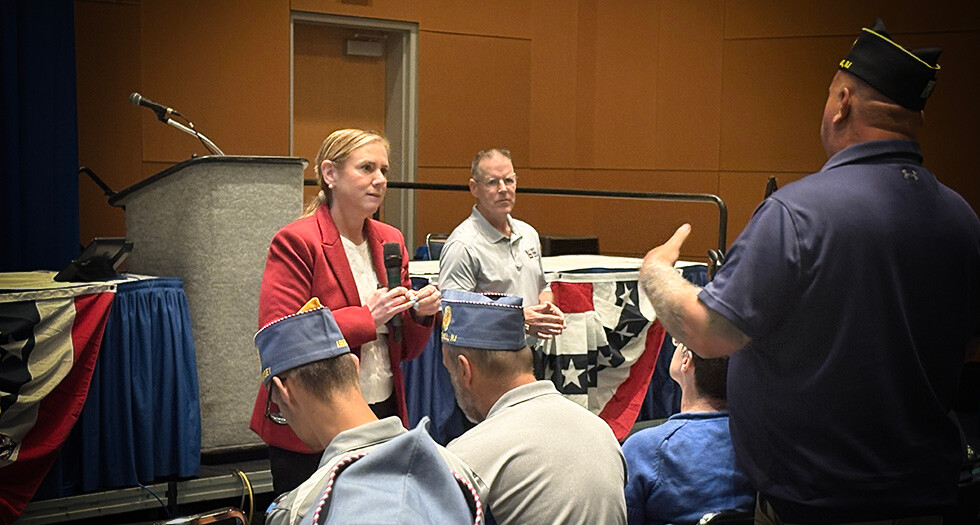
For the first time, the Robert Irvine Foundation teamed up with Columbia for a training session, which was attended by about 100 New Jersey American Legion Family members at its department convention in Wildwood on June 10.
Dr. Keita Franklin, who is married to an Air Force veteran and whose father was in the Navy, is the co-director of the Columbia Lighthouse Project. Franklin, a mental health professional who has worked at the Pentagon, the Department of Veterans Affairs and elsewhere, led the training session.
“I could not be more proud of The American Legion and particularly the state of New Jersey for the work that you're doing to lead the way by letting us come to conventions like this,” she said. “Instead of talking to our own at the American Psychological Conference, we're talking to American Legion members and giving you info that you will then take and ideally save lives yourselves.”
Larry Bishop, a past commander for the Department of New Jersey, recalled receiving a phone call from a distraught veteran just days after attending a previous training session.
“The veteran was on the verge of suicide,” he said, as he acknowledged the six-question protocol on a card he was holding. “He was so distraught. This card is pretty amazing. I had it next to me on my desk and I started asking him the questions.”
After hearing the veteran answer, “Yes, I want to take my life," Bishop went to meet with him in person. The veteran was coping with PTSD and had a recent encounter with police.
Bishop was able to safely get a gun away from the veteran and bring it to his house. He stays in contact with the veteran who is doing better now.
“This is really amazing training,” Bishop said. “This card is really valuable to know what to say. And, in this case, this guy was over the edge. I was able to get him a lawyer, got him some help. This training is outstanding. ‘Be the One’ to really pay attention and act when you can.”
During the 90-minute training, Franklin explained how to use the card to determine if a veteran is in crisis. She also shared some facts and myths, discussed the changes she’s seen in the perceived stigma around suicide and more.
To illustrate a point about being open about mental wellness, Franklin told attendees she had a runny nose due to allergies.
“My gosh, I have allergies, I have itchy eyes,” she said. “We want that to be the same approach if I'm not feeling well with my emotions. We want people to be able to share like you would with the common cold. Like, ‘I'm just having a bad day today. I'm grieving the loss of my sister or I'm struggling with this.’ And we want that to be OK to talk about among each other in an authentic way.”
Still, she did note progress toward that effort.
“People are talking about mental health more now than maybe when you were on active duty or your early days (in the service),” she explained. “We want them to talk more about it. We want to normalize seeking help.”
Marine Corps veteran Robert Yarnall represented the Robert Irvine Foundation.
Yarnall talked about the foundation’s Bad Day Plan (also known as a crisis response plan) which is a personalized, practical tool that can be used anytime the veteran feels they may be headed to a dark place. It serves as a step-by-step guide to navigate stressful moments, avoid risky situations and access support quickly.
“It's a self-management tool you can use to know that's happening to yourself,” he explained. “After all, you know yourself better than anybody else.”
Yarnall’s official title is the chief of programs and outreach. But, as he told attendees, what he really does is work toward saving lives, much like the Legion’s Be the One initiative.
“What I really believe I do every day is I save lives,” he said. “We talked about the protections, then there's the preventions. We connect people. That's a protection, but when we go out and we do this type of training and we work with people and we spread that word, now we're preventing suicide. In the end, it saves lives.”
- Be the One