
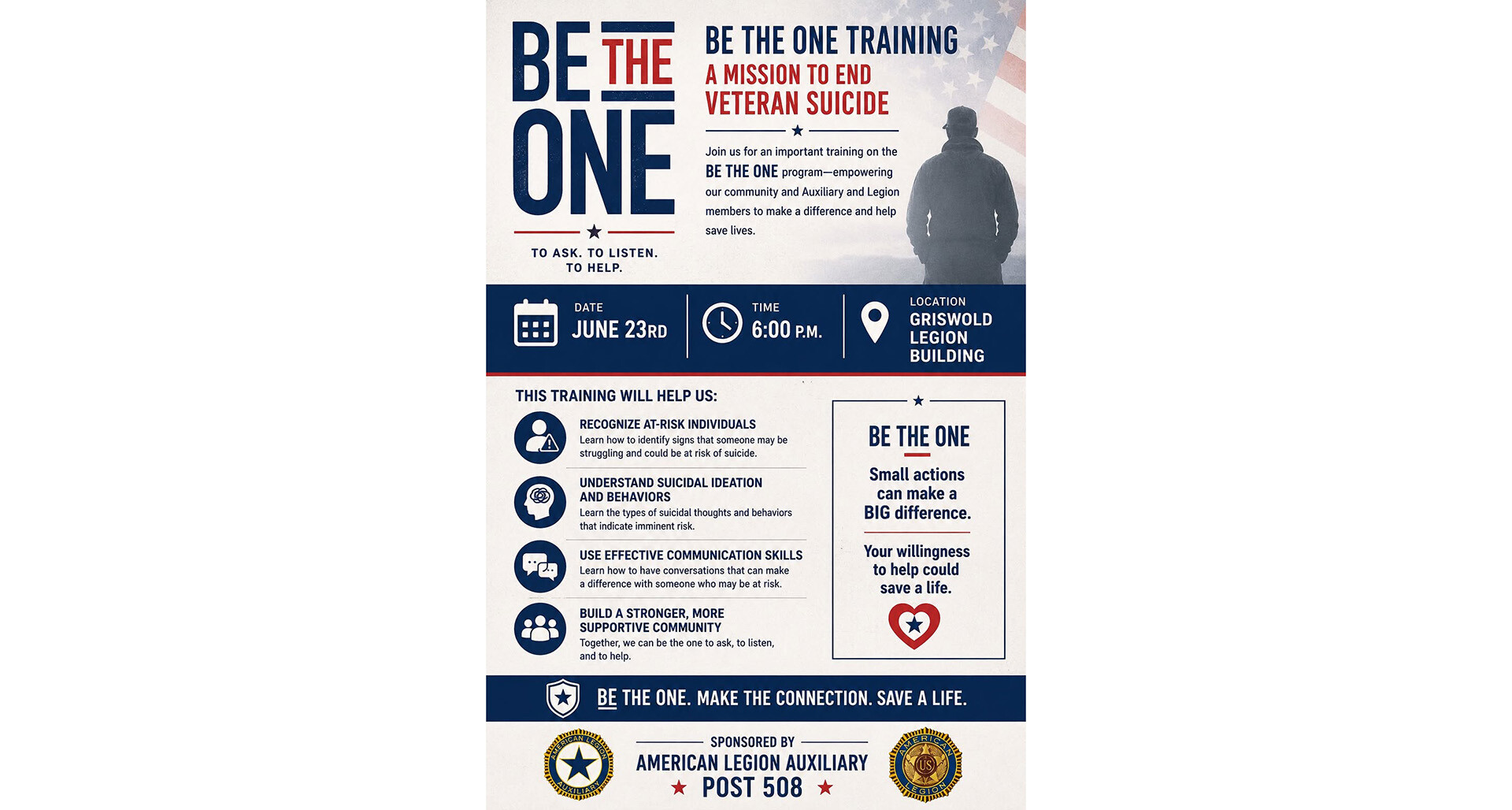
Auxiliary Unit 508 in Iowa hosted Be the One training to educate Legion Family and community members about the Legion’s veteran suicide prevention mission.
When American Legion Auxiliary Unit 508 President Kristie Scism was asked by post member Michelle Hartfield if the Auxiliary would help host a Be the One training, Scism didn’t hesitate.
“I said absolutely. Because unfortunately, suicide is something that touches a lot of people and so it's something that we need to educate ourselves about and learn how to help prevent the unfortunate number of daily suicides, especially in the veteran community.”
The Be the One training was held June 23 at American Legion Post 508 in Griswold, Iowa, and conducted by District 9 Be the One chair Bri Pullen. The training was open to Legion Family and community members with news of the training announced in ads in the local newspaper, live radio interviews given by Scism and District 7 Commander Mitch Brahms, promotions on Unit 508’s Facebook page, and emails sent to Auxiliary members in other units.
The result was a success as attendees included Post and Unit 508 members, other Auxiliary members, along with a police officer, mental health workers and Veterans of Foreign Wars members from nearby Atlantic.
“It's one of those things that you want suicide, veteran suicide, to be important to everyone,” Scism said. “So it was a good thing to see all these different people from different areas in our community and the surrounding communities that came together to learn about this program. I had a lot of people come up and thank us for hosting it and say how important the subject matter is.”
Scism said Pullen provided training on how to have conversations with a veteran who may be at risk of suicide, what at-risk signs to look for, mental health resources to help the veteran, and how the words you speak matter.
“I want people to feel confident in their ability to recognize signs of crisis and know what resources are available to help, and know that they can make a difference for that person,” Pullen said. “I've enjoyed that (as a Be the One trainer) I’ve been able to help share the information that can make a difference, not just for veterans, but for anybody struggling with thoughts of suicide.”
“Part of what I really loved about this training was how it focused so much on destigmatizing suicide. Because suicide has a stigma, and it's something that makes people very uncomfortable (to talk about), but it is a huge problem,” Scism said, adding that when it comes to words used, Pullen emphasized not to say someone committed suicide or tried to commit as it can imply a crime or other meaning.
“I do think this language absolutely matters because of the stigma to those surrounding suicide,” Scism said. “Anybody that has died by a suicide, they weren't selfish. They were in such deep pain, and it was traumatic. When you talk about somebody that was maybe suicidal, you don't want that to become their defining personality trait. You don't want to define them by that because people that have any form of mental illness or addiction, then that gets the focus or the blame. I like that we are moving toward showing more respect for anybody that is in this situation, and we're using words differently to be more caring and more respectful about it.”
Additionally, the training included role playing where each attendee asked the same hard question to two or three others.
“We had to say ask, ‘Are you feeling suicidal?’ Normally, I would ask ‘Are you OK? You seem depressed.’ I've never been so bold as to say, ‘Are you feeling suicidal?’,” Scism said. “So pushing people out of their comfort zone and having them practice saying something that doesn't feel natural, I think was good.”
“We are all capable of saving lives” Pullen said. “We just have to be willing to open up, open our eyes and ears and step up to ask the hard questions.”
Before hosting the training, Scism was aware that ending veteran suicide through Be the One was a top priority of The American Legion thanks to the program shared during District 7 Auxiliary trainings. However, she didn’t know the full scope of what Be the One entails until the training.
“This training was great and education is key,” Scism said. “While this is a Legion program, and we are discussing veteran suicide, but what you learn with the exceptions of the veteran specific contacts that we were given you can utilize that in any walk of life with anybody from any station. Asking, ‘Are you considering suicide?’ is not specific to veterans. You could say that to anyone that you think might be in that place.”
Scism can see Post and Unit 508 conducting more Be the One training sessions because she believes communication and education is key to saving lives.
“I've said this in every aspect of my life, and I feel it to be true, communication is key to every good relationship and outcome,” she said. “I'm not saying that communication will save every veteran, but it's the best place to start. And getting educated and knowing how to do that, and how to spot someone that might be depressed or in trouble in some way, shape or form, and knowing how to communicate to them and then knowing where to go from there, I think that is one of the best things that we can do as a society is educate ourselves. Because these men and women signed up to possibly give their life for us, I think the least we can do is try to save theirs now.
“(Be the One) is a great program, and we can all do a small part to make a difference.”
- Be the One