

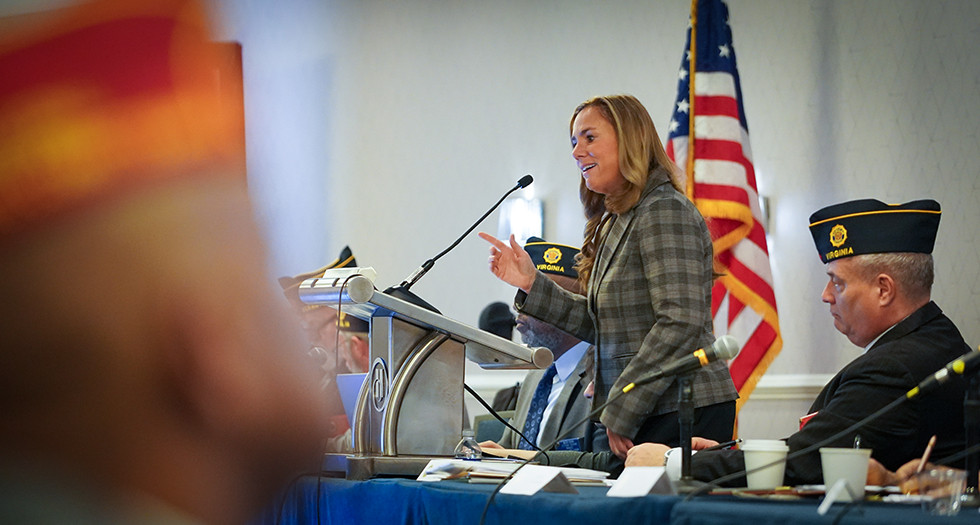
Lighthouse Project co-director shares the impact of the partnership delivering Be the One training during Washington Conference.
Included in the recently released 2025 U.S. Department of Veterans Affairs’ National Veteran Suicide Prevention Annual Report was the statistic that 61 percent of veterans who die by suicide are not receiving VA care.
That statistic alone is reason enough to tout the importance of The American Legion’s partnership with Columbia University’s Lighthouse Project to train Legionnaires how to recognize and then approach a fellow veteran in crisis.
That’s what Keita Franklin, Co-Director of the Columbia Lighthouse Project, told American Legion Family members during the Be the One Mental Wellness Committee portion of the Legion’s March 2 Veterans Affairs & Rehabilitation Commission meeting.
“The partnership matters,” Franklin told those attending in the nation’s capital for the Legion’s annual Washington Conference. “We do need to reach veterans that are not in VA care. We need to just trust each other. Let’s trust our own networks to do it.”
The 90-minute Be the One virtual and in-person training sessions teach the Columbia Protocol, also known as the Columbia-Suicide Severity Rating Scale, that supports suicide risk assessment through a series of six simple questions that anyone can ask. Its goal is to provide those who take it with the tools to develop early detection skills for veterans in crisis.
Primary funding for the training comes through a USAA Face the Fight grant. The American Legion is one of 250 organizations to have joined Face the Fight, which works to break the stigma surrounding suicide in the military community by raising awareness and fostering real, open conversations around support and hope.
Franklin – who has served as a senior executive in suicide prevention efforts for both the U.S. Department of Defense and Department of Veteran Affairs – said 20,000 American Legion Family members from all 50 states have received the training, which has led to a change from awareness to early detection and action. “We believe we have shifted the perception from it’s not just a mental health issue to we’re all protectors in this room,” she said. “You’re all the one. It’s normalized asking about suicide.”
Franklin provided measured outcomes from The American Legion-Columbia Be the One training partnership that include:
· Increased self-reported confidence in asking about suicide.
· Increased knowledge of risk stratification.
· Increased familiarity with the 988 Veteran Suicide Prevention Crisis Line and local referral pathways.
· Increased distribution of Columbia Protocol materials at the Legion post level.
Franklin has attended several in-person training sessions across the nation. “I’ve been so impressed when I go out to the states, and even at the national level, with the level of engagement,” she said. “When we have over the past two years given a training, it’s not uncommon for Legionnaires to stay behind to really try to understand the issues. They’re asking hard questions – very hard questions. I’m always surprised how they’re currently struggling with suicide risk. Not themselves, but they know someone.
“There’s not a time when I’ve done one of the trainings where I leave and I’m not in the car thinking we probably saved a life that day. And it’s not always other Legionnaires. I have Legionnaires coming to me worried about their children. The risk is out there, and the Legionnaires are ready to talk about it.”
During her remarks, Franklin shared information on VA’s recently released report on veteran suicides for 2023 – the most recent year of data available. The report noted that while the total number of veterans who died by suicide slightly reduced from 2022 to 2023, the overall rate of veteran suicides increased over that period. From 2022 to 2023 – the most recent year for which data is available – suicides among veterans dropped from 6,442 to 6,398 suicides. And the average number of veteran suicides per day fell slightly, to 17.5 in 2023 from 17.6 in 2022. Of those veterans dying by suicide, 61 percent don’t use VA services.
The latter statistic is why Franklin said Columbia’s work with the Legion is so important. “Maybe they weren’t eligible (for VA care). Maybe they chose not to,” she said. “There’s a whole host of reasons, and so that’s what makes it tricky if we just relied on the VA to do it, which is why I am so pleased that we’re working with The American Legion. Working with veterans where they work, live and thrive organically is, I think, how we’re going to get after it, (rather than by) waiting until they come to health care and just sort of thinking we’ll prevent it during 7-4 Monday through Friday. We did that for decades, and that’s not working.”
Also noted in VA’s report is that suicide rates are elevated for veterans aged 18 to 34 years, and those with certain risk characteristics that include mental health Issues or substance use; those with a head trauma or traumatic brain injury; those with access to unsecured firearms; and those experiencing homelessness.
But Franklin said tying mental health issues to all veteran suicides is a myth. “Absolutely not the case,” she said. “Roughly 60 percent of them had mental health or substance use problems, but I want also to know that 40 percent of them were struggling with life problems. You might be interacting with people in your Legion (post) and you may be thinking, ‘Well this one doesn’t really have a mental health problem, so they’re less at risk.’ But they’re struggling with life problems, which is just like anyone in this room.”
Up next for the Legion-Columbia endeavor is what Franklin called a “Train the Trainer” pilot program in order to scale and sustain the training long-term. Through the Face the Fight grant, funding is in place to develop a curriculum to train Legionnaires to do what Lighthouse Project staff has been doing.
“We have to pilot test it,” she said. “We have one pilot test stood up already, but we’re looking for other pilots. We probably have to do one or two pilot tests to get feedback from the Legionnaires. It’s likely a two-day (program), but we have to pilot test it. It could be two and a half days. We’re trying to make it as tight as possible.
“It is like a graduate-level deep dive into the history of suicide, from beginning to present, and all of the factors and then what to do about. We want to make sure Legionnaires who get trained can answer any odd question that comes their way. We think if we … give (Legionnaires) the materials, they can run with it.”
To take part in the Columbia Lighthouse Project pilot program or to provide Be the One training feedback, email Kelly.posner@nyspl.columbia.edu or visit https://cssrs.columbia.edu/. To sign up for virtual Be the One training, click here. Legionnaires also can schedule in-person training by emailing Wendy Lakso, director of partnerships and veteran and military initiatives for the Columbia Lighthouse Project, at wendy.lakso@nyspi.columbia.edu.
- Be the One