

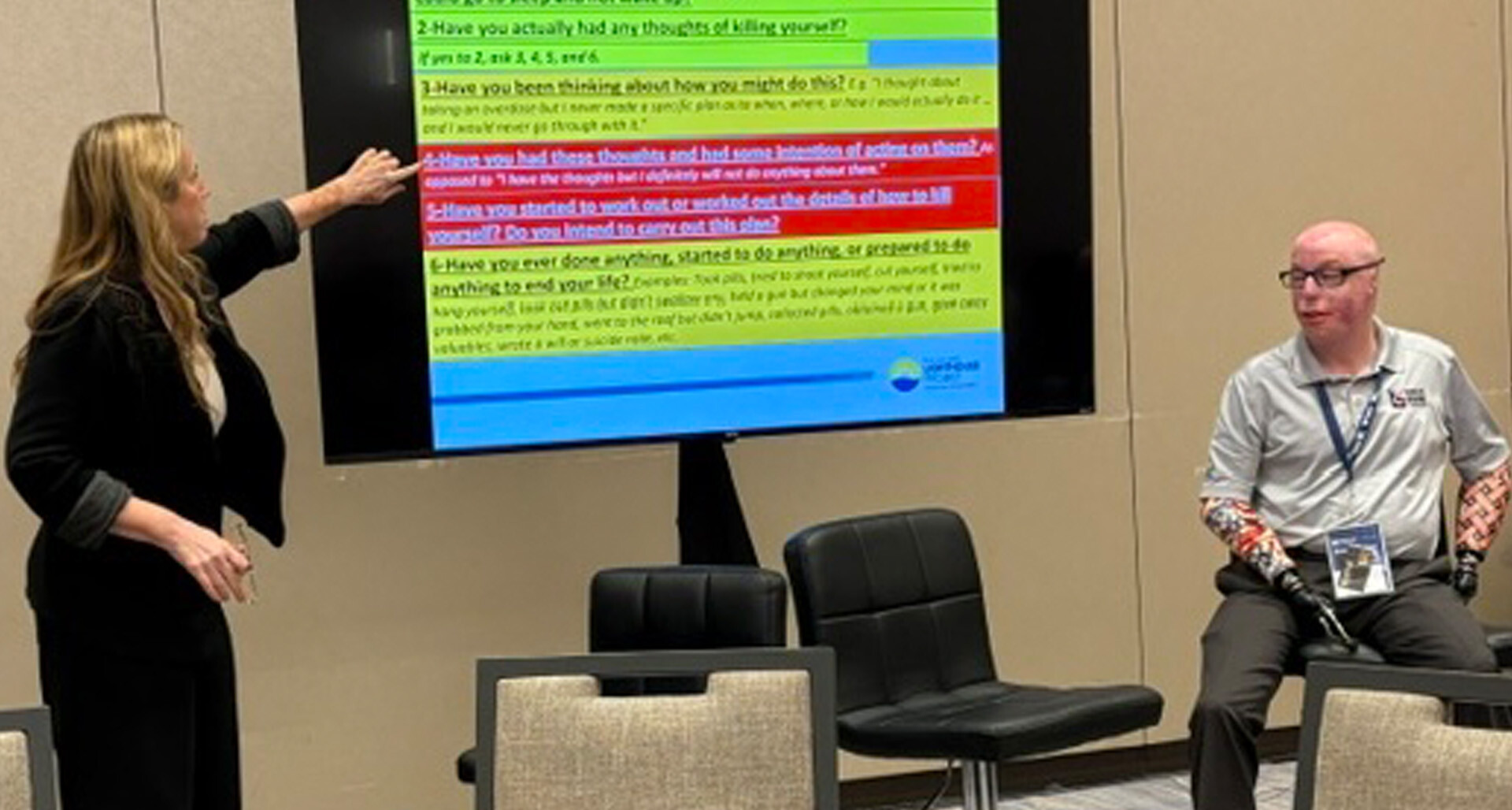
American Legion, Columbia Lighthouse Project and Robert Irvine Foundation team up to empower veterans, social workers and others at Military Influencer Conference.
The American Legion hosted a Be the One training session for dozens of veterans, social workers and other military supporters at the Military Influencer Conference (MIC) on Sept. 25 in Tampa, Fla.
Dr. Keita Franklin, co-director of the Columbia Lighthouse Project, led the session, which walked participants through the Columbia Protocol, dispelled myths about veteran suicide, and concluded with a question-and-answer session. In contrast to nearly all of the previous 10 training sessions she has led at American Legion events, this one was more external facing.
“The American Legion has done an incredible job, bringing tools and training to Legionnaires across the nation,” she said about Be the One. “They’ve set themselves up to be the example. Now they’re serving as a force multiplier, taking the training and the content to other entities to replicate what they’re doing. That’s what’s so incredible about being at the Military Influencer Conference – we’re going to see a whole new group.”
Franklin pointed out that 18- to 34-year-olds and men over age 55 are high risk groups to die by suicide.
“The American Legion is helping us reach the men over 55, but this 18- to 34-year-old group you might not traditionally get through traditional channels like The American Legion,” she said. “For this type of an audience, we’re meeting people where they’re at. Here at MIC, we’re bringing them tools where they learn how to ask people the right questions.”
The Columbia Protocol is a six-question protocol that anyone can use to determine whether a veteran is at immediate risk.
“In fact, you really only have to ask the first two questions about suicide risk so there’s no longer a gray area,” Franklin explained. “When you’re worried about someone, you’ll identify very quickly whether they’re at low, moderate or high risk and then you’ll learn what to do about it. Attendees actually come and they increase their awareness, but then they leave with a concrete tactical tool they can deploy later this afternoon if they ran into somebody.”
Retired Army veteran Mike Schlitz, Vice President of Outreach at the Robert Irvine Foundation, also presented. The foundation incorporates food into its suicide prevention programming, Bad Day Planning.
At the foundation’s events, Schlitz explained, they walk attendees through creating their own self-assessment plan which they can refer to later. He explained the plan’s five steps:
· What are your warning signs, or triggers? By understanding these factors, people can avoid certain stressors, places or environmental factors.
· What are your coping mechanisms? If someone gets triggered, their plan can help guide them to an action step to remove the stressor – leaving the place, calling a loved one or friend, or changing the activity.
· What are your reasons for living? This helps refocus the person. For some, it’s supporting their family. For others, it’s to pursue their career, or volunteer work or raise children. And for a surprising number, it’s their commitment to feeding a pet the next day.
· Who is your support network? That list should include individuals, as well as groups like American Legion posts.
· What is your action plan? Lock in your plan ahead of time that includes multiple options. Among them: Call the Crisis Line at 988, and dial 1 for veterans; text or call a loved one or family member; and go to a mental-health facility.
“The greatest gift you can give your social network, those people who you care for, is to be here tomorrow, to be here in a week, to be here next year,” Schlitz said. “Why not take that next step? Make that call or go get checked in somewhere that can give you the help that you need.”
- Be the One