
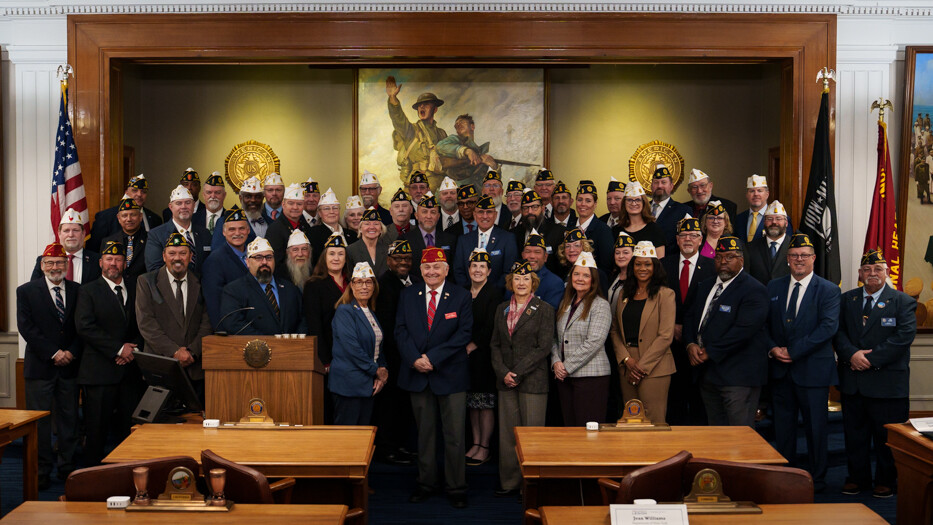
The 2026 graduating class learned how servant leadership applies in all areas of The American Legion to sustain its vision and mission.
National American Legion College 2026 – six days, 54 Legionnaires, 44 departments, 32 courses, one mission – servant leadership.
“What resonates with me with servant leadership is that we need to stop, actively listen and be that mentor,” said Judy Pearson, a Legion College student from Post 426 in Pittsboro, Ind. “At one time my mentor said to me, ‘I can’t mentor you anymore. You’re past me.’ But remember no matter what level you are at in the Legion, somebody could be below me and still mentor me. I want people to remember that.”
The Legion College students have been gathering at American Legion National Headquarters in Indianapolis since Nov. 14 to learn how servant leadership plays a role in all areas of the organization from strategic planning, membership growth, communication, community outreach, financial stability, advocacy and more. When asked how they will apply servant leadership upon returning home, the students were aligned in their responses:
· Be an active listener
· Listen with empathy
· Provide mentorship
· Create a vision for the future
· Start succession planning
· Get the Legion out into the community
Before graduation got underway, American Legion National Commander Jay Bowen addressed the 2026 Legion College class and left them with a reminder about the value of being a blue cap Legionnaire.
“It’s the blue cap where all the work gets done. The only hat that we own that’s permanent is the blue cap. Any other cap that we wear today, other than blue, is temporary,” Bowen said. “It’s the blue-cap level, the grassroots level of this organization, where all the work gets done. So be proud of the blue cap. Be proud of the cap you wear today but know, keep in mind, that it is a temporary cap. The blue is the one that matters.”
For Amanda Jones of Post 99 in Fairbanks, Alaska, Bowen’s words resonated that no matter the color of a Legionnaire’s cap, Legion College is for everyone.
“American Legion College is something that all my mentors and friends have said it’s something you have to do, don’t delay any longer. And now that I’m here, I completely understand why they were saying that because this course isn’t just for intermediate and advanced students, it’s for beginners too. However, intermediate and advanced students are going to learn from all the information here,” she said. “Even if it’s something we may have learned already, it reinforces those skills or puts them in a different purview so we can apply them to our current role in The American Legion and in the future.”
Other Legion College students shared how they will apply servant leadership upon returning home and their takeaways from the week:
Clifford Shingleton of Post 31 in Shinnston, W.Va. “I’ve learned so much here. I thought I knew what the Legion was and after being here, I’ve learned so much. The networking with people, getting other people’s opinions, finding how other posts are doing things, this is over the top,” said Shingleton, who shared a best practice that he is going to implement at his post. Post 31 conducts quarterly resource fairs and Shingleton will start surveying veterans to hear feedback on how it can be improved. “We’ve been doing them for three years. It never crossed my mind to ask the veterans on the way out if we could do something better. We just keep doing the same thing over and over again because no one complained. But we never asked either.”
Harold Wages II of Post 20 in Cody, Wyo. “This week has just been incredible. There’s so many things that I’ve been exposed to in life with leadership and this week has brought it all together and packaged it up in a way that I’m going to be able to better use and teach to others.”
Carol Howitz of Post 164 in Spearfish, S.D. “We kept talking a lot about our elevator pitches, and you don’t know what resonates with people. So to recruit new members and engage them and grow our Legion, I think at my post we’re going to sit together, across generations, and create a couple of elevator pitches that will resonate with people. That way it increases the knowledge of the Legion, and it gets people out there practicing that 30 second speech when they’re trying to get someone to join.”
Lenore Hackenyos of Post 380 in Mico, Texas. “Everything for me can be encompassed in one sentence. When I go home, I’m going to tell people from my post to the department, I’m going to meet you where you are. It doesn’t matter if it’s in planning, mentorship or getting out to posts in the district, I’m going to meet you where you are.”
Kenneth McMinn of Post 1990 in Nesbit, Miss. “Everywhere I go I try to build relationships because you never when that can help not just in Legion life but life itself. That’s how I ended up with two department commanders as close friends and mentors of mine. So build the relationships.”
Winston Boddie of Post 30 in Edgefield, S.C. “Like everyone else, listening and empathy, but for the long-term viability of our organization, succession planning and mentorship so that we have an organization to pass on to the next generation. If we can get our mission and vision out into the community, it gets us community support and it does another thing, it lets veterans in the community who may not know about The American Legion, know what we’re doing. So it’s its own recruitment tool. I think getting our vision, our purpose and our mission out to the community is vitally important.”
Nelson Maldonado Jr. of Post 223 in Shippensburg, Pa. “The material was tremendous. However, game nights, the dinners, the group discussions, the networking, the fellowship was priceless.”
Chris Brasted of Post 76 in Tremonton, Utah. “After looking at the lessons and listening to everybody’s story, I feel like we’re all part of the same post, same district, same department. I’m going to return home with confidence that there’s 54 people who care for the future of the organization and want to make it stronger.”
- American Legion College