

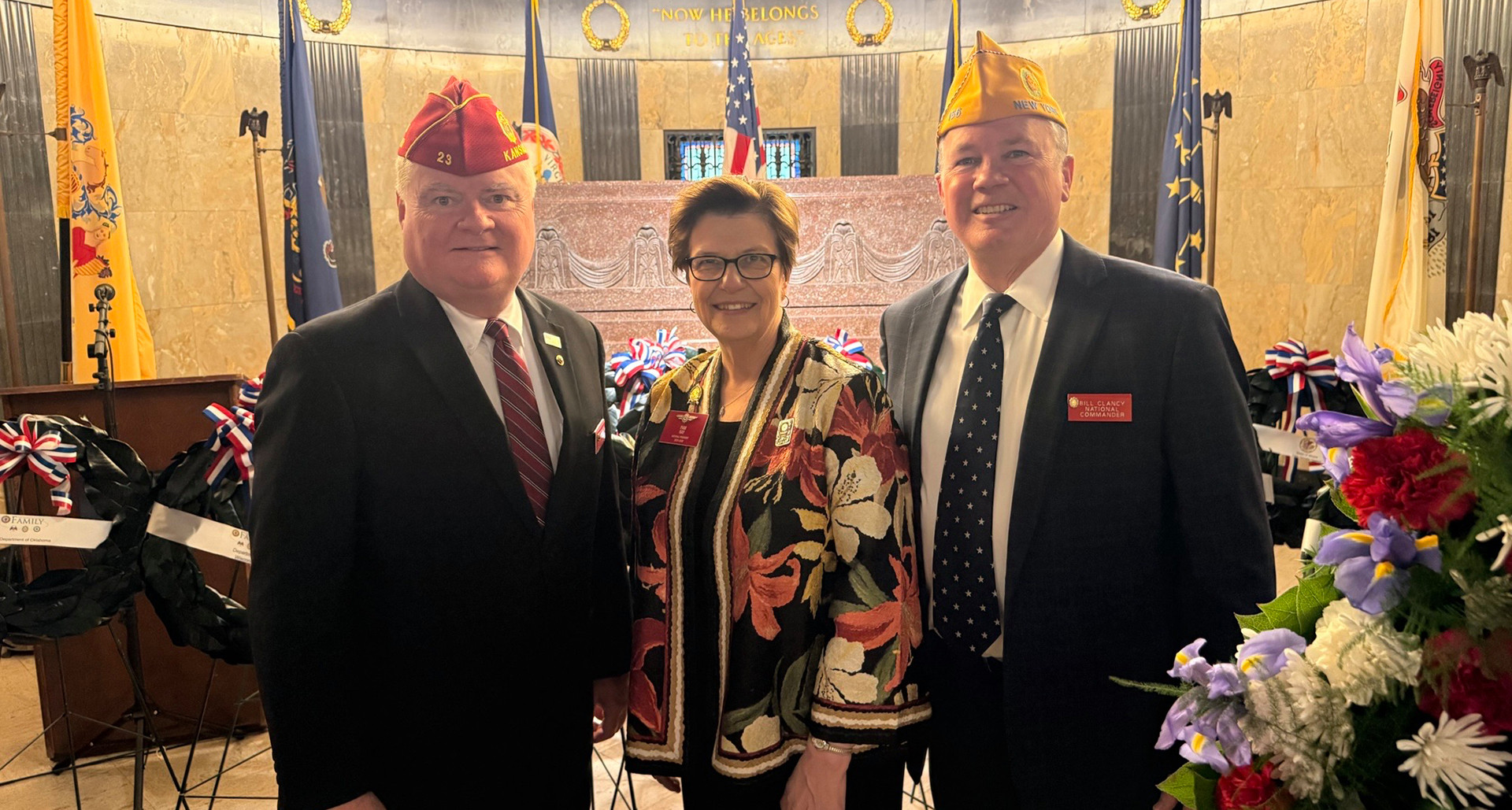
American Legion national commander keynote speaker of the 92nd annual pilgrimage to Lincoln’s tomb.
As the keynote speaker at the 92nd annual Pilgrimage to President Lincoln’s Tomb Thursday, American Legion National Commander Dan K. Wiley explained the unique legacy left by the 16th president.
“The abolishment of slavery remains a central part of any discussion about the life of Abraham Lincoln,” Wiley said. “Yet, he was not our first president to speak against this ugly institution. Presidents John Adams and John Quincy Adams also opposed the practice. Lincoln’s predecessor, James Buchanan, called slavery a ‘political and moral evil,’ though he supported policies to keep it in place. But Lincoln was unlike other politicians. He truly recognized not just that slavery was wrong, but that Black people deserved the same dignity and respect as all other Americans.”
Wiley then pointed to the 14th and 15th amendments granting citizenship and expanding voting rights as part of Lincoln’s legacy that continues long after his death.
American Legion Post 32 in Springfield, Ill., has led the longest running annual observance held on Lincoln’s birthday since 1935. At least 14 departments were represented at this year’s pilgrimage.
Kate Peters, a member of Auxiliary Unit 32, served as emcee during wreath layings and addresses at the tomb. She quoted from Lincoln’s 1863 letter to New York City Mayor George Opdyke. “Honor the soldier and sailor everywhere, who bravely bears his country’s cause. Honor also the citizen who cares for his brother in the field, and serves, as best he can, the same cause. Honor to him, only less than to him, who braves, for the common good, the storms of heaven and the storms of battle.”
The pilgrimage was a homecoming for American Legion Auxiliary National President Pam Ray, a former resident of Springfield. “Here in Illinois, we think of him as one of us,” she said. “He stated that our veterans should be remembered, and he promised that our country would take care of them. Abraham Lincoln was a president for the people.”
During a luncheon following the Tomb pilgrimage, Sons of The American Legion National Commander Bill Clancy III stressed the importance of including young people at American Legion Family events. “We were in the museum yesterday, and there were at least four different school groups traveling through the museum and we tried to engage as many of them as possible, and they were having fun and learning about great stuff. So maybe just in the future, in all of our endeavors, try to think about how we can invite more young people to partake, maybe not to sit through the entire thing, but to be there so that they're touched by the moment, and they learn about America's greatness.”
“Each year you as veterans, come to this wonderful town that Lincoln walked the streets of, out of your obligation of love and your obligation for country, your obligation for service and your obligation for history,” Springfield Mayor Misty Buscher said at the luncheon. “Your obligation means a lot to me as the mayor of Springfield. The American Legion Family understands that freedom is not free.”
Wiley closed the luncheon by noting similarities between Lincoln’s ability to overcome great personal challenges and The American Legion Be the One mission to prevent veteran suicide. “Abraham Lincoln became the one to stand up and be the one for our republic, to be the one to stand up for all people, because he knew, as a people and as a country, we were better together.”
- Commander