
National commander tells student veterans about the multi-generational bond shared by all who have served in uniform.
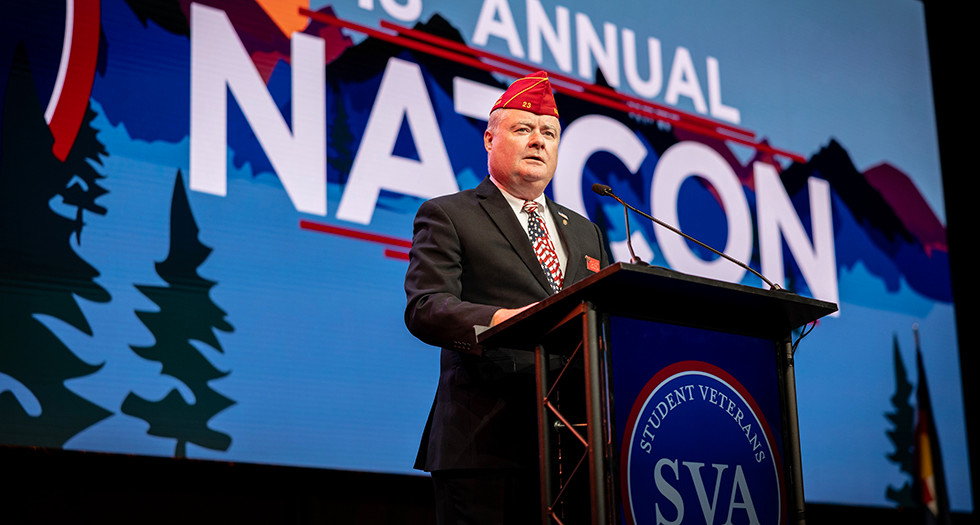
As Sister Sledge’s 1979 anthem “We Are Family” played before a crowd of veterans mostly born decades after it climbed the pop charts, American Legion National Commander Dan K. Wiley strolled to the podium at the 18th Student Veterans of America (SVA) National Conference in Colorado Springs, Colo.
His choice of intro music was intentional – not just to fire up a crowd that awakened Friday morning to six inches of fresh Rocky Mountain snow and marched through the cold to the Broadmoor Convention Center for the Government Affairs General Session of the conference. The song’s message and spirit, especially for those who have served in uniform throughout U.S. history, fit the occasion and the words he was about to share.
“What I want to talk about this morning is family – whether we are referring to blood relatives or our brothers and sisters in arms, veterans understand the importance of family,” Wiley told the crowd, who came from college campuses across the nation. “We also understand that it isn’t just the veteran who serves. Families serve. Caregivers serve. Spouses and partners serve. Even if the families arrived after we’ve left the military, they’ve had to listen to our stories.”
The connection between The American Legion and SVA is an example of the multi-generational bond among all who have sworn with their lives to defend the nation, regardless of era, dating back to the American Revolution.
Wiley explained to the students that the GI Bill benefits most are using in 2026 were born in 1944, when World War I veterans of The American Legion, looking out for future generations, drafted the Servicemen’s Readjustment Act (the original GI Bill) and fought for its passage. Over half of the 16 million World War II veterans who came home alive used those benefits to transform America and the world.
He spoke about how The American Legion continued to battle in Washington through the years – in times of war and peace – to strengthen the GI Bill and since 2008, the year the American Legion provided free office space for the start-up SVA in Washington D.C., worked arm-in-arm with student veterans to create the Post-9/11 GI Bill and improve it in subsequent renditions.
“We learned a long time ago that we are a lot stronger when we add the 2.5 million voices of The American Legion Family … (to) the 1,600 chapters of Student Veterans of America, we become an unbeatable force.”
When the longest government shutdown in history paralyzed most government services last fall, Wiley said, The American Legion was relieved that VA healthcare was spared. “But,” he added, “There was one particular stoppage that really ticked me off – the GI Bill Hotline.”
Student veterans who needed help with their benefits, including delayed stipends, had no one to call for answers. “I have heard many stories this week of the impact to education services during the shutdown. This, in my opinion, falls into the category of a broken promise. And it’s our job to let VA and Congress understand this failure.”
The student veterans gave a rousing applause to that point, the operative word being “our.”
Wiley said that by working together, as allies in advocacy for veterans past, present and future, The American Legion and SVA have a shared duty to make sure that Congress and the White House “prioritize quality healthcare for veterans, educational opportunities for all who served and transition assistance for those adjusting back to civil society.”
The national commander noted earlier that it was no coincidence there was significant political and public support for the original GI Bill, signed into law just two weeks after American troops stormed the beaches of Normandy on D-Day. Throughout the GI Bill’s history “legislative momentum and public support always seemed proportional to the number of troops engaged in combat at a particular time,” he said. “This seems shortsighted.
“We all know that a major shooting war involving our troops can occur at any time. This is why it is important for the Student Veterans of America and The American Legion to keep alive the legacies of those who fought these wars, and those who are currently defending us.
“SVA is uniquely qualified to remind the country that veterans are not just a legacy, but an investment. Veterans understand that if you are taking care of the veteran, you are taking care of the family.”
Applause came again when Wiley made his closing point, a directive for both organizations. “We need to stop the national tragedy of veteran suicide. One veteran death is one too many.
“In The American Legion, we call this mission Be the One. Be the one to save one. We collaborated with mental health professionals at Columbia University to offer free training to anybody willing to sign up. You do not have to be a member of The American Legion to participate in our Be the One training. You don’t even have to be a veteran. You just have to care about the well-being of those who serve.”
He reminded attendees of a Be the One training session scheduled for later Friday at the conference and the success of the Columbia University partnership. More than 20,000 have now taken the Be the One/Columbia University training on how to detect risk and effectively prevent veterans from taking their own lives.
That, he suggested, is a mission to be shared. “Organizations like The American Legion and SVA are not merely nonprofits. We are brotherhoods and sisterhoods. We are family.”
- Commander