

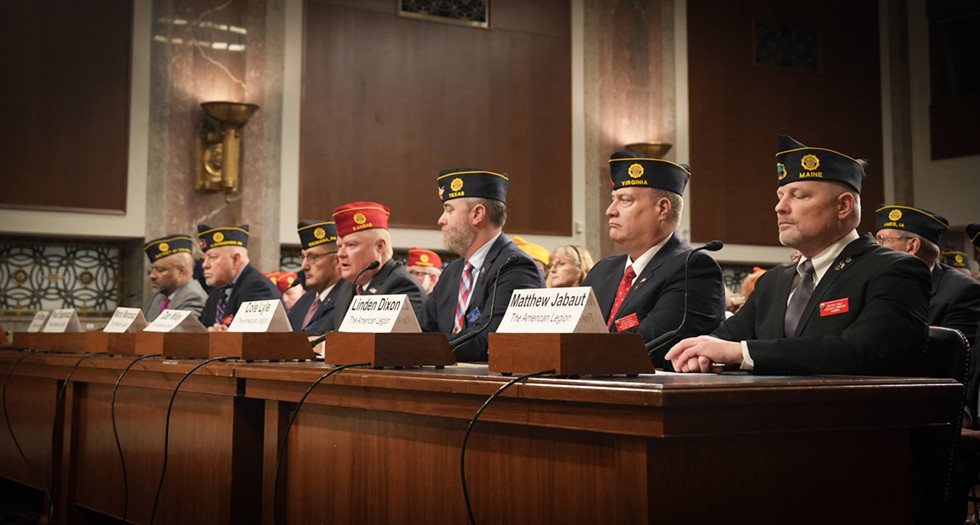
National Commander Wiley delivers testimony to Congress, emphasizing Be the One, access to health care and passage of the Major Richard Star Act among the Legion’s legislative priorities.
Noting that this is “a pivotal time for our country,” American Legion National Commander Dan K. Wiley urged lawmakers to focus on the treatment of the nation’s veterans – as well as those on the verge of becoming a veteran – while also ensuring those currently wearing the nation’s uniform never go without their earned benefits.
Appearing before a joint session of Senate and House Committees on Veterans’ Affairs March 4 during the Legion’s annual Washington Conference, Wiley shared the organization’s top legislative priorities while also noting what The American Legion has meant to the nation since its inception in 1919.
“Recent military action reminds us of the cost of service, shouldered by a shrinking minority of American families,” Wiley said. “In our all-volunteer force, military service has become a family business. And while average time in uniform is just 4-8 years, the costs can potentially last a lifetime. As we mark the 250th anniversary of our nation’s founding, it is essential we examine those costs, and make sure they are paid in full.
“That is precisely why Congress chartered The American Legion after World War I: to promote a strong national defense, encourage civic education, and to create a community of veterans to support one another, whose voices are heard by our nation’s leaders. Since 1919, the Legion has been instrumental in landmark changes like the GI Bill, creation of the modern VA, appeals modernization, and the MISSION Act. We created programs like the American Legion Child Well-Being Foundation, Legacy Scholarships, and Boys Nation. Our mission, every single day, is to serve those who served us.”
Wiley also noted that the Legion partners with the U.S. Department of Veterans Affairs for National Buddy Check Week, and conducts reviews of VA health and benefits services through the organization’s System Worth Saving and Regional Office Action Review programs, providing policymakers with on-the-ground feedback regarding health care and benefits. The Legion also works with Congress to ensure that while the administration seeks bold change, there is no reduction in accessibility of services and benefits to any veteran or their family.
“Just two weeks ago, The American Legion spoke against a proposed rule that would change the way VA rates a veteran’s disability based on medication management,” Wiley said. “We were glad to see Secretary (Doug) Collins listen to the veteran community and ultimately rescind the rule.
“We will remain vigilant and give you all our feedback on what is working, and what needs to change.”
But the Legion’s impact isn’t only felt on the national level. “At the post level, Legionnaires serve their communities in times of crisis,” Wiley explained. “Just last year, after the tragic floods in Kerrville, Texas, Legion Post 208 provided urgently needed resources for those who had just lost everything and served as a relief point for aid workers who came from across the country.
“American Legion service officers assist veterans with disability claims, and in 2025 processed $29.5 billion for veterans. This was free of charge, regardless of whether they were members.”
Wiley also spoke about the Legion’s Be The One veteran suicide prevention campaign to reduce stigma, provide critical training, and ultimately save lives. As he moved into sharing the organization’s legislative priorities, he said veteran suicide prevention remains the organization’s top focus.
“VA estimates more than 17 veterans die by suicide a day. Traditional approaches to this problem – pills and therapy – have, objectively, not worked,” he said. “We need stronger transition programs, innovative therapies and improved safeguards to medication management. That’s why we support things like the FOX grant program, the BEACON Act, the Written Informed Consent Act, and other bills that seek to address this problem.
“It’s also why, after a decade of Legion advocacy, I was proud to be in the Oval Office as President Trump signed an executive order reclassifying cannabis as a Schedule III drug, allowing for federal research on how it can reduce health issues drivers of suicide. The American Legion does not support recreational use of illegal drugs, but we strongly support research that could result in new, effective treatments.”
Wiley also touched on additional legislative priorities.
· Access to timely, quality health care. “While most veterans prefer to receive care from VA as a one-stop shop, community care has exploded since the passage of the MISSION Act. Congress must provide the necessary funding to ensure the VA system remains strong, without curtailing a veteran’s access to community care if it is in their best interest. Ultimately, veterans should get the care they need, when they need it. But VA must remain the center of all veteran healthcare. As we discuss VHA reorganization, the NextGen Community Care contract, and acceleration of electronic health record deployment, Congress must also address aging infrastructure and give VA the authorities and funding it needs to compete with the private-sector job market.”
· Care for women veterans. “Women veterans, the largest growing subpopulation in our community, experience homelessness, depression, infertility, migraines, and other issues at a higher rate than their male counterparts. This is attributed to military sexual trauma and domestic violence. Congress should pass legislation to improve research on how issues unique to women veterans, including menopause, affect health outcomes, and increase the availability of gender-specific rehabilitation programs.”
· A smooth transition from military to civilian life. “Enabling veterans to thrive in civilian life is a huge task. Congress can make it easier by ensuring our servicemembers don’t experience financial uncertainty prior to separation. When I served in the Air Force, I never worried about getting paid on the first and 15th. But as government shutdowns become more frequent, that is no longer guaranteed. Not long ago, The American Legion provided over $1 million in grants to Coast Guard families because Congress failed to do its job and ensure they were paid on time. We need ironclad protections to ensure uninterrupted pay for all service members in our all-volunteer force.”
· Ending the “wounded veterans tax.” “Consider Major Richard Star, who deployed multiple times and was diagnosed with lung cancer linked to burn pit exposure. Before his death, he endured the indignity of a ‘wounded veterans tax’ — an offset of his disability compensation against his pension because he was medically retired before 20 years. This is wrong. Collecting both benefits is not ‘double-dipping.’ Retirement is for time served; disability compensation is for harm caused during service. Congress must pass the overwhelmingly supported, bipartisan Major Richard Star Act.”
Wiley closed urging Congress to ensure that the treatment of veterans now positively impacts the future. “The way America treats its veterans directly influences whether the next generation raises their right hand to defend our 250-year legacy,” he said.
Following his testimony, Wiley and American Legion national staff took a few questions from members of both committees.
Among those asked:
· Senate Veterans Affairs Committee (SVAC) Chairman Jerry Moran asked Wiley if he knew a specific individual who would benefit from passage of the Major Richard Star Act. The national commander referenced a servicemember who had been badly burned and was medically retired before 20 years and now has his retirement pay offset by his VA disability compensation. “Quite obviously, this takes funds away that would benefit his family for a lifetime,” Wiley said. “He’s got a lifetime of care and a lifetime of loss as a result of those injuries.”
· SVAC Ranking Member Richard Blumenthal asked how the Legion felt VA’s service for women veterans could be expanded. Wiley said separate entrances and areas for women at VA hospitals is one way to improve those service, while American Legion Veterans Affairs & Rehabilitation Director Cole Lyle added that The American Legion supports women veterans using non-VA evidence in the claims process and also reiterated areas in VA facilities that provide a safe environment for women veterans. “Also, (Rep. Julia Brownley) has a bill to expand research on menopause,” Lyle said. “There’s a lot of anecdotal evidence. There’s not a lot of research on menopausal links to certain things that drive suicide. As we know, women veterans experience suicide at a much higher rate than their civilian counterparts.”
· House Veterans Affairs Committee (HVAC) Ranking Member Mark Takano asked what comes next after passage of the PACT Act of 2022, which opened eligibility for VA health care and benefits to some 3.5 million veterans who previously did not qualify for federal support. “(A mechanism existed in the PACT Act) because Congress didn’t want to legislate presumptive conditions going forward,” Lyle said. “That process has been slow and sometimes the process has been opaque. So I think if there were mandatory timelines requiring VA to review prospective presumptive conditions within, say, 180 days, (and) mandate some sort of external review if mandates were removed or an external review right after they were finalized, and then codify the presumptives could only be removed if there’s overwhelming evidence that contradicts the existing science that was used in the approval process.”
· HVAC member Rep. Kimberlyn King-Hinds asked what the Legion felt is the biggest problem in the delivery of benefits to veterans. “It’s the high rate of remands from (VA’s) Board of Veterans Appeals,” Lyle said. “That has directly resulted from the quality of (Compensation & Pension) exams in that process. The VA largely utilizes contractors to conduct those C&P exams. In our site visits we find inadequate (Disability Benefits Questionnaires) that are submitted for C&P exams that result in appeals, delays, things like that.”
· SVAC member Sen. Chris Sheehy asked what can be done to help those transitioning out of the military find employment in the skills trades, law enforcement and agriculture. “The American Legion has always supported expansion of the (Transition Assistance Program),” National Veterans Employment & Education Director Joe Sharpe said. “We believe the TAP program should be a way for veterans to find employment. Not all of our veterans are aware of the various services that are out there for veterans finding employment. The American Legion believes there should be a transition app with an AI component to it to put all veterans that are leaving the military on a level playing field. Because depending on what installation that you are leaving from may not have all the services for everyone.”
· HVAC member Rep. Herb Conway, a member of American Legion Post 336 in New Jersey, asked what the biggest barriers are for veterans in accessing mental health services. “I think obviously outreach is a huge thing,” Lyle said. “The VA’s budget for mental health and suicide prevention outreach, I think, is hovering around $600 million dollars, which sounds like a large number. A big portion of that is going to the Fox Grant Program, advertising, things like, and that represents 1 percent of VA’s overall budget. So outreach could definitely improve.”
· HVAC member Rep. Elissa Slotkin said she’s concerned that artificial intelligence could be used to assist in determining a veteran’s VA disability claim. Wiley said he had a recent visit to a VA Regional Office, where he saw AI being used productively for administrative tasks. “What should not happen, what we cannot allow to happen, is for artificial intelligence to substitute for judgment,” Wiley said. “Judgment has to be a human being that can review all of evidence and make an independent determination using everything they know. Artificial intelligence is not a replacement for that.”
- Commander