

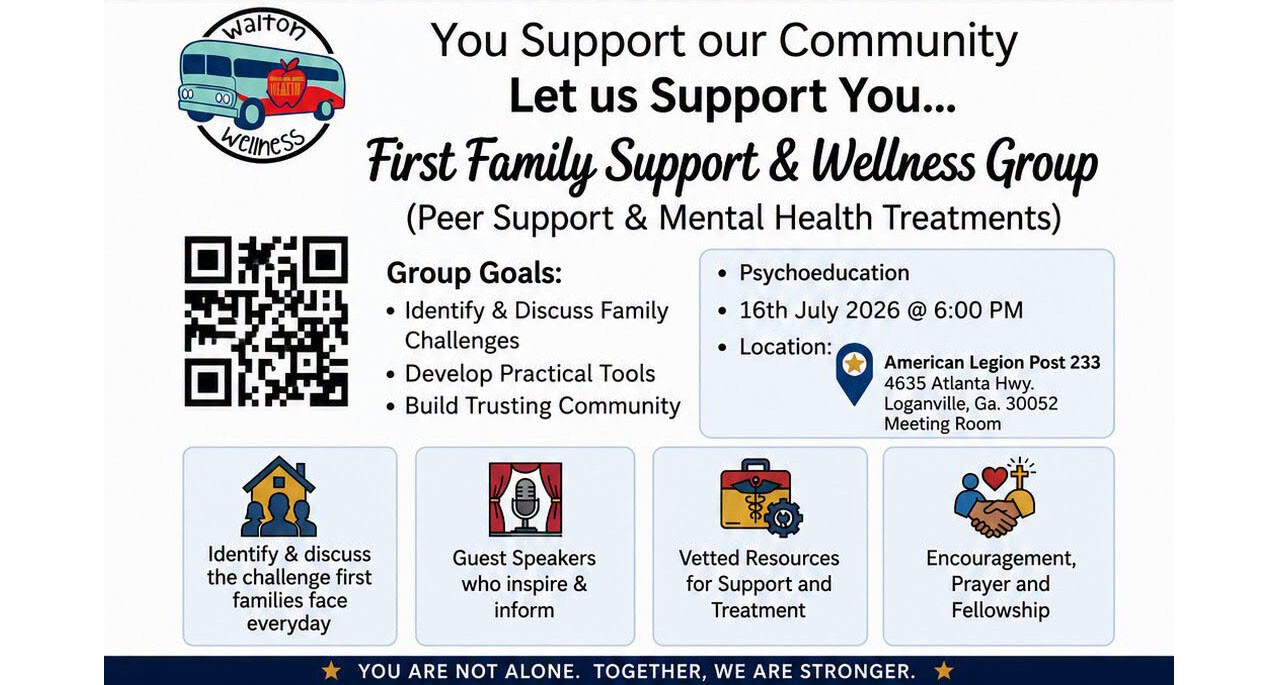
American Legion Post 233 in Loganville, Ga., hosts third Homefront Harmony meeting, which addresses challenges and provides resources to those families.
A collaboration between local nonprofits and a Georgia American Legion post now is bringing monthly mental wellness support sessions to spouses and family members of veterans and first responders, in an attempt to help those family members recognize and understand the stress those they love may undergo.
Homefront Harmony addresses the unique challenges first responders and military families face, while also providing guest speakers and connections to mental health resources, and building a community among the families.
The program was started by Walton Wellness, which takes a community approach to health, and Operation Rally Point (OPR), whose mission is to immediately assist the individual needs of transitioning veterans by providing lodging, emergency housing, mental health individual and group therapy sessions, workforce development and job placement, as well as referrals to partnering agencies.
Both are based in Monroe, Ga., and teamed with American Legion Post 233 in nearby Loganville for the most recent July session. Mike Madsen, commander of Post 233 and the former development officer at Operation Rally Point, said his work with the latter – and role as a veteran service officer for more than six years – brought to his attention the importance that spouses and family members can play in the role of a veteran or first responder.
As a staffer with OPR, Madsen would attend meetings of the Walton Justice Mental Health Task Force in Walton County, which typically deals with veterans in crisis in the community.
“When you’re getting called out when a veteran’s having a problem with an officer, and they are referred to Operation Rally Point … it seemed like we were always talking with the spouse because law enforcement had to handle the veteran,” Madsen said. “You start talking to wives, and you start talking to kids, and you start talking to older brothers and fathers, and they all said the same thing: ‘We try to support, but we don’t know what we’re doing. We don’t understand what they’re going through.’
“That’s when we realized, ‘Maybe we need to start talking to these people.’ They’re truthfully the first line of defense, and they can identify these small triggers without any type of clinical training.”
Madsen’s daughter, RoseAnn Lamacchio, is both a military and law enforcement spouse to husband Ryan, a Navy veteran and Loganville Police Department lieutenant. Operation Rally Point Clinical Program Director Nikki Allemani, a former military spouse, said she and RoseAnn began “kicking around ideas for this. And (Walton Wellness Executive Director) DeDe Harris was also kind of floating the idea. So we all met one day after the task force meeting. It was a no-brainer to get this started. So it was, ‘Let’s pick a date and see who shows up.’”
The first session took place in May; similar sessions took place in June and July. Eight people attended the first session.
“Since then, the crowd has adapted and changed a little bit, but it continues to grow.” Allemani said. “And the needs that are out there are vast. The details are different, but the needs are the same, if that makes sense. A lot of validation up to this point has been really important. It’s a place to really normalize.
“Even though I’m sitting there as a peer, I’m also sitting there as a clinician. So I offer a lot of psychoeducation to these women so they understand what their spouses are experiencing. When’s a good time to intervene, and when’s a time to just support. And what does that support look like for each one, because each one’s different.”
Allemani said it’s critical to provide an outlet for family members to share how they deal with a veteran in crisis. “When I started working with transitional veterans in general, I knew it had to be a family unit that we were dealing with,” she said. “You’ve got people coming straight off the battlefield and going straight into things like graduation parties. And the family just doesn’t get it. So this is an underserved population, and I’ve said it for years.
“The children, parents and spouses tend to be the invisible servicemembers. They tend to be the ones that do not get acknowledged at all. Where I think we’re kind of getting a handle on our veterans, we’re still dropping the ball on the families.”
Madsen praised Allemani for her role in the program, which he says continues to show its value. “Nikki is extremely good at establishing a curriculum,” he said, noting that while the first meeting lasted one hour, the next two went between two and three hours. “The participants don’t want to leave. They want to keep talking. And I can tell you that so far, everyone who has attended has ended up in tears. That tells me that this was something that needed to be built.”
Madsen said the reason for Post 233 stepping up to host the third session was twofold. “I had it here because we have an excellent meeting room,” he said. “And I figured most of these people know the Legion and know that it’s a safe zone … a safe environment where they know that they can open up. They can talk amongst themselves.”
Allemani said having The American Legion involved in Homefront Harmony made sense. “To me, it’s imperative to have their buy-in,” she said. “Where do the veteran families go? You’ve got the Vietnam veterans, and then you’ve got every generation after that. We’re seeing posts get younger, which is a great thing. But at the same time, their families need that support system so that we don’t drop the ball like we did with the other eras.”
- Community