
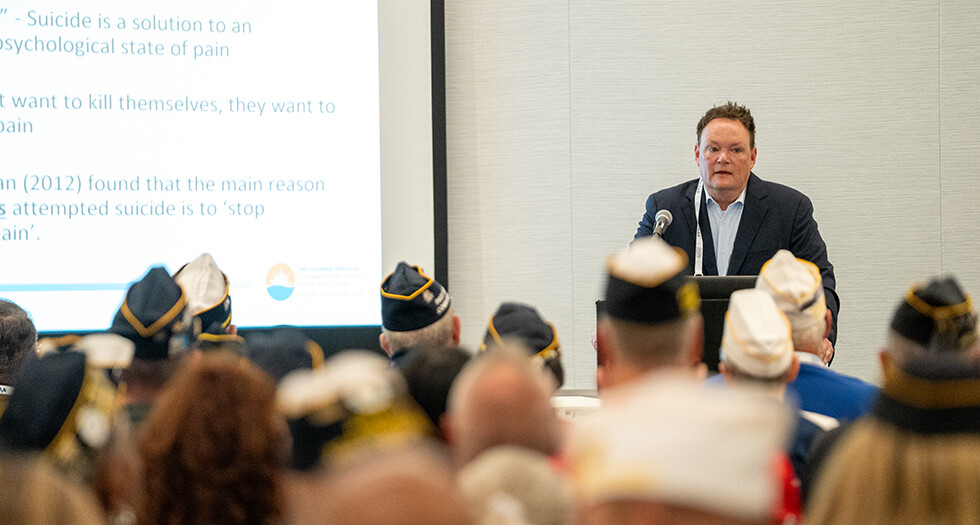
American Legion Family filled the room at the Kentucky International Convention Center to hear how to identify veterans at risk of suicide and ask the six questions.
The American Legion’s Be the One veteran suicide prevention training held during the 107th national convention at the Kentucky International Convention Center in Louisville Monday afternoon was standing-room only.
“This is a good problem to have,” said Department of New Hampshire Commander Myron Crossley, who is a strong advocate of Be the One in his department.
The training was provided for national convention attendees to support the organization’s Be the One mission to reduce veteran suicide by knowing how to save a life by understanding risk factors and using the Columbia Protocol’s six questions.
“It's really important for us to provide this peer-to-peer training so that you can reach out to fellow servicemembers, veterans and be there for them and have the conversation that they need,” said Dr. Adam Walsh, who conducted the Columbia Protocol training as part of The American Legion’s partnership with Columbia University Lighthouse Project. “Many times you'll find someone who simply wants to talk and wants to bend your ear and wants to be heard about whatever they're going through. The fact that you are here and are ready to learn some information so you can reach them is incredibly important.”
Walsh opened his presentation with the following statistics:
- Approximately 17.5 veterans die by suicide a day.
- Suicide is the 12th leading cause of death for veterans.
- Suicide is the second-leading cause of death for veterans under age 45.
- 60% of veterans who die by suicide never received VA care.
- 73.3% of veterans die by suicide with their own firearm.
Risk factors that can lead to suicidal ideation are not just mental health-related, as Walsh shared that about 58% of military suicide-related deaths did not have a mental health diagnosis. It can be a variety of factors from relationship problems, financial hardship, health issues like chronic pain, sleep issues, military sexual trauma, homelessness and an other-than-honorable discharge.
STORY CONTINUES BELOW
“Suicide is one of those things where things change from day to day,” Walsh said. “I always tell people a famous statement that I was told when I was just a young person from one of my mentors. He said, ‘Many people don't know they're suicidal until they are.’ So it's not something that's a static target that we can just home in on day after day. You have to think about all the different complexities and all the things that might be going on in people's individual lives.”
There are protective factors against suicide, said Walsh, like ensuring that every person has one person they can rely on and reach out to when they're feeling down, stead employment, family and peer support, social connection, access to mental health care, and being able to see seeking or asking for help as a good thing.
“It's not a bad thing, it’s not a broken ring or a weak thing to seek help,” he said. “You want more protective factors against more of those risk factors, and you'll also want to try to instill this sense of hope. It's hard to have hope when you feel isolated.”
Walsh also shared several misconceptions and facts about suicide. One misconception is that those who die by suicide are cowardly or selfish.
“People who die by suicide want to stop the pain, and they feel like they have no option. So viewing suicide as a cowardly act will only increase the stigma and may prevent people from asking for help,” Walsh stressed. “This whole thing here is that we’re trying to get people to ask for help.
“And you have to remember that in most situations people who are thinking about suicide feel hopelessness, they feel trapped. They actually feel like their loved ones will be better off without them. So again, viewing suicide as selfish is another barrier for people asking for help.”
The Questions to Ask. Walsh shared the six Columbia Protocol questions to ask a veteran to identify their risk factor and provide help if needed. “With these questions, you have to show empathy, show that you care for people, that you listen to people,” Walsh said. “These questions will be much more powerful when you’re approaching a person that way.”
The six questions are:
1. Have you wished you were dead or wished you could go to sleep and not wake up?
2. Have you actually had any thoughts about killing yourself?
If YES to 2, answer questions 3, 4, 5 and 6. If NO to 2, go directly to question 6.
3. Have you been thinking about how you might do this?
4. Have you had these thoughts and had some intention of acting on them?
5. Have you started to work out or worked out the details of how to kill yourself? Do you intend to carry out this plan?
Always ask question 6
6. Have you done anything, started to do anything, or prepared to do anything to end your life?
Walsh understands its not easy to directly ask if they have thoughts about killing themselves. But he said, “It’s important to say because it’s very clear what we’re asking.
“They don’t want to die. They want help. They want things to change. We need to ask people how they are doing.”
If someone is in immediate crisis, Walsh encouraged attendees to call 988, get help immediately and:
- Stay with the person and keep them safe
- Talk about reasons for living
- Make a warm hand off
- Follow up, if possible
If a veteran answers no to question 2, identify how you can help them feel more connected. It may be inviting them to a post meeting, on a fishing trip or to coffee. “What can you do to help keep them connected so they don’t eventually get to a suicidal point?”,” he said.
Training in Action Cliff Shingleton, commander of American Legion Post 31 in Shinnston, W.Va., and District 3 commander, attended the Be the One training and shared that he is a certified suicide prevention instructor through Livingworks SafeTALK.
“Veteran suicide needs to stop, and The American Legion is moving in the right direction with it (through Be the One),” he said. “This training is a very good introduction to the topic.”
Through suicide prevention training, Shingleton has been taught how recognize signs, respond, connect individuals to resources and stay with them until they are stable.
Shingleton, an ER nurse, shared the effectiveness of his suicide prevention training. Two days after being certified, he met a 17-year-old who was suicidal and brought into the ER. “I walked him through the SafeTALK process and within 15 minutes he asked his mom and dad to care for his animals because was going to get some help,” he said. “That young man got his mental health assistance and is now back to his family and doing well. We stay in touch with them until they are stabilized.”
Shingleton is taking the SafeTALK training to American Legion posts in districts throughout West Virginia. And when a veteran is assisted, Shingleton is making them part of Be the One.
“We try to get them into something like this (Be the One training) and say, ‘You have friends that may be struggling too. Let’s show you how you can help somebody else like we did for you,’” he said. “That’s an important step too in making them a part of the solution.”
Sign Up for Free Training The American Legion and Columbia University Lighthouse Project provide free virtual suicide prevention training by using the Columbia Protocol. The 90-minute sessions are on Zoom. Sign up for training in September.
- Convention