

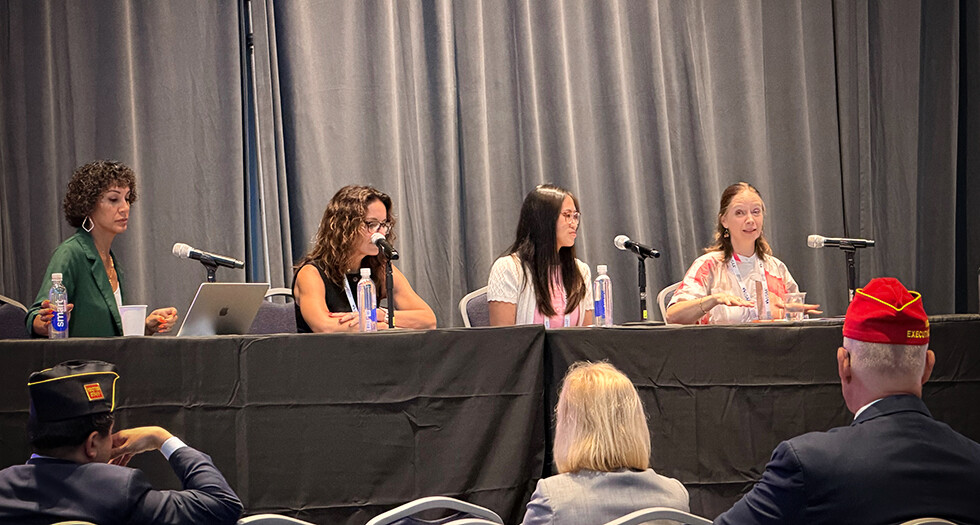
Legion’s Veterans Affairs & Rehabilitation Commission witness to a thoughtful discussion on women veterans healthcare and where issues remain.
The consensus from a panel discussing the healthcare received by women veterans was that the U.S. Department of Veterans Affairs has come a long way in delivering that healthcare. But the participants in the panel, “Women Veterans, Health and What Comes Next,” all agreed more work remains.
The panel took place during The American Legion’s Veterans Affairs & Rehabilitation Commission meeting on Aug. 29 and featured speakers employed by VA, as well as the former director of VA’s Center for Women Veterans.
Among the panelists was U.S. Army veteran Kayla Williams, who deployed to Iraq in 2003 as an Arabic linguist with the 101st Airborne Division and now serves as the Senior Policy Advisor for Vet Voice Foundation. The nonprofit provides support, training, and tools to assist veterans in continuing their service and finding new missions at home, both through becoming civic leaders and policy advocates.
“The VA that I go to now compared to the VA that I entered 20 years ago, 21 years ago, it’s just been a tremendous amount of improvement for women,” said Williams, who previously served as the head of VA’s Center for Women Veterans. “And I’ve been thrilled to watch it and play some tiny role in pushing it along. We are now much more likely to just be recognized as veterans when we walk in the door. We are much less likely to experience harassment from our fellow veterans within VA facilities.
“We are much more likely to be able to get high-quality, evidence-based, culturally competent care for military sexual trauma (MST). There have been some phenomenal changes that I think are system-wide, like universal screenings for MST that are really, really helpful.”
However, “I think somewhat less likely or more inconsistent is whether or not that positive screen immediately leads to a referral to care,” Williams said. “There are other things that I’m hesitant to say whether it’s a gap between national policy in what we experience and the flexibility in what national policy allows,” Willams said. “For example, some VA facilities have separate entrances for women, have separate women’s clinics. Some do not. And some of that is because of infrastructure. It’s just not possible everywhere.
“I used to think, ‘Oh, this is an easy fix.’ And when I sat on the committees that actually look at every single infrastructure request that comes in to Central Office, and weighs which ones to fund and which ones not to fund … sometimes you have to make these hard choices.”
Dr. Nicole Ray, Women Veterans Program Manager at the Louisville VA Medical Center, said that VA’s progress includes women veterans no longer being seen as a “niche population. Our policies are good. But consistency, awareness and navigation across the system and our follow-through is varied from VA to VA. Our services can technically exist and still be very hard to access. And the veteran has to know every step along the way exactly who to call and have to explain their issues over and over again. So our benefits and our services are only really as good as our veterans’ ability to find access to it. We have to find ways to get better at that.”
Melissa Tran, the Reproductive Health Program Manager at the Orlando VA Healthcare System, also touched on what Ray said. “You’re expecting people who don’t know what to ask who are not necessarily experts in the field but are experts on their body to ask the right questions,” she said. “And if they don’t ask it the right way, then they won’t get the help they need. So creating a wraparound interdisciplinary approach to women’s experience or a veteran’s experience is really where it needs to be. The (care) team is saying, ‘I’ve got this veteran, and she is going through X, Y, Z’, and the team discusses as a whole, ‘Oh, well, that heart condition can really impact the stress, and she’s a caregiver as well. And so we need to make sure we’re setting up support, and did you know she’s due for her mammogram or cancer screening as well?’
“So you’re talking about it as a whole, instead of hoping that the veteran knows she needs to start her cervical cancer screenings at the certain age or things like that. The burden should not be on the veteran or the patient to know these things.”
Tran noted that while all VA medical centers have MST coordinators, “How much time do they have to actually coordinate when we’re trying to encourage patient care,” she said. “You have to pick and choose, and it seems like you’re choosing what is not the worst thing. We have to support innovation. We have to have funds. We have to talk to people about the value and benefit of these things. If we don’t invest and we don’t have buy-in from local all the way up the chain of command to national, how are we going to get support? It’s going to be roadblock after roadblock.”
Getting the word out about services and programs for women veterans is critical.
“Our services are only valuable if veterans know what we have to offer,” Ray said. “We have tremendous resources at the VA. But you have to know what’s available locally because it’s not the same at every location. It’s having … the awareness that programs even exist. It’s really important that we build that type of navigation into our system.”
Ray also talked about VA care vs. Community Care, and how to blend the two. “For me, standard of care doesn’t stop depending on your ZIP code,” she said. “We’ve got to find ways to bridge those gaps, so Community Care is essential for access. We can’t provide all services everywhere. But access and quality are not the same things. Getting the appointment is an access measure. Getting the right care from the right clinician, with communication back to the VA team, is really more the quality piece of this equation.
“We have to be careful that we’re maintaining that care coordination so we don’t lose the veteran along the way. We don’t have to perform every procedure internally to get good care to our veterans, though we do it well. But the VA needs to maintain that expertise and that coordination to ensure the veteran gets the right care where it does occur.”
Williams was asked what she feels is critical for Legionnaires to know about women veterans. “You should all know that we exist,” she said. “And when we walk into one of your posts, please start with, ‘Are you a veteran?’ and not ‘Oh, are you here with your husband?’ It is a really excellent way to get us to turn around and walk back out. It is very upsetting.
“Please know that when we are in a hospital, we do not want you to tell us to smile. We may have just gotten a cancer diagnosis. We don’t necessarily want anybody to try to ask us out on a date in a hospital. If you see other male veterans hitting on or harassing women veteran patients, please step up and rein them in.”
Panel moderator Juliana Mercer, a U.S. Marine Corps veteran with multiple deployments to Iraq and Afghanistan, urged those watching the panel to remember what was shared.
“This is a conversation about women’s health, but it’s also a conversation that we need support from our brothers as well,” Mercer said. “I’m thankful to you all in the room because … understanding what women are facing as barriers and what we can do to make that healthcare better for them is important for all of us to get together and rally behind.”
- Convention