

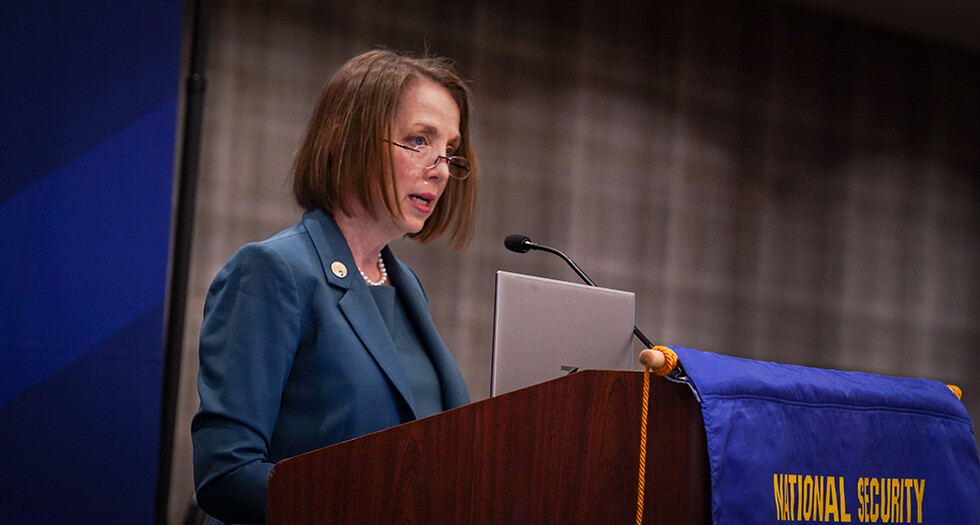
National Security Commission members hear about the agency’s record year in 2025 and stories from family members whose loved one is still missing or has been recovered and brought home.
Pam Cain can remember Feb. 15, 1966, like it was yesterday. She was walking home from middle school in the Washington, D.C., area when an unfamiliar car and her grandparents’ car were parked outside her home. She wondered why her grandparents were there when she was supposed to see them in New Jersey that weekend. Then she saw her mom.
“For the first time in my life, I saw my mother cry,” Cain said. Her father, U.S. Air Force Col. Oscar Mauterer, was missing in action in the Vietnam War. His A-1E Skyraider was shot down over Laos and while he did exit the aircraft, he was believed to be captured as a prisoner of war.
“My dad was a sandy pilot, very proud of that aircraft and how low and slow it went and how much ammo and armor they could hold,” Cain said, whose father at 40 years old left behind his wife, daughter, and son Randy.
“He really felt it was his job to go over and fight the war that his country had trained him to do. So he was very much a family man and took it upon himself to make us understand why he had to go,” Cain said as she shared her story with members of The American Legion’s National Security Commission on Saturday, Aug. 29, during the 107th national convention in Louisville, Ky. “For a good 45 years, we really didn't know if he was dead or alive. My mom would go into the casualty office and go through photos of POWs to see if anyone resembled her husband.”
Cain’s father has been identified as a POW through photo recognition and is one of the 1,565 Vietnam War servicemembers who remain unaccounted for according to the Defense POW/MIA Accounting Agency (DPAA). Cain has spent her adult life advocating for her father’s return home and for the families of the other missing Vietnam War POW/MIAs by working with and supporting the DPAA.
“We are realistic enough to know that not everyone will be accounted for. They won't be able to bring everyone home, but our men deserve that,” she said. “It is our nation’s sacred obligation to bring them home, to give us a chance to give them their funeral and to bury them where they want to be.”
A Record Year DPAA Principal Deputy Director Jennifer Walsh emphasized to commission members that “our purpose is to uphold that principle of keeping your promise. And that promise is that we don't leave a fallen comrade. Our mission is to provide the fullest possible accounting of those missing from designated past conflicts.”
There are 700 military and civilian contractors and 130 partners in the public, private and nonprofit sectors working globally to identify those unaccounted for – 80,991 from World War II to Iraq and other conflicts. Of that number, 38,684 can be recovered. The agency operates in Arlington, Va., Nebraska, Hawaii and has detachments in Germany, Laos, Thailand and Vietnam.
“The numbers can look daunting. I want you to know that we are not deterred,” Walsh said. “We operate throughout the theaters of designated conflicts where U.S. forces fought and went missing. We work closely with those cemeteries managed by the Veterans Administration and American Battle Monuments Commission so that those who were buried as unknown have an opportunity to be identified because of the latest, greatest cutting-edge technology. And then, ultimately, be identified and reunited with their families.
“We can't do what we do without your support, American support, and critically the support of other countries where we are searching for and finding our missing.”
Walsh gave an update on what DPAA has been able to accomplish over the past and current year. In Fiscal Year 2025, DPAA had a record number of identifications – 231. “That’s two-hundred and thirty-one families who received the answers they had long waited for and deserved,” she said.
So far in Fiscal Year 2026, 202 unidentified remains have been identified with 62 field missions in North America, Asia, Europe and the Pacific. Those identifications include seven crew members who went missing when their B-24H aircraft was shot down by enemy fire and crashed on the Isle of Morgo, Northen Coast of Italy, on Jan. 30, 1944.
In 2010, DPAA began investigating the search for the seven missing when it was indicated to researchers that there was a possible impact crater on the Isle of Morgo. “It was an impact crater in water, and it was a complex field operation. The site is referred to as the duck pond because it is just that,” Walsh said, adding that the unique environment of this crash site resulted in remarkable preservation of artifacts like a silk flight map and a Bible from one of the servicemembers.
“Like many of you, DPAA stands this watch, and we appreciate the support from The American Legion. And we welcome this collective group of reflecting, remembering and honoring,” Walsh said. “I know that families appreciate it, too. Many of them have said to me, ‘We worry that we will be forgotten. That folks won't care.’ I think being in a room like this it's very clear people do care. People do remember, and therefore, the fallen are not left behind.”
A Family Remembered Jacque Van Buskirk understands that people do still care about the more than 80,000 servicemembers still unaccounted for. Her uncle, U.S. Army Technician Fifth Grade Clifford H. Strickland from Fowler, Colo., remained missing as a POW until his remains were identified and accounted for on Dec. 20, 2023.
“We grew up on family dinners, family reunions, Sunday get-togethers, and we all knew about our Uncle Clifford from my aunts, uncles, grandmother and grandfather telling stories about him all through our growing up,” she said. “He was kind, he was smart. He was a hard worker, and he loved horses.”
Strickland, 25, survived the Bataan Death March and then was held at the Cabanatuan POW camp where he died on July 29, 1942, from malaria and dysentery.
“He’d been in the hospital for 10 days, and my grandmother always agonized over how long he lay there suffering,” Van Buskirk shared with National Security Commission members as she shared her uncle’s story of being identified.
Strickland was buried along with other deceased prisoners in the Cabanatuan Camp Cemetery in Common Grave 215. In 2010, a sibling of Strickland’s provided DNA to the DPAA when the family learned that they were looking to identify the remains of those buried in the unmarked grave.
“It is difficult for us to express the relief and joy of having my uncle identified and brought home,” Van Buskirk said. “It is completely numbing and still big. It’s difficult to talk about some parts of it.”
Strickland is buried close to his parents, and The American Legion was there to welcome and escort Strickland home. Legionnaires also provided flowers at the cemetery and handed out 2,500 U.S. flags for people to wave as Strickland was escorted to his burial site.
“The American Legion was a big part of our memorial, our family memorial. We can’t under express our gratitude for all that The American Legion did for us,” Van Buskirk said.
Since his identification, Van Buskirk and her extended family have looked at letters that Strickland wrote home to his family while he was serving. “It was incredible to look at his writing, read his words, and to get to know him,” Van Buskirk said. “In one of the letters to his mom he wrote about his brother Milton. He wrote, ‘I got a letter from Milton. He didn’t know where he would be stationed after he finished school. If you can talk him into staying in Denver, do it. Because he doesn’t know what he would be up against in the foreign service. He’s too young and wild in nature for this kind of soldiering.’ My Uncle Milton went on to serve in World War II, Korea and Vietnam.”
This year National POW/MIA Recogntion Day falls on Friday, Sept. 18. Walsh encourages American Legion posts to hosted gatherings to remember those still unaccounted for and their families who are waiting to bring them home.
“We need you. You are our voices when our voices are worn out, tired, or we just can't see,” Cain reflected on. “Please keep your promise, keep your support of DPAA, please keep your support of the families who couldn't do it without you.”
- Convention