

Topics covered at Louisville meeting range from veteran careers to data centers.
From its inception several years ago, the Task Force Movement (TFM) public-private initiative has sought to connect transitioning servicemembers and veterans with secure jobs in growing or national-security-related fields. As that landscape has changed, those at the table – and what they bring to it – have changed as well.
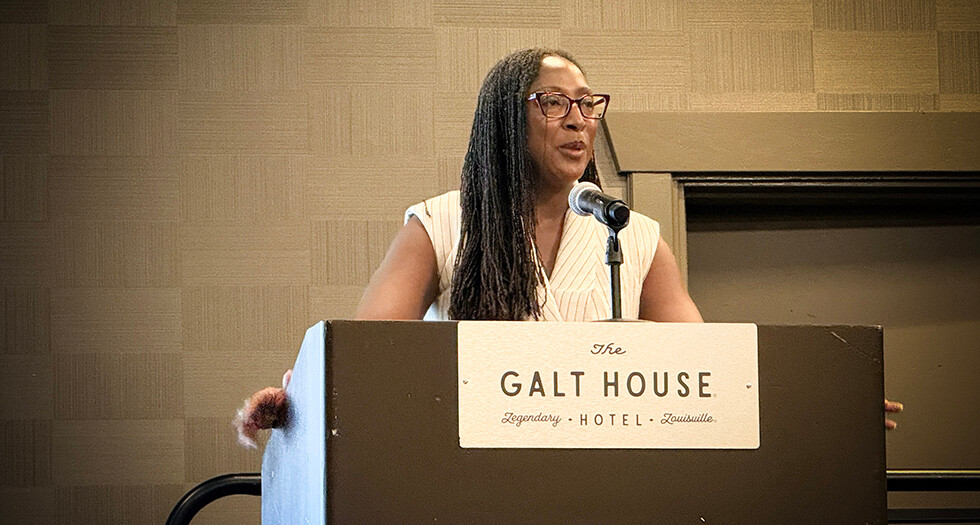
On Aug. 28, the annual TFM meeting at the American Legion national convention was held at the Galt House in Louisville, Ky.; the Legion has a seat on the initiative’s Steering Committee. Two phrases prominent in current public discourse were also a focus of conversation there: AI and data centers.
Among the innovations Army recruiting has taken over the last few years is overhauling its recruiter curriculum to incorporate AI assistance, according to guest speaker Lt. Gen. Johnny Davis, commanding general of what since 2025 has been a “mega” Recruiting Command that now includes all Army force generation and marketing (”Be all you can be” is back – Davis said it worked on him.). Decades-old tactics like cold-calling have fallen by the wayside, and two weeks of training have been added that include family input on assignments. The service branch has spent $60 million on improving almost 800 facilities, right down to the furniture.
And it’s working. More than 61,500 new recruits have been put under contract in the last 120 days. Reserve recruitment is averaging 70-80 per day, a historic level. Almost 110,000 have been trained in the last year. And the force is building up its delayed-entry program, lessening stress for recruiters. Davis said they are in a good place for the next two years, “but we still are always looking for talent.” Data can help them correlate ZIP codes with probable MOS interest, enabling them to spend their money better.
In 2026 the average age of an Army enlistee is 23, so Davis asked those in attendance to consider encouraging people around that age to consider the military as a career; these days, “You cannot take that for granted” when it comes to people just walking in on their own to join.
Laura Berrocal of Verizon put the matter bluntly: “AI is an opportunity and a challenge.” She is executive director of policy and strategic partnerships and part of the Responsible Business Team, which does the company’s corporate social responsibility work aiding small businesses, education, disaster mitigation, veterans organizations and more. Technology plays an important role not just for businesses but individuals, including military families – her husband missed their oldest daughter’s birth due to his Air Force duties – and being able to understand and apply it is critical to career growth today.
Verizon has begun working with The American Legion on its technological offerings, including free workforce upskilling for individuals and businesses, transitioning into high-demand fields and professional certifications. One problem with the current AI landscape, Berrocal said, is its vastness: there is no one standard certification, but multiple ones depending on who is doing the training. So far the team has reached out to 600,000 businesses and has a goal of 1 million; Google “Verizon Responsible Business” to learn more.
Keith Giemzik is a director at BlackRock who leads Taft-Hartley and multi-employer business and serves as labor liaison. He grew up in a labor union home on the south Side of Chicago. He spoke to the TFM attendees about his company’s investments in improving the U.S. grid and infrastructure – ultimately a national security concern – including data centers, which he said use less water than rumored and contribute to the local tax base. Of the $15.3 trillion under management by BlackRock, $100 billion is Taft-Hartley pension funds. And none of it is actually the company’s money, but its clients’, something he said commenters (especially on Instagram) often don’t realize.
The investments don’t stop with facilities. The Future Builders program serves those coming into unions and trades from school and the military. The biggest entry to entering the trades, as with the military, is fear of what might happen, and more information can help. He asked the attendees, with their “access at the highest levels,” to open up conversations among themselves and with others. “There’s more need, and capital, than we’ve ever seen,” he said, adding that building and maintaining data centers – “behind-the-mirror power” – means jobs.
Helmets to Hardhats Executive Director Martin Helms echoed that fact in a panel discussion on the defense industrial base (DIB): “People are not going to give up their technology,” he said, and all those power demands mean a need for lots of workers; preventive maintenance in data centers is defined by redundancy. The shortage in skilled-trades workers is no news to his organization, which was one of the first in the space of reskilling servicemembers and veterans for new career opportunities.
The DIB was another hot topic during the meeting, which American Legion Veterans Employment & Education Commission Chairman Paul Espinoza opened by addressing the partnerships on display there and describing the Legion’s emphasis on helping the government link to veteran-owned small businesses. Another panel focused on TFM’s efforts in the sector and veterans’ pathways to it via the public-private workforce, but other speakers focused on more general aspects of getting veterans careers:
Chantile Stovall, VA’s executive director of veterans readiness and employment services who was sworn in in June, explained that her program works with service-connected disabled veterans to help them understand what they still bring to the table while addressing some employers’ preconceived notions about them. Vocational rehabilitation counselors help them “cross-walk” MOUs to civilian jobs. It has seen around 60% growth since the passage of the PACT Act. Out of the more than 200,000 participants, many are pursuing four-year degrees, so there is room for growth in the trades.
Regarding both government program like SkillBridge and those stood up by unions, Mike Hazard with UA’s Veterans in Piping (VIP) stated, “The way people transition out of the military is selling the military like never before,” and compared it to his own experience leaving the Navy after 12 years: “I kind of got kicked to the curb.” The VIP program focuses on direct entry and the end of the process, not the beginning: “People need a job, not an interview.” That guarantee of a good job and a good worker supports the defense industrial base through reliability and adapability, both qualities veterans bring wherever they go.
Ultimately, to meet the needs of today’s veteran worker in today’s society, unions are going all out to provide wraparound services. Several representatives at the TFM meeting discussed mental-health programs to encourage conversations and catch problems before they get out of control. And Bryan Stymacks of the International Association of Machinists and Aerospace Workers (IAM)’s Veterans Services Program described how the program was certified as a VSO to help its members with VA disability claims in January 2025. More than $5.5 million has been returned so far, including to extended family members.
- Convention