

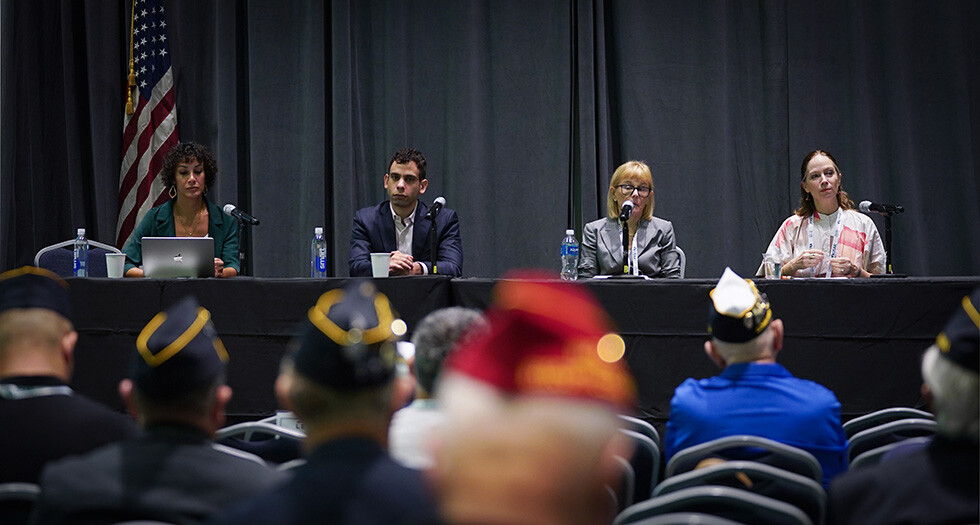
Preventing suicide and treating PTSD panel prompts insightful discussion during national convention.
While emphasizing the importance of treatment for someone going through a mental health crisis, perhaps just as important is the person going through the treatment knowing that others will be there to support his or her effort.
That was shared with The American Legion’s Veterans Affairs & Rehabilitation Commission meeting on Aug. 29 during the meeting’s mental health panel, “Strategies for Preventing Veteran Suicides and Treating PTSD.”
Alex Silva, Military Program Manager for the American Foundation for Suicide Prevention (AFSP), said a veteran dealing with PTSD or some other mental health condition stands to gain nearly as much from support as from treatment.
“A spouse, a fellow veteran, a peer, they’re not necessarily going to be somebody’s mental health professional. But a mental health professional won’t be their veteran, either. Or their spouse or their peer or their family member,” said Silva, a U.S. Air Force veteran. “Everybody in this room has a vantage point that a professional will never have. And when somebody has support from the people around them when they’re going through treatment – because treatment is hard – that’s what keeps things together.
“We don’t have to be somebody’s therapist. We don’t have to diagnose somebody. What is our business is if somebody is struggling, if somebody is having a hard time, if somebody is having an appointment, getting an evaluation.”
The panel included VA National Center for PTSD Executive Director Dr. Paula Schnurr and veteran Kayla Williams, who deployed to Iraq in 2003 as an Arabic linguist with the 101st Airborne Division and now serves as the Senior Policy Advisor for Vet Voice Foundation.
It was moderated by Juliana Mercer, a U.S. Marine Corps veteran with multiple deployments to Iraq and Afghanistan and executive director of the nonprofit Healing Breakthrough. She also emphasized the importance of peer support.
“I think everyone in this room is very aware of the suicide epidemic that we’ve been facing: 6,400 veterans a year since 9/11 losing their lives to suicide. That’s 150,000 veterans since 9/11,” Mercer said. “It’s such an important topic, and if it wasn’t for organizations like the Legion, and if it wasn’t for our brothers and sisters keeping track of each other, checking in with each other, I think that number would be so much higher. So, the importance of that peer support, I don’t think it can be measured. It is so important.”
Williams said veterans who have struggled and successfully gone through treatments are a valuable resource for those who have yet to seek help. “All of us in this room can play a role in encouraging other veterans to trust that care works by being candid about our own experiences,” she said. “I’ve experienced trauma. And I’ll say, ‘I’ve gone to treatment and that it’s been extremely effective for me.’ I try to talk about that openly with my peers on a regular basis because veterans trust other veterans – sometimes more than they trust scientists.”
Schnurr provided some perspective on how the perception of PTSD has changed since she began studying it in the 1980s. “It was a really different time. People questioned the validity of PTSD,” she said. “We had to fight hard because people thought it was just neurotic. We now know that’s absolutely not true. At the time, a lot of our researchers focused on establishing the validity of PTSD.
“Now we’re in a situation where we know how many people are affected … what we can do about treatment. We now know it can be treated. At the time, the dominant thinking was that treatment was more about helping people cope with symptoms than it was a chronic disorder.”
But although times have changed and treatments and resources have expanded for veterans, their suicide rate remains proportionally higher than the civilian population.
“This is why we really have to embrace the complexity of what suicide is and how it works, and never just look at suicide as a single number. Because we can miss important differences,” Silva said. “Veterans from older generations … are coming to an age group that has higher rates of suicide. When we look at rural veterans, people from rural areas die by suicide at a higher rate. When we talk about women veterans, women make up a smaller portion of the military, but this is a group that’s dying by suicide at a rate that is increasing faster than women who have not served and is now over 90 percent higher.
“If we just look at these little pockets within the population and we blur them all and say ’22 a day, 17 a day’, we’re missing the nuances for this.”
When it comes to care and treatment, Williams shared how a bad experience made her realize the value of getting treatment through the U.S. Department of Veterans Affairs, rather than via an outside provider. She was referred to Community Care for her mental health treatment, which did not go well.
“My first appointment with a Community Care provider I said, ‘One of the things I want to talk about here is MST, or military sexual trauma,’” she said. “And she said, ‘Well, what is that?’ And I was like, ‘Nope, I cannot come to therapy and train you about what veterans experienced.’ That is why I would rather stay in the VA system and believe very strongly we need to fight, because VA is a system worth saving.”
Later during the panel, Williams shifted her focus to how one means of dying by suicide needs addressed. “We’ve got to talk about the guns,” she said. “That is one of the big differences, especially with women veterans, for example. Non-veteran women are more likely to attempt suicide than men, but they are more likely non-lethal means and survive an attempt. Women veterans are more comfortable with guns. We carry firearms, so we are more likely to choose lethal means, and we are more likely to die by suicide.
“So what organizations like individual Legion posts can do is to talk about the importance of safe storage of firearms. Understand what your state laws are. See if there are other organizations that you can partner with if a veteran is in crisis. They can find a safe place to store their firearm outside of their home during their period of crisis.”
Williams also suggested that providing gun locks is another way to avert a firearms crisis. “We have to talk about this,” she said. “I’m not saying give up your guns. I get it. We have a gun in the home. It is stored with a lock. When I’ve been feeling stressed, I’ve asked my husband, ‘Take the key. Don’t let me know where it is.’ We keep the ammunition stored separately. This is for our safety as veterans who have histories of suicidal ideations, and also for our children’s safety.”
Silva piggybacked on Williams’ message. “I want to talk about impulsivity,” he said. “Something that is shown time and time again is that when people have time to change their minds, they do. They really do. When we talk about somebody who’s in a suicidal crisis, something to know is that a crisis happens in a moment where somebody can’t see a way out.
“This is part of why things like having a lock on your firearm, rather than sleeping with your firearm under your pillow. It really does save lives because it gives people time to change their lives. Almost half of suicides happen within 10 minutes of making the decision. And so that’s the critical moment to intervene.”
- Convention