
Legion officials, congressional staffers share perspectives on bill.
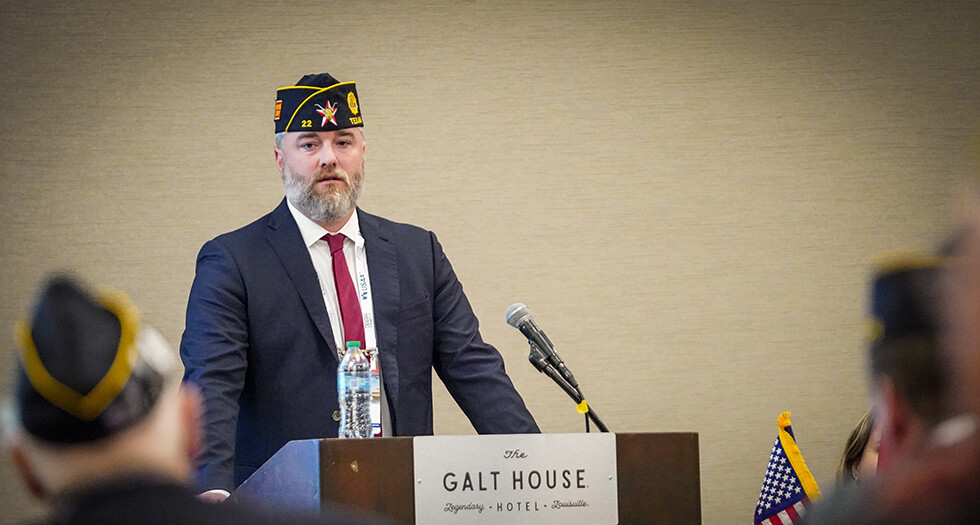
The Taking Care of America’s Veterans Act (TCAVA) has been a hot topic of discussion at all levels of The American Legion, and that has not abated with the beginning of this year’s national convention in Louisville, Ky. As one of the most involved segments of the organization, the National Legislative Commission’s meeting on Aug. 29 at the Galt House Hotel was full of both commission members and convention attendees, wanting to hear the latest.
Commission Chairman Matt Jabaut opened the meeting by reminding everyone of the commission’s responsibility “to ensure that the voices and experiences of veterans are heard in Washington.” Legislative Division Deputy Director Bailey Bishop gave an update on the division staff’s recent efforts to make the Legion’s positions known through testimonies, meetings with lawmakers and more. She went over some victories – including legislation on VA home loans and housing – but added that despite bipartisan progress on issues, “budget politics have arrived in veterans policy.” That reality would come up again.
Legislative Associate Logan Barber discussed ongoing legislative priorities such as the Love Lives On Act, benefits expansion and GI Bill parity, and emerging technological opportunities. “We want veterans to have a piece of (the AI/data center) economy,” he stated. Also included was the Major Richard Star Act, a longtime Legion priority; despite widespread support in both chambers, it has repeatedly run into roadblocks to passage.
It was then that American Legion National Commander Dan K. Wiley entered the meeting. He thanked the Legislative team and the Washington, D.C., office in general. “In my opinion, the Legion is clearly the leading voice” for veterans in the nation’s capital, he said, partly because of staffers’ professionalism. He recounted his visit to the White House for the signing of the executive order on reclassifying cannabis for research. On TCAVA, he referred attendees to the informational video developed by the Legion on its position and reminded them that the rescission talk started in 2022 under a different administration. When a similar situation occurred in the 1990s, the money saved ultimately went not to veterans, but to transportation. Looking at the entire situation and the financial realities of Congress, the act is truly the best opportunity to enact many longstanding American Legion legislative priorities. Of the opposition to it he asked rhetorically, “Then what’s your solution?”
“There’s a lot of noise surrounding this,” Legislative Division Director Cole Lyle said when he took the podium. The very beginnings of the discussion started in 2009, when VA first undertook a review of its disability rating schedule as a whole. Under the PAYGO rule of Congress, money committed to spending increases or tax cuts must be balanced out, or offset, by spending reductions or tax increases somewhere else. “It gets harder and harder to pay for things,” Lyle expressed. Exceptions can be made and often are for legislation such as defense or tax cuts, but for veterans legislation it has only been done twice in the last 20 years. Lyle himself has sleep apnea and tinnitus, the two conditions most potentially affected by TCAVA, and he admitted that he might be affected down the line if it passes – but it’s “worth it for a stronger VA that works for (veterans) and their families in the future.”
And he made the point that passage would not the end of the line for components such as the Star Act; Congress has enacted later legislation adjusting parts of previous legislation. “We’ve asked for the perfect repeatedly,” he said in responding to a commission member’s question, and the hope is that that would happen in TCAVA’s case.
Next on the agenda was a panel of congressional Veterans’ Affairs committee staffers; in his introduction Jabaut called such employees “the real architects of veterans policy.” The panel consisted of Steve Gonzalez (HVAC Majority), Gary Woodward (HVAC Minority), Jon VanderPlas (SVAC Majority) and Carlos Fuentes (SVAC Minority). Topics discussed included:
- Dealing with what their congressional members consider the biggest structural threats to VA in the next five years, which range from “making sure the VHA is working for today’s needs,” Gonzalez said, to dealing with more money but less staff (”you can’t cut your way to better,” Woodward said);
- How to balance community and direct care within the VA healthcare system;
- Possible infrastructure adjustments as veterans age and move to warmer weather’
- TCAVA, on which the panelists gave their perspectives on the sometimes fraught process of trying to come together, make the legislation work and get the good that is in it done. A follow-up discussion revolved around the biggest priorities for their members if TCAVA ultimately passes or fails.
- Counteracting increased partisanship on the Veterans’ Affairs committees. Woodward, who has worked on the Hill for 24 years, said he has never seen it as bad as it is currently. Fuentes recounted how many bills in the past have been compromised on and brought forward by bipartisan, bicameral work.
American Legion National Legislative Council Chair Angela Evans’ update lauded Kansas on leading state activity on VoterVoice – it is both Wiley’s home state and hers – with 15,671 actions in the past year, and reminded attendees that anyone, not just Legion Family members, can use the platform. Nearly 69,600 TCAVA messages have been sent since July 1. Legionnaires making their voices heard in Washington, on TCAVA and other legislation, may be as critical to passage as it has been in the past.
- Convention