

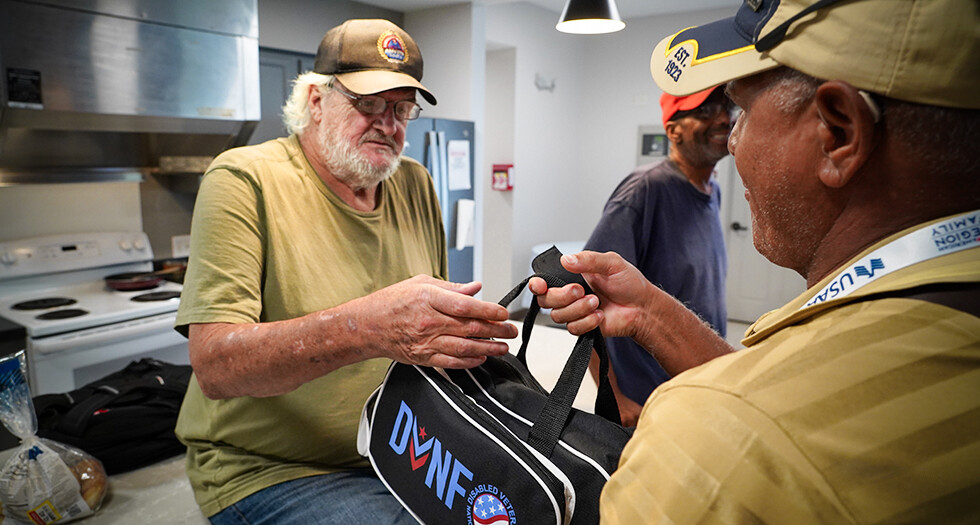
American Legion Family continues tradition of visiting with veterans in a homeless facility, this time at Louisville’s St. Vincent de Paul.
Arkansas Legionnaire Estella Morris worked for the U.S. Department of Veterans Affairs for 49 years, including during the inception of the department’s homeless veterans program.
Now she serves as the Homeless Veterans consultant for The American Legion’s Veterans Employment & Education (VEED) Commission. And for years, she has been on multiple offsite visits during the Legion’s national convention to tour local homeless veterans facilities and learn about their services and programs.
She was a part of a similar visit on Aug. 31 in Louisville, Ky., when she was a group of more than a dozen American Legion Family members, national staff and others who took a tour of the campus of St. Vincent de Paul Louisville to meet with residents, talk with staff and tour the facilities.
During the visit, the Legion contingent also distributed duffle bags to residents of the facility full of personal items that include soap, shampoo, toothpaste and other personal hygiene items.
The visits are something that Morris, a member of Michael Vann Johnson Jr. Post 74 in Sherwood, Ark., looks forward to each year.
“It’s always one of those rewarding times when we’re able to go out and visit the facilities, visit the shelters, look at what they’re doing, looking at the services they’re providing for veterans who are experiencing homelessness,” she said. “To see not only what is available, but the opportunity to see where gaps might exist in various areas of the country. Those tend to be different based on the geographical location that the facility may be located in.”
St. Vincent de Paul serves individuals and families in need including those who are homeless, living in poverty, suffering from addiction, enduring mental illness, or experiencing acute economic crisis. Its campus includes Waypoint House, which has 24 rooms dedicated to housing homeless veterans permanently, both male and female. The rooms are for veterans who are homeless, at immediate risk of homelessness, or currently living in a transitional housing setting.
Rent is $650 a month and can be both paid privately or through HUD-VASH vouchers, a program through a collaboration between the U.S. Departments of Veterans Affairs and Housing and Urban Development that provides housing vouchers for rent.
The residents of the facility have shared bathrooms for every two units, with access to a community kitchen, a common area and laundry room facilities. There also is a designated computer area with Wi-Fi for residents that is open from 8:30 a.m.-4:30 p.m. Monday through Friday. The area allows residents to search out and connect with resources that may benefit them.
Although there are no case managers for Waypoint, veterans can receive resources through VA.
St. Vincent de Paul also has a food pantry open Tuesday and Thursdays from 9 a.m.-noon, an Open Hand kitchen that serves lunch and dinner seven days a week to anyone who needs a meal, and emergency housing that has 60 beds for area residents and 20 more rooms reserved for veterans. There are case workers available for those using emergency housing.
STORY CONTINUES BELOW
Phil Murray, who served in the National Guard from 1985 to 1988, has been a resident at Waypoint for two years. He said that ending up at Waypoint House might have been his destiny.
“I’m also an ordained minister and was a National Guard chaplain,” he said. “I think my calling was to come here. Sometimes you have to fall. I do bible studies here, and I talk to the veterans. And I did my first memorial service here.”
Murray was appreciative of the Legion visit, not just for himself but for other residents. “It means a lot because some of these veterans do not have family here,” he said. “It’s a blessing for them, and it’s a blessing that they pass out the gifts. Nobody really comes to see these guys and gives them gifts. It’s a blessing that other people recognize us.”
St. Vincent de Paul Chief Operating Officer Dominique Batts also praised the Legion for taking time to visit her facility.
“It is an extraordinary thing for an organization to want to come and support the individuals that we house here,” Batts said. “As with any nonprofit, we realize resources are never enough, and we’re always looking for more things and trying to provide what we’re able to. But for an organization to want to come in and hear (from the residents), I think what we hear from a lot of the veterans is they want to be heard.
“To have people come and sit down with them and hear about what they’ve experienced and what their needs are, I think it’s an incredible venture that The American Legion was able to come here and do that today and provide that for them.”
Veterans Employment & Education Division Director Ariel De Jesus said touring facilities like St. Vincent de Paul is important because it shows the veterans living there that they are not forgotten. “I think it’s important because we have veterans out there that are homeless. Sometimes we tend to forget who they are,” he said. “It’s letting them know that we are still here for them and getting that veterans homeless population down to zero is our main goal. Getting out there, I think it’s important just to show them support for our homeless veterans and making sure that we take care of them.
“I talked to a few veterans here, and they didn’t know about VA (disability) ratings, they didn’t know about The American Legion. They didn’t know about different resources that are out there to help them.”
Morris said she plans to attend as many such as she can. “It’s always rewarding to be able to provide some assistance from the commission to the veterans in that area,” she said. “As long as I am on the commission, I plan on being a part of this activity.”
- Homeless Veterans