

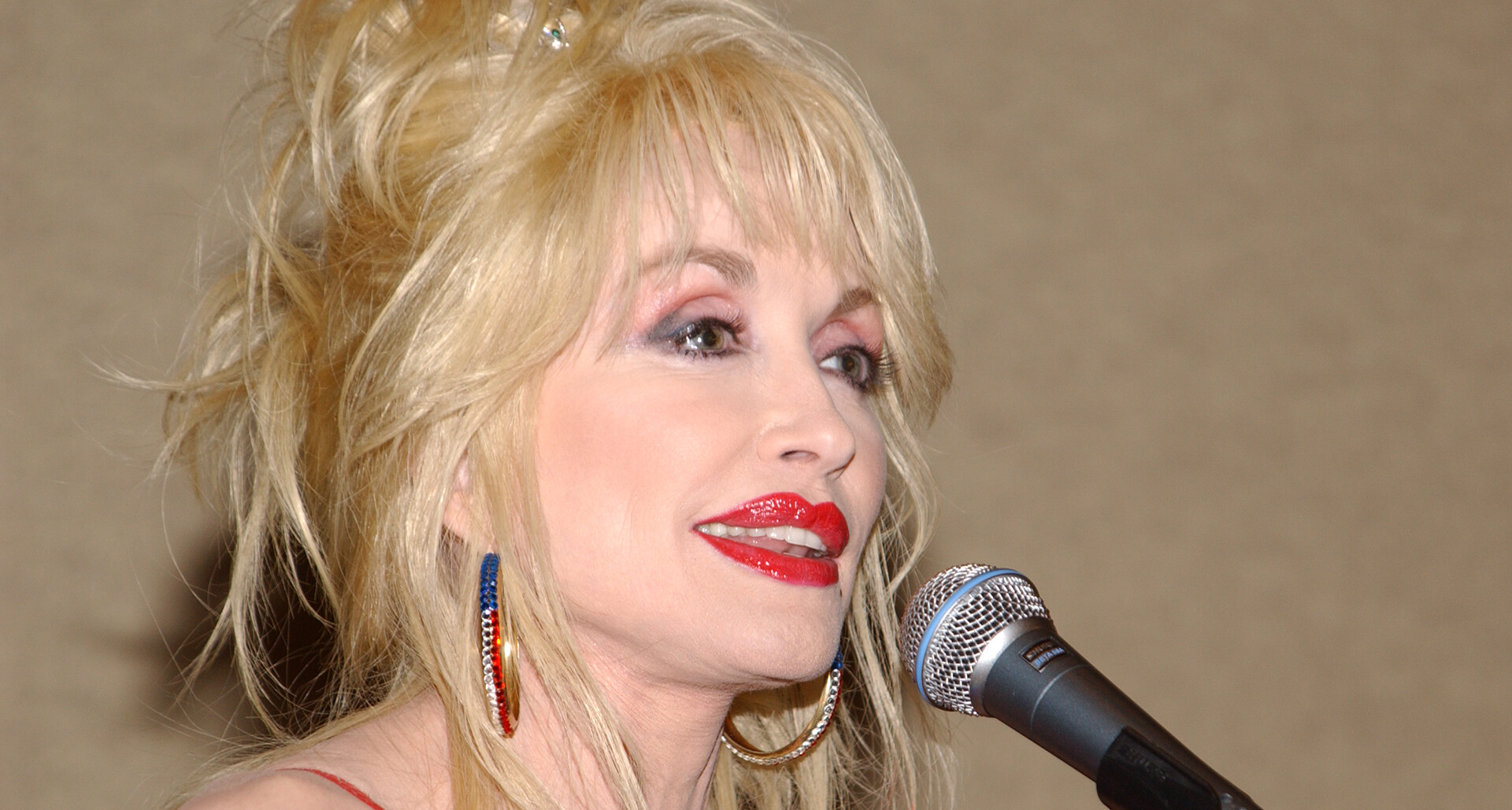
In a 2004 American Legion Magazine interview, the entertainment legend talked about her faith, patriotism and appreciation for the U.S. military.
Editor’s note: The following interview with Dolly Parton appeared in the March 2004 American Legion Magazine, available here in the Legion’s digital archive. Later that year, she received the Legion’s James V. Day “Good Guy” Award, given to individuals who demonstrate exceptional commitment to their community, state and nation. Among her many contributions recognized were Parton’s successful initiative to reduce the high-school dropout rate in Sevier County, investments in local and regional healthcare, and support of children’s literacy through her Imagination Library program. Parton died this week at age 80 after a brief battle with cancer.
With a flair for telling stories in songs and a voice to match, Dolly Parton always intended to become a household name. On her graduation day in 1964, Parton’s high-school class laughed in her face when she declared, “I’m going to Nashville to become a star.” That she did, jumping from top billing on the popular “Porter Wagoner Show” to the top of music charts to Hollywood’s silver screen, proving that a penniless “hillbilly” from the mountains of Tennessee has as much of a shot at success as any other person born in America.
Parton, who once said she grew up so poor that “even the ants who stole our food felt sorry for us,” now has a personal fortune estimated at $300 million. She has written more than 3,000 songs and released nearly 70 albums. She owns a music publishing firm, two production companies and a chain of equestrian-themed “Dixie Stampede” dinner theaters, as well as a sizable portion of a Tennessee theme park and water park that bear her name.
Ask how she did it all and Parton won’t be shy about the musical gifts that rocketed her to fame. In the same breath, though, she’ll tell you how grateful she is to God and America for a career most celebrities would envy. Parton offers thanks on her latest record, a collection of religious and patriotic songs released last Veterans Day.
The American Legion Magazine recently spoke with Parton about the inspiration behind “For God and Country.”
You grew up poor in the mountains of East Tennessee, then went to Nashville and – after a lot of hard work – hit the big time. In a way, you have a rags-to-riches story. Would you say you’ve lived the American dream?
I’m still living it. I feel so blessed just to live in America. Even with all our weaknesses and faults, we’re still the greatest country in the world. I’m a good example of what kind of opportunities America has to offer. I can’t imagine what my life would have been had I lived somewhere else.
You’re not just a singer and songwriter, but a businesswoman. It’s said that your Smoky Mountain theme park, Dollywood, has brought thousands of jobs to what was a poor part of Tennessee.
It’s part of the American dream to appreciate the position you’re in by giving back. I feel fortunate to have been able to do that through the theme park. I love knowing I’m able to help other people. I’m big on the values I was taught growing up: home, God, faith, sharing, caring, being a good neighbor, loving everybody like they’re your own family.
You have a few connections to the military. Your husband, Carl Dean, served in the National Guard. Your best friend, Judy Ogle, served in the Air Force. Your uncle, Bill Owens, also served.
So did Don Warden, who works with me. Many of my relatives served too. I’m surrounded by all these veterans. I meet veterans all the time. I’ve written many songs about soldiers, what they go through and what they give up to protect us. They know they’ve got to do it; they want to do it. They’re my heroes, and I want to thank every one of them. We could never say enough about them. We could never praise and honor them enough.
It’s been said that a couple of your songs are based on a veteran who lived not too far from your childhood home. In your autobiography, “Dolly,” you say he taught you some banjo.
I based the story of “Joshua” on him, and “Applejack.” His name was Perry Lindsey. We called him “Sawdust.” He was a loner. He was a World War II veteran, and he used to tell me all about the war and the fighting. He was a special person. It’s those people from your childhood who take you outside of yourself and where you live. He influenced my music and my life in general.
On “For God and Country,” you show a new side of Dolly Parton by poking fun at America’s enemies, challenging Osama bin Laden to join his suicide bombers and calling Saddam’s men “a deck of all jokers.” Have you considered doing comedy?
Well, I think it’s important to have a sense of humor all the time, not just during war. Humor, laughter – they’re very healing.
What impact did Sept. 11 have on your songwriting?
“Color Me America” is a song I wrote the day after the tragedy. I was frightened. Something like that shatters your confidence and faith. It makes you feel vulnerable. As a songwriter and singer, I’m so glad to have an outlet to express those feelings for myself and others.
What role do you think entertainers have during wartime?
Well, I think it’s our place as entertainers just to entertain. You can only imagine how homesick the soldiers must be. I’ve never done any USO tours because I’m scared to death of airplanes, but I’d love to do what Bob Hope did. He brought so much to the spirits of American troops. We’ll be traveling to bases to do shows and maybe go overseas. It’s our place to do what we can.
Considering the war in Iraq is unpopular with many celebrities, did you think it might be risky to release a patriotic album at this time?
I do not have a doubt that this was the right thing to do, at least for me. This album isn’t anti-anything. This is pro-God and pro-America. As for some celebrities, they probably wouldn’t be that into this anyhow. We all have freedom of choice, freedom of speech. Some abuse ’em, some don’t. I’m just proud to be part of the whole thing.
What reaction has the finished product received from your family and friends?
They love it. Everybody said, “Well, it’s about damn time.” I’m not political, but I am patriotic.
Of the album’s 18 songs, do you have a favorite or two?
“Welcome Home” is the first single off the record, and it’s my favorite one for personal reasons. It has a way of tying God and the patriotic together. My other favorite is “Brave Little Soldier.” I wrote “Brave Little Soldier” for my niece who had leukemia. I love the whole album, though.
“Welcome Home” is one of a handful of spiritual songs on the album. You sing of a father welcoming his son home from war, and in the next verse you sing of God welcoming Christ home from the cross. More risky territory?
I have no fear of glorifying God. My faith is true. It’s been what has led and guided me. I’m not afraid to speak about it. They crucified Jesus. Why shouldn’t they crucify me? Most people believe in God. I happen to be a Christian myself. With God, I can do all things. Who do I have to be afraid of?
One of your earliest hits, “The Seeker,” is about finding shelter in the Lord. You’ve been writing songs about God as long as you’ve been writing songs.
People know my faith and my background. I’m not trying to cram my religion down anyone’s throat. I think people accept that that’s who I am. I’m not going to back up now.
“For God and Country” comes just a year after the release of your most recent bluegrass album, “Halos & Horns.” You pulled it together fast.
I did it in three months. I’d always hoped to do a patriotic recording. With all the stuff going on in the world right now, it seemed to be the right time. I’m as proud of it as I am of anything I’ve ever done. We’re planning a TV special based on the album, and I’m hoping to do an all-American tour in auditoriums and churches. I think I’ll be doing this for the next 18 months to two years. I hope it’s an inspiration to people.
- Honor & Remembrance