

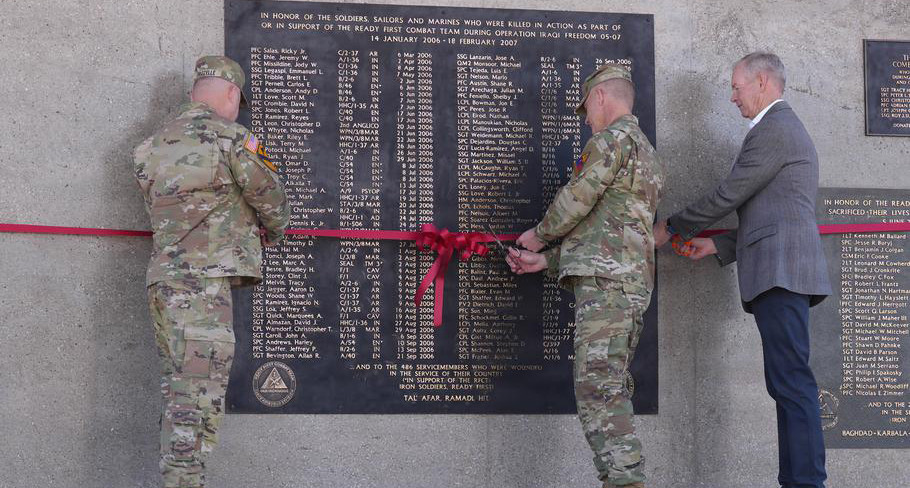
Retired Lt. Gen. Sean MacFarland, who commanded the 1st Brigade Combat Team during the deployment, got the idea for the memorial after visiting a small plaque placed on post in 2007 that was in bad shape from years in the desert heat.
The names of the 94 service members who died in Iraq as part of the Second Battle of Ramadi are now memorialized at Fort Bliss as the 1st Armored Division marked 20 years since one of its brigades participated in the tide-turning combat operation.
More than 1,200 veterans were at Fort Bliss in west Texas during the weekend for the memorial unveiling, said retired Lt. Gen. Sean MacFarland, who commanded the 1st Brigade Combat Team during the deployment. He said the brigade fought alongside Marines, Navy SEALs and airmen in Ramadi, which experts said marked a change in the United States’ understanding of the war and successfully used combat outposts to gain control in the city.
“Thanks to each of you who shared that battleground with us, and each of you who remembers the turmoil, the triumphs and the tragedies,” retired Navy Lt. Cmdr. Jocko Willink said Saturday during the memorial dedication ceremony.
He led a unit of Navy SEALs in the battle and described the feeling of being constantly surrounded by the enemy. However, he said he always knew U.S. troops were just a radio call away if a situation turned for the worse.
“That’s because this was a unified team of American services, from sea, air and land, all branches, all uniforms, one flag and one mission,” Willink said. “The ones we owe the most thanks to — the ones we are eternally grateful for — are the heroes that did not come home, the ones who gave everything for us so that we can be here today.”
First Brigade soldiers deployed first to the Iraqi city of Tal Afar in January 2006 and then in May moved south to Ramadi, where they reported to the 1st Marine Expeditionary Force, MacFarland said. The bulk of the city was under the control of insurgents, primarily foreign fighters from al-Qaida.
The brigade used the clear, hold and build strategy by setting up small outposts throughout the city, he said. Troops also developed alliances with local tribes, known as the Sunni Awakening, which changed the whole approach to the war — not just in Ramadi but in all Sunni provinces.
MacFarland had picked up the strategy of small outposts from the 3rd Armored Combat Regiment’s deployment to Tal Afar the previous year. Military officials credited success in Ramadi for the success later seen when the U.S. surged troops in Iraq.
“It was a, a city that nobody thought we could take. Not our Congress, not our press, only the soldiers that were on the ground and those that led them believed that we could be successful,” Command Sgt. Maj. James Light, the senior noncommissioned officer of the 1st Armored Division and Fort Bliss, said Saturday.
Light credited the actions of each individual service member for leading U.S. forces through the difficult fight.
The names on the memorial represent each U.S. service member from all military service branches who were killed in action in Ramadi. The memorial plaque is one of several marking operations in the Global War on Terror that are affixed to a wall of the brigade’s headquarters building.
MacFarland got the idea for the memorial after visiting a small plaque the unit had placed on post in 2007. He found it leaning against the wall and in bad shape from years in the desert heat.
He knew his former soldiers were hurting, too, weathered in their own sense from returning home from combat and finding their new place in the civilian world. He decided the memorial would be a catalyst to get everyone reconnected.
“I did it because they did so much for me and for all of us,” MacFarland said.
The grassroots effort for a new plaque and a reunion weekend came together with support from several nonprofits, including America’s Mighty Warriors, founded by Debbie Lee. Her son Marc Lee, a Navy SEAL, died Aug. 2, 2006, during the battle of Ramadi. Lee’s organization provides programs to improve quality of life and recovery for service members and their families.
Speaking at Saturday’s memorial dedication, she validated the pain many veterans of the battle and their loved ones still feel 20 years later.
“To the Gold Star families, your pain and sacrifice did not end with a folded flag,” Lee said. “You live with a weight that does not leave, a grief that does not expire, and a love that never fades. To the teammates who fought beside them, you carry memories burned into your soul, moments that return, uninvited, questions that still echo in the quiet.”
The experience of reconnecting was healing, yet bittersweet, MacFarland said Wednesday as he reflected on the reunion. There were lots of tears and laughter among folks who hadn’t seen each other in two decades.
“I really hope these units will now stay connected and continue to reconnect on their own at the company and battalion level … and continue to build that support structure,” he said.
- Honor & Remembrance