

Statue of Liberation in Normandy aims to inspire generations.
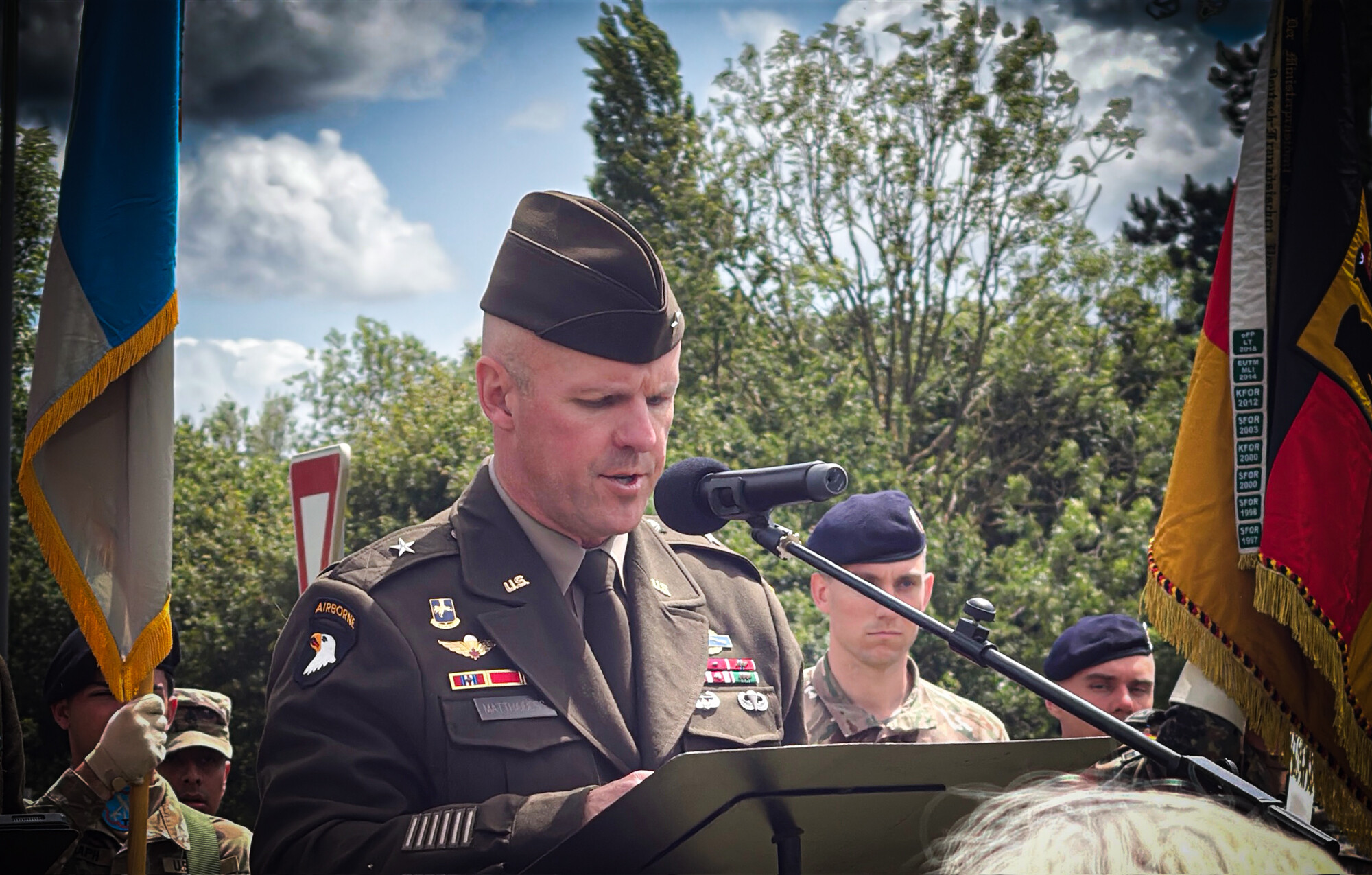
One day after earning his first star in a pinning near the Utah Beach Memorial in Normandy, U.S. Army 4th Infantry Division Brig. Gen. Ed Matthaidess III executed a mission that couldn’t have fit the occasion better.
He delivered remarks June 5 about another former 4th Infantry officer, Brig. Gen. Theodore Roosevelt Jr., also a newly minted one-star at age 56 before he stormed Utah Beach 82 years ago in the first wave of the Allied invasion of German-occupied France, which led to Allied victory over Nazi Germany in the European Theater of World War II.
“Roosevelt was the unsurpassed leader, motivator and trainer of the formation,” Brig. Gen. Matthaidess III said in a ceremony at the Statue of Liberation that stands in Ste. Mère-Église, first French town liberated by the Americans on June 6, 1944. “Roosevelt knew the division. And while he knew it was well-trained, he also knew it was green and inexperienced. Already a veteran of three amphibious assaults, Roosevelt knew that the landings at Utah would challenge even the most seasoned veterans, so he volunteered to go with them, to lead them. Despite the lingering arthritis from his World War I wounds that required a cane to get around the battlefield, despite a lingering bout with pneumonia, despite that as a president’s son, he did not have to go, and probably shouldn’t have gone. Despite the myriad other reasons not to, he led them.”
The American Legion, Operation Democracy, Amis des Vétérans Américains and the City of Ste. Mère-Église joined forces four years ago to install the bronze statue at the town entrance that depicts Roosevelt Jr., an American Legion founder, son of the 26th U.S. president and combat veteran of both world wars, who died from a heart attack just five weeks after D-Day and was initially buried in Ste. Mère-Église.
“His bravery earned him the Medal of Honor,” American Legion National Commander Dan K. Wiley told the crowd. “The oldest man and only general officer to storm the beaches in the first wave, Roosevelt Jr. received America’s highest military citation in September 1944. By that time, however, he was lying here in Ste. Mère-Église, in a temporary cemetery, among his fellow soldiers who also gave their last measure of devotion for the great cause of freedom.”
Brig. Gen. Matthaidess III spoke of Roosevelt Jr.’s tenacity and calm under pressure, having landed far from his unit’s designated target on the beach. “He said the words that shaped the course of the day and the rest of the campaign: ‘We’ll start the war from right here.’ With those simple words, he transformed uncertainty into action. With those words, he ensured momentum when momentum mattered most.”
Ret. Gen. David Rodriguez gave special thanks to “Commander Wiley and The American Legion who helped make this statue and memorial happen.” He said Roosevelt Jr. was many things, but foremost was a dedicated man of military service and an ardent supporter of his fellow veterans. “During his life, he was a businessman, a politician and a soldier,” Rodriguez said. “I can only tell you which one he liked the most.”
Lauren Themis, vice president of New York-based Operation Democracy, called Roosevelt Jr. “one of the greatest Americans ever to serve our nation” and that “as we approach the 250th anniversary of the United States, we are called to reflect not only on our founding but on the generations that preserved and protected the freedoms we hold so dear. The story of our nation is not simply found on American shores, but in places like Normandy, where courage, sacrifice and duty shaped the course of our history.”
She explained to the crowd that Roosevelt Jr.’s “fierce determination, enduring patriotism, love for his fellow veterans and unwavering devotion to country continue to inspire us today. Teddy Roosevelt Jr. believed deeply in service. Following the First World War, he helped found The American Legion – dedicated to supporting veterans and strengthening our nation. For him, service was not a chapter in life. It was the defining purpose of his life. And nowhere was that commitment more evident than here on the shores of Normandy.”
Wiley explained that Roosevelt Jr.’s spirit is reflected in the organization’s constitution. “After World War I, The American Legion was established on principles President Roosevelt and his son believed were worth fighting and dying for,” Wiley said. “Foremost, they believed we all have individual responsibility to step up when called … for the common good. In The American Legion’s Preamble, we call this “individual obligation to community, state and nation.”
Earlier on June 5, Wiley and his fellow Kansas Legionnaires – National Executive Committeeman Jeremy Ehart and Alternate NEC Angela Evans – stopped to salute Roosevelt Jr.’s grave at the Normandy American Cemetery after placing a wreath there in honor of all the heroes laid to rest on that hallowed ground.
STORY CONTINUES BELOW
Wiley said the Statue of Liberation in Ste. Mère-Église is a reminder for future generations of standards that cannot be relegated to history. “As America celebrates its 250th anniversary this summer, I ask that we all remember every man and woman who came before us, who set a standard for human civilization that cannot be lost on new generations. That standard requires responsibility and action.
“That is the importance of this immortal statue – a monument that will outlive us all – that we in The American Legion were honored to sponsor and support in memory of our founding leader and the standards he set and demonstrated for the free world. And in honor of a vow we share: individual obligation to community, state and nation.”
“May this monument serve as more than a tribute to the past,” Themis said. “May it inspire future generations to embrace lives of service. May it remind every visitor that the freedoms we enjoy were secured by men and women willing to place country above self.”
- Honor & Remembrance