

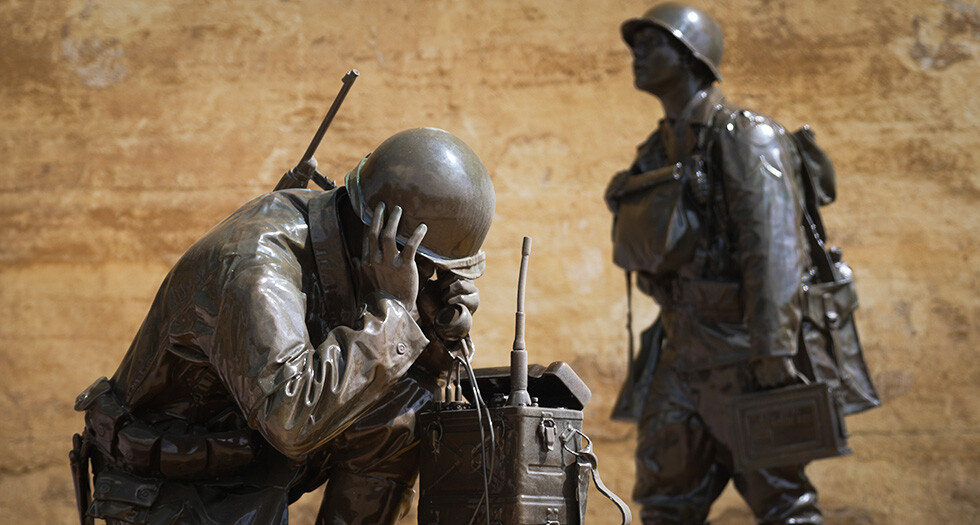
Twelve life-size statues immortalize Army Rangers who scaled Pointe du Hoc on D-Day.
Driving along the Great River Road at Grafton, Ill., one can’t miss what looks like soldiers climbing the limestone bluffs overlooking the Mississippi River.
The bronze statues, 12 in all, are a life-sized tribute to Army Rangers who, under fire, scaled the 100-foot cliffs at Pointe du Hoc on D-Day. They’re also the centerpiece of the new National Memorial of Military Ascent (NMMA), dedicated in Grafton on the 82nd anniversary of the Allied invasion.
Inspired by a trip to Normandy, retired Army Col. Mike Morrow saw the town’s river bluffs as a perfect setting for a monument honoring sacrifice and conveying the positive nature of military service. In 2021, the Gulf War veteran and Legionnaire was elected mayor and shared his vision for an entire memorial complex, including a plaza and museum recognizing every branch and era.
Last weekend, Morrow declared the project’s first phase complete as he unveiled the Ranger statues at a ceremony attended by hundreds. Two World War II veterans – Art Williams of Godfrey, Ill., and Vic Kregel of Kansas City, Mo. – joined him in the ribbon-cutting.
“This memorial represents one small piece of a larger battle,” Morrow said. “In World War II, more than 5 million men and women were in uniform overseas and here at home. Women took the place of men in factories and on farms. Every family served in some capacity, including rationing, Victory Gardens, scrap drives and war bonds. Their combined efforts made victory possible.
“We dedicate this memorial to the indomitable spirit of the American people and everyone who ever served in uniform, their families, and all who supported them ….This memorial is for you.”
STORY CONTINUES BELOW
PHOTO 1: The Leech Lake Ojibwe Honor Guard from American Legion Post 2001 out of Bena, Minn., presents the colors. PHOTO 2: Members of Whalen-Hill American Legion 648 in Grafton, Ill., perform a rifle salute. PHOTO 3: Grafton Mayor Mike Morrow, right, escorts NMMA chaplain and Vietnam War Army veteran Warren Gohl. PHOTO 4: Grafton Mayor Mike Morrow prepares to cut the ribbon for the National Memorial of Military Ascent. PHOTO 5: Guests at the NMMA dedication included Army officials, Grafton residents, veterans and their families. PHOTO 6: The memorial’s 12 life-size statues of Army Rangers were crafted by Carolina Bronze Sculpture in Seagrove, N.C. PHOTO 7: Carolina Bronze Sculpture created the statues using scanned photographs of members of the 2nd Ranger Infantry Battalion of St. Louis, a reenactor and living history group. Photos by James Jackson
Members of the Leech Lake Ojibwe Honor Guard from American Legion Post 2001 in Bena, Minn., Whalen-Hill American Legion Post 648 in Grafton and Veterans of Foreign Wars Post 805 in O’Fallon, Ill., opened the ceremony with a presentation of the colors. NMMA Chaplain Warren Gohl – a retired Army warrant officer, Vietnam War veteran and member of the Seneca Nation – gave the blessing.
Morrow led the crowd in singing the national anthem before introducing guest speaker Army Lt. Gen. Jered Helwig, deputy commander of U.S. Transportation Command at Scott Air Force Base.
In his remarks, Helwig painted a vivid picture of the tension on the morning of June 6, 1944, “as dawn broke over the cold, gray waters of the English Channel, and the fate of the free world hung in the balance. Allied forces were preparing to launch the largest amphibious assault in history. But before the main invasion force could safely land on the beaches of Normandy, a deadly threat had to be neutralized.”
Atop the cliffs of Pointe du Hoc sat a German artillery battery that threatened the landings of U.S. troops at Omaha and Utah beaches. Enter Lt. Col. James Rudder of the Army’s 2nd Ranger Battalion, who led 225 men in a daring assault to destroy it.
“To scale the cliffs, the Rangers fired grappling hooks and climbed ropes and ladders in the face of enemy fire, smoke and explosions,” Helwig said. “When one man fell, another took his place, continuing the relentless push into the teeth of the enemy.”
The Rangers succeeded in their mission, but after two days of heavy combat and German counterattacks, fewer than 90 of the men were still able to fight.
“These bronze figures capture a moment of ascent under fire,” Helwig said. “They capture a spirit of duty accepted, and a hardship endured. Set here on the bluffs of Grafton, this memorial gives physical form to a climb that took place on distant cliffs in Normandy, and brings us alongside the historic men of the 2nd Rangers. It gives future generations a place to learn, to reflect, and to understand what freedom means and what it costs. Memorials like this call us back. They remind us that liberty is not self sustaining …. It must be defended, preserved, and passed on.”
Morrow made special mention of two people watching the ceremony’s livestream in Trévières, France. One of the NMMA’s commissioners, Christine Robertson, was a child when the Germans occupied her country; she learned later that her parents, well aware of the danger, hid an American pilot and other soldiers during the course of the war.
On the morning of D-Day, Robertson’s friend, Jean Pierre, was playing with another boy behind Omaha Beach. When the naval bombardment began, they took cover. Then, hearing voices, they looked up and saw a U.S. soldier advancing toward them. What they didn’t see was a German machine gun in the distance – and when it began firing, the soldier threw himself over the boys and saved their lives.
“Jean Pierre and Christine want us to never forget,” Morrow said. “Honor. Educate. Never forget.”
The mayor also recognized key donors and project partners, as well as Carolina Bronze Sculpture for creating the statues. Reenactors from the 2nd Ranger Infantry Battalion of St. Louis served as models for the 3D scanning process, lending uniforms and equipment, too.
One of the NMMA’s strongest backers in the community is Whalen-Hill Post 648, where Morrow is a member. Post 648 was the first American Legion post in Illinois to donate to the memorial, and in 2025 it hosted NMMA’s Heroes’ Ascent Fundraiser, updating the memorial’s founding members and supporters on its progress.
The NMMA now enters its second phase, continuing a capital campaign to build a plaza near the Grafton Visitor Center and construction of a museum focusing on the Vietnam War – the heart of which will be a Navy Strike Assault Boat (STAB), one of 22 built at the former Grafton Boat Works in 1968.
John Jadwinski, a Navy veteran who served three tours in Vietnam, discovered one of the old riverine assault boats in a atop a shipping container in a California junkyard. He began researching STABs, then buying and restoring them. Jadwinski and his wife, Donna, donated Boat No. 10 to the NMMA for display.
“These boats were crafted right here in Grafton and sent halfway around the world to serve our troops in Vietnam,” he told the Illinois Business Journal last year. “It’s a privilege to bring one home. This isn’t just a boat – it’s a time capsule of American resolve, and it will have a permanent home at the memorial where its story can continue to be told.”
- Honor & Remembrance