

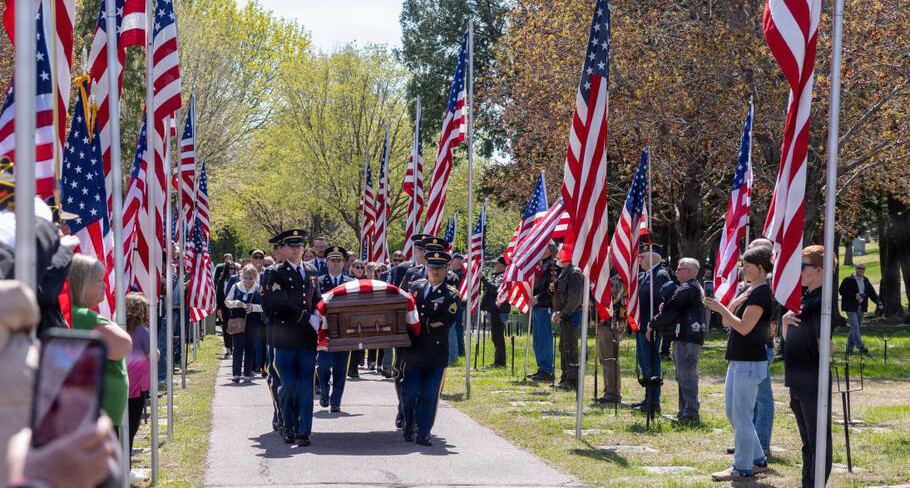
Medal of Honor recipient Willibald Bianchi was buried last week in his hometown of New Ulm, Minn., more than 80 years after the Army captain died aboard a Japanese ‘hell ship’ near the end of World War II.
Medal of Honor recipient Willibald Bianchi was buried last week in his hometown of New Ulm, Minn., more than 80 years after the Army captain died aboard a Japanese “hell ship” near the end of World War II.
Bianchi’s remains had been buried for eight decades as “unidentified” at the National Memorial Cemetery of the Pacific, in Honolulu.
“We never really thought that he would ever be recovered,” Bianchi’s niece, Sue Marti, 71, told the Minnesota Star Tribune last month.
In August 2025, Bianchi’s relatives were contacted by the Pentagon. A Defense Department forensic laboratory had found a match between remains and samples the family provided.
Capt. Bill Bianchi had been positively identified. He was going home to New Ulm.
“I just think everybody’s got shivers going up their spine to find out that he’s coming back,” Marti said.
Bianchi was buried with full military honors on May 2 at the New Ulm City Cemetery with many of his 17 living nieces and nephews attending.
He was born on March 12, 1915, in New Ulm, the only boy among five children of poultry farmers Joseph and Caroline Bianchi. Bianchi was forced to quit high school to support the family after his father died in a farming accident.
Eventually getting his high school diploma, Bianchi worked his way through South Dakota State University as a furnace mechanic and janitor, while playing football and joining ROTC.
In June 1940, during the American military buildup prior to entering World War II, Bianchi graduated and was commissioned a second lieutenant in the U.S. Army. He requested overseas duty and, in April 1941, was sent to the Philippines.
On Dec. 7, 1941, the Japanese attacked Pearl Harbor. They also bombed Clark Field in the Philippines, the precursor to an invasion of the islands soon after. U.S. forces under Gen. Douglas MacArthur fell back to the Bataan Peninsula and Corregidor Island.
Bianchi was a first lieutenant commanding Company D, 1st Battalion, 45th Infantry Regiment, Philippine Scouts on the Bataan Peninsula on Feb. 3, 1942. When another company was assigned to try to knock out two Japanese machinegun nests, Bianchi volunteered to go along.
Wounded twice in his left hand, Bianchi advanced using just his pistol while tossing grenades that wiped out one enemy stronghold. Wounded twice in the chest, Bianchi climbed aboard a tank and used its machine gun to silence the second nest. Another round of enemy fire hit Bianchi, and he fell from the turret to the ground.
For his valor in the face of heavy enemy fire, Bianchi was promoted to captain, and commanders recommended him for the Medal of Honor, the nation’s highest award for combat bravery.
A month after the firefight, Bianchi returned to duty. On April 9, 1942, U.S. forces in the Philippines surrendered to the Japanese. Bianchi was among about 75,000 other American and Filipino soldiers taken as prisoners of war.
Bianchi survived the infamous 65-mile Bataan Death March to a prisoner of war camp, a grueling journey during which Japanese soldiers shot or bayoneted stragglers.
Soldiers who survived the war said Bianchi urged men to keep moving and stay alive.
“Many servicemen wrote to Bianchi’s mother following the war, telling her that they owed their lives to her son,” according to the Minnesota Medal of Honor Memorial website.
Bianchi was moved to several camps as the U.S. turned the tide of the war in the Pacific. American troops landed in the Philippines in December 1944.
The Japanese wanted to take prisoners back to mainland Japan. Bianchi and hundreds of other American POWs were loaded onto the transport Oryoku Maru, one of the sweltering “hell ships” packed with POWs to be sent to the Japanese mainland.
The Oryoku Maru left Manila on Dec. 13, 1944, with 1,620 American and allied prisoners of war in the hold. Another 1,900 Japanese civilians and military personnel were in the passenger cabins.
The Japanese intentionally did not mark POW ships, which were regularly attacked by U.S. planes whose pilots believed they were attacking enemy troop transports or cargo ships.
The Oryoku Maru was bombed by U.S. Navy planes from the carrier USS Hornet. Just under 300 aboard died on the sinking ship, while Bianchi and other survivors were herded back ashore in the Philippines.
Bianchi was put on another unmarked POW ship, the Enoura Maru, which made it as far as Japanese-occupied Taiwan. While in Takao harbor on Jan. 9, 1945, an American plane dropped a 1,000-pound bomb on the ship. The blast killed about 300 POWs, including Bianchi. He was 29.
On June 7, 1945, Bianchi’s mother received the Medal of Honor on her son’s behalf during a ceremony at Fort Snelling in Minnesota.
After the Japanese surrender in Sept. 1945, the American Graves Registration Command began bringing the remains of American dead back to Hawaii. In 1946, 311 bodies were exhumed from a mass grave on a Taiwanese beach. The remains of prisoners from the Enouru Maru were among 430 unidentified dead who were re-buried at the National Memorial Cemetery of the Pacific.
In Minnesota, Bianchi’s friends and relatives worked to keep his memory alive. The Medal of Honor he received posthumously was displayed at the local historical society. New Ulm named a street after the Army captain.
Decades later, relatives gave DNA samples to the Defense POW/MIA Accounting Agency, which was using new technology to identify “unknown” remains from past wars. In 2023, the gravesite in Hawaii was reopened, and the remains were sent to a DPAA laboratory in Omaha, Neb.
Using DNA gathered from relatives of missing service members, they looked for matches with DNA extracted from the remains. In August 2025, Bianchi became the 21st person positively identified.
At of the end of April 2025, the Defense POW/MIA Accounting Agency reports it has identified approximately 3,780 sets of remains since the agency was created at the end of the Vietnam War in 1973. Bianchi is among 1,935 identified from World War II.
Sue Marti, Bianchi’s niece, told Minnesota Public Radio last week that the family always knew “Uncle Bill” was dead, but having his remains home to rest beside his parents’ graves was the best possible ending after such a long time.
“It’s heartbreaking when someone’s gone now 80 years,” Marti said. “Seems like, ‘oh geez, that shouldn’t matter to anybody anymore.’ But it does. It really matters to people.”
According to the DPAA, about 71,755 U.S. service members from World War II remain missing and unaccounted.
- Honor & Remembrance