

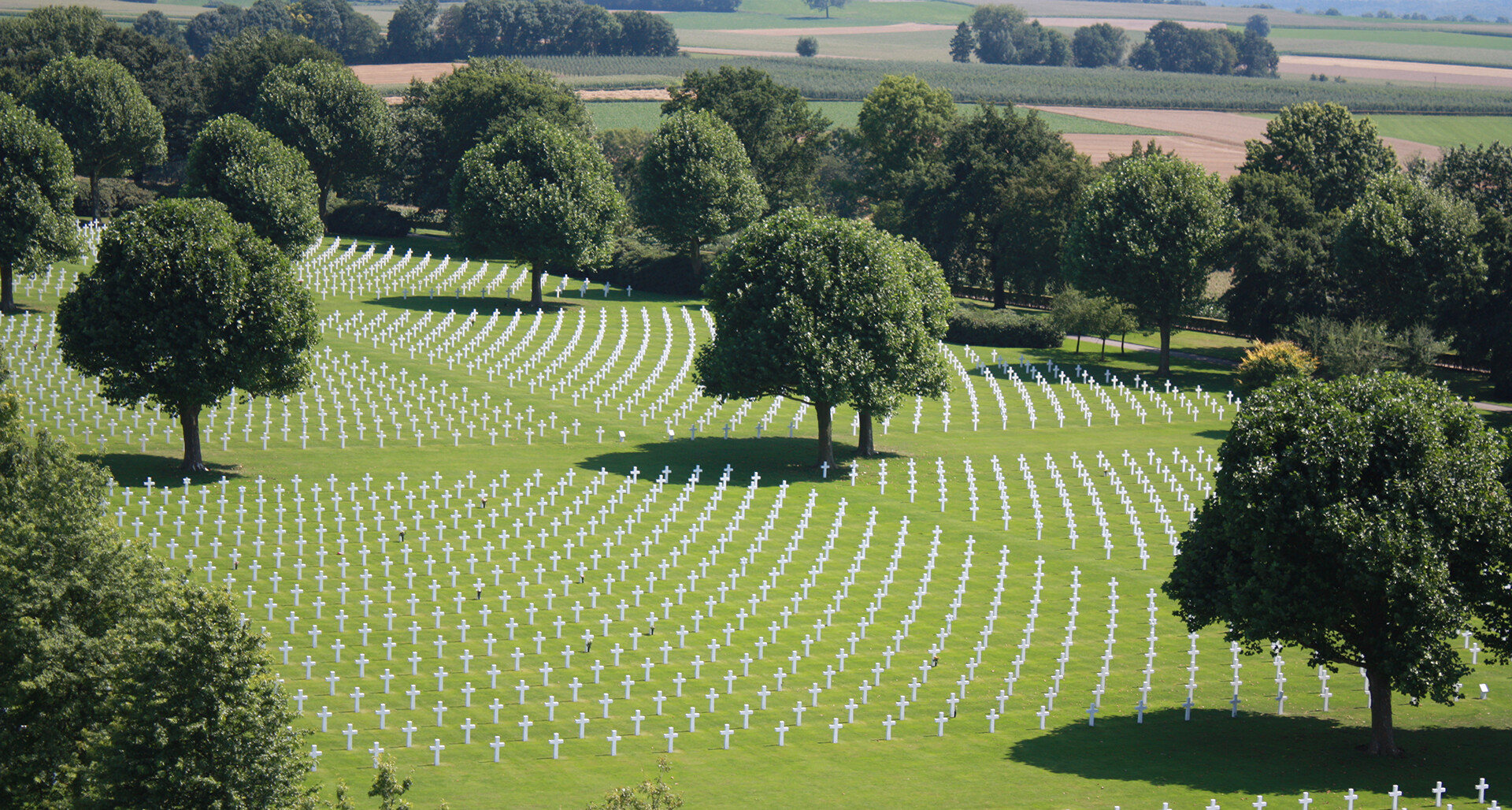
‘The Monuments Men’ author Robert Edsel’s new quest aims to connect U.S. families with Dutch grave adopters.
Robert Edsel had no inclination to write a new book, not after all that had gone into his works on the Monuments Men.
“The Monuments Men: Allied Heroes, Nazi Thieves, and the Greatest Treasure Hunt in History” was made into a critically acclaimed hit movie in 2014. It quickly became a New York Times No. 1 best-seller. “Saving Italy,” his book about the exploits of these soldier-scholars in Italy, also a Times best-seller, soon followed.
Edsel has spent decades spelunking through long-forgotten archives, poring over photos, deciphering yellowed dossiers, diaries and letters in multiple languages, immersed in a quest to learn how so many treasures of Europe had even survived World War II. He moved to Florence, Italy, after selling his business in 1995, and indulged his passion for art and architecture. A question soon came to his mind: “How did all these things survive the most destructive war in history, and who saved them?” He asked around. No one seemed to know exactly.
RELATED ARTICLE | ‘IT’S A SYMBOL OF OUR ONGOING PROMISE’ U.S. Ambassador to the Netherlands discusses diplomatic effects of Dutch grave adoptions
To find answers, he began tracking down aged survivors around the world, collecting personal accounts of all the Monuments Men did to recover priceless paintings, sculptures, religious artifacts, rare books and furniture that Nazi looters had harvested from museums, churches, libraries and private collections. Ultimately, he interviewed 18 Monuments Men and three Monuments Women to learn how they located and returned millions of stolen objects – an effort that continues today.
Moreover, the story of the Monuments, Fine Arts and Archives (MFAA) multinational military section (about 350 personnel) that had languished in obscurity was suddenly vaulted to overdue public appreciation. Best-selling books and hit movies have a way of doing that. One prestigious recognition came in 2015 when the Monuments Men and Women collectively received the Congressional Gold Medal. Then-Speaker of the House John Boehner asked Edsel to invite as many Monuments Men and Women and their families as possible to Washington, D.C., for the ceremony.
“We reached out to the 200 or so family members that we knew, and they came from 12 or 13 different countries,” Edsel explains. “Jim Huchthausen, nephew of Walter Huchthausen, one of two Monuments Men killed in action, responded right away. ‘Of course, I will be there.’ He then added, ‘By the way, I just returned from London where I had a wonderful visit with Frieda. I’ve attached a photograph of us.’”
Edsel looked at the photo and paused. “Frieda, Frieda, Frieda … I don’t know any Friedas. It bedeviled me for about a day. The only Frieda I ever knew was that 19-year-old girl in the Netherlands … and then I thought, damn, she must still be alive.” He had mentioned her briefly in the final chapter of “The Monuments Men.”
“So, I said to my wife, ‘I want to go to England and meet her.’
“She asked, ‘Do you have some ambitions?’
“‘Ambitions? Like what?’
“‘Well, writing another book?’
“I laughed. ‘Are you kidding?’”
Edsel sat down at the modest breakfast room table of Frieda Gumn (formerly Frieda van Schaïk of Maastricht, the Netherlands) in her home south of London on Memorial Day 2016. “She had photo albums stacked on the table and asked, ‘Would you like to see my photos?’”
“‘Yes, absolutely. I love looking at photographs.’”
Edsel’s first book, “Rescuing Da Vinci,” (2006) was a self-published photographic assemblage of more than 300 pages chronicling Nazi leader Adolf Hitler’s obsession with building the Führermuseum and the Third Reich’s industrial-scale operation to steal art, books, religious objects and historic treasures that followed. Interspersed among the paintings and sculptures that Hitler coveted are pictures of Nazi leaders enriching their personal collections, and German soldiers plundering art they later hid in more than 2,000 salt mines, caves and castles.
His book also documents frantic efforts of European museum officials to protect and hide universally beloved works, including Michelangelo’s sculpture David and Leonardo Da Vinci’s “Mona Lisa.” Images of the Monuments Men finding, inventorying and returning stolen art round out the pages of “Rescuing Da Vinci.”
Edsel was not exaggerating to Frieda. He loves looking at photographs.
––– STORY CONTINUES BELOW –––
The albums transported 91-year-old Frieda back to her teen years living near Maastricht during one of the darkest times in the Netherlands, a nation occupied by Nazi Germany for nearly five years. One photograph was special. It captured the first U.S. tank that passed directly in front of her as she stood on the porch of their home when the southern swath of the country was liberated Sept. 13-14, 1944. The north would remain German-occupied until the end of the war in Europe, in May 1945.
Following liberation, Ninth Army headquarters sprang to life within driving distance of the Battle of Aachen, Operation Market Garden, the Battle of Hürtgen Forest and the Battle of the Bulge. Citizens in the Maastricht area were greatly relieved to have their freedom restored, yet malnourished, cold and destitute after years of oppression. They welcomed the Americans as best they could, and the Americans provided for families there, too, as best they could, sharing rations and forming bonds.
A love grew between them. America had delivered their freedom, if not their very survival.
Dead Americans began arriving by the truckload, their uniforms blood-stained from battle. They were buried at a military cemetery dug by hand and pick axe in near-constant rain and snow. One of the 17,800 soldiers ultimately buried there would be Capt. Walter Huchthausen, the Monuments Man gunned down by German soldiers just four weeks before the war’s end in the European Theater. He had been especially close with Frieda and her family.
“As a Civil Affairs officer and the only Monuments Man assigned to Ninth Army, Huchthausen would often stop and visit with Frieda’s family when passing through Maastricht, and they would have him over for dinner,” Edsel says. “They were devastated to learn that he had been killed.”
Heartbroken, Frieda devotedly visited his grave and decorated it with flowers. She was only 19 in October 1945 when she wrote a letter to Harvard, Huchthausen’s alma mater.
After we first met him, several times he visited our home and so he became a very good friend of ours … I’d be very pleased if I could come in touch with his family. He is buried at the large U.S. military cemetery at Margraten, Holland (a place 6 miles from where I live) and I have been taking care of his grave … If you know the address of Walter Huchthausen’s mother, I’ll be much obliged to you if you’d let me know.
Harvard’s response just two weeks later set in motion a lifelong friendship between Frieda and the Huchthausen family.
––– STORY CONTINUES BELOW –––
The U.S. government, wary of exploitation (no evidence of any occurred) and the privacy of U.S. families (who had no idea the Dutch were mourning their loved ones), refused to provide next-of-kin information.
More than 40,000 Dutch citizens attended the first post-war Memorial Day ceremony in May 1945, an event a reporter with the New York Times characterized as “without precedent.” By the second post-war Memorial Day, every grave in the cemetery had a Dutch adopter, which is still the case today. The memory of each fallen liberator is passed from one generation to the next, a sacred inheritance. Photos of families’ soldiers are displayed on living room walls. They continue to honor them, still hoping to find their American families.
Frieda asked Edsel at the breakfast table, “Have you been to the American Military Cemetery?’” He had, several times. “So, you know about the grave-adoption program.”
“The what?” he asked.
Edsel, a former oil and gas exploration entrepreneur whose company had pioneered the use of horizontal drilling, son of a World War II combat veteran, suddenly had a new quest.
“The Monuments Men and Women story – the importance of preserving our shared cultural heritage – is hugely important. But I believe ‘Remember Us’ is even more important because without our freedom, what do we have? And then there is this transcendent element that is universal to all human beings … a shared desire to be remembered somehow, some way, by somebody.”
“Remember Us: American Sacrifice, Dutch Freedom, and a Forever Promise Forged in World War II” was published in 2025 by Harper-Horizon. Eight years in the making, it has 53 pages of bibliography and primary source attributions.
And, as with “The Monuments Men,” it is not simply a story about World War II.
––– STORY CONTINUES BELOW –––
Edsel met with eight-time Academy Award-nominated producer Kathleen Kennedy after “Rescuing Da Vinci” was published, as he was planning what would become “The Monuments Men” book. A co-producer on Steven Spielberg’s “Saving Private Ryan,” her film credits include the “Star Wars” franchise, three of the Indiana Jones movies, “Schindler’s List” and other blockbusters.
“What’s your story about?” she asked.
“It’s a story about World War II that involves …”
“She asked a second time: ‘What’s your story about?’
“As I was saying, it’s a story about World War II that …’
“After interrupting me a third time, I smiled and said, ‘If you’d stop interrupting me, I’ll answer your question!’
“She said, ‘Well, my point is, your book can’t be about World War II. What do you think ‘Saving Private Ryan’ is about?’
“And I said, ‘It’s a story about World War II
that …’”
“No, it’s not. ‘Saving Private Ryan’ is a very simple story. Four brothers. Three dead. One missing. Go find him. You can’t write a story about World War II. It’s too big. What’s your story about?’”
“After a few moments, I said, ‘You know what? I don’t know.
I know what it involves, but I don’t know the answer to your question. Not yet.’”
Kennedy’s question has been tumbling through Edsel’s mind ever since.
So, what is “Remember Us” about?
“Remember Us” recounts German occupation in Limburg province and the resolve the Dutch demonstrated, their world transformed from peaceful to oppressive, comfort to survival. The Germans stole their freedom much as they had the great works of art and treasures of Europe. The book is written through the harrowing experiences of 13 real figures in history, including 11 U.S. soldiers and airmen from various walks of life; Emilie Michiels van Kessenich, a mother of 11 children and wife of Maastricht’s wartime mayor; and Frieda, who was 15 when the Germans invaded her homeland. It traces the various roots of the servicemembers – from West Point graduate Robert Cole to sharecropper’s son Jefferson Wiggins – to show the diverse pathways Americans took to reach the Netherlands and play a role in restoring Dutch freedom.
American Legion Margraten Post NL01 was renamed in honor of the American Battle Monuments Commission cemetery there in 2017, having originally been chartered as Rotterdam Post NL01 in 2002. Members (nearly 200) have played an active support role for the cemetery through “Faces of Margraten,” which by early 2025 had assembled and displayed photos of nearly 9,000 images of Americans buried or memorialized there and through support of the grave-adoption program. The Faces of Margraten effort was featured in the May 2021 American Legion Magazine.
The Americans whose stories are told had to have a connection to the Netherlands American Cemetery in Margraten. For nine of them, the connection is permanent. They are buried there. Others, like Staff Sgt. Wiggins, who lied about his age at 16 to escape poverty and racism in Alabama by enlisting, served in the Army’s Quartermaster Corps. He survived his grim wartime duty handling corpses and digging graves. He returned for the 65th anniversary of the Netherlands cemetery’s founding in 2009, having been an educator in his postwar life.
By 1946, some 17,800 Americans were buried in Margraten. About 10,000 remain there. None of those who remain, however, is alone.
It is a story about the dead and the living alike. It is the story of the Dutch, who adopted the 8,300 graves and all 1,722 names inscribed on the Walls of the Missing. It is about their relentless pursuit to find next of kin, regardless how many generations have passed, to let them know that someone still cares for their fallen loved ones. Only about 25% of the Dutch grave adopters have made those U.S. family connections.
What’s your story about?
“This is not a book about World War II,” Edsel says. “That’s the backdrop. This is a story about remembrance, gratitude and grace set against the backdrop of the most destructive and deadly war in history.
“The things that are most valuable in life cannot be bought. They have no price tag. Friendship. Health. Freedom. When it comes to freedom, the lesson of history is this: by the time you realize it is gone, it may be too late to get it back. The Dutch had 100 years of freedom, a freedom they assumed by declaring neutrality they would always have. When they lost it, they did not like it. And they weren’t prepared for it. No black market. No resistance network. Nothing. They were starting from scratch, left to hope that someday they would be free again. Their freedom was restored, but at great cost.”
An essential character in “Remember Us” is Emilie Michiels van Kessenich. In a chapter titled “An Egg,” the severe depravation of occupation is revealed, as is the resolve of the mayor’s wife and her family. They were living on carefully divided pieces of bread, stamppot soup of cabbage and potatoes, maybe a small piece of meat in the bottom of a pot. On one occasion, the pregnant mother went to collect her family’s ration of eggs. There was only one. Her husband said she should eat it. She insisted on dividing it among the children.
“The loss of eggs,” Edsel writes in the chapter. “Would anyone understand, in the years to come, how much the loss of something so simple as an egg had terrified her?”
What’s your story about?
In August 1945, just a few months into the grave-adoption program, Emilie made it her mission to find U.S. families of the fallen and connect with them. She had written a personal letter to President Harry Truman that summed up in a sentence all the Dutch hoped to accomplish:
––– STORY CONTINUES BELOW –––
“ … And now that most of the Army has gone back to the States, and only your fallen heroes remain in our soil, we want to establish a lasting tie between their relatives and our people.”
She closed her letter with an oft-repeated plea: “I am a mother of 11 children ranging from 14 years to 3 months, and if it should happen that my boys were buried in American soil, I would be so grateful if an American mother would send me a photograph and go there sometimes in my place.” Her request for contact information was denied.
Months later, Emilie boarded the first airplane of her life, bound for the United States. Only the beginning of her plan was clear, landing in New York City and then making her way to Washington, D.C., where she met with elected officials, including a young congressman from Texas, Lyndon B. Johnson, an American Legion member and later the 36th U.S. president. He suggested she go to Texas, where an early stop was the American Legion post at Mineral Wells. Emilie later met with Legionnaires at Bronson-Hawley Post 134 in Bridgeport, Conn.
For five weeks, she traveled through Texas, across the southern states to Atlanta, then up the eastern seaboard to Connecticut, staying with families who had lost a son or a daughter, gathering names and addresses. “Emilie was someone to talk to,” Edsel says. “And there wasn’t anybody else. Emilie was the beating heart of compassion, of saying, ‘We understand you are grieving. We know about your loss. We care.’
“To each person, each gathering, her message was the same: ‘Leave your boys with us; we will watch over your loved one, like our own, forever.’”
The operative word here is “forever.”
Edsel spoke at the 106th American Legion National Convention in Tampa, Fla., last August to tell the story of “Remember Us” and ask attendees to visit the Forever Promise Project website to get connected with the Dutch grave adopters of their loved ones. “Americans should know these … countless citizens of Limburg province who went to extraordinary lengths to honor fallen Americans,” he told the crowd. “Throughout my research, I wanted to know what motivated the Dutch to honor foreigners in such a moving, lasting way. As the answers emerged, a second question came to mind: Why isn’t there a grave-adoption program of fallen Americans, by Americans, in our country?”
A massive ovation followed.
Robert Edsel had seen it before, the way discussions of long-ago topics with older people can revive their spirits. While researching “The Monuments Men,” he sought out S. Lane Faison Jr., one of the last surviving Americans who rescued art and protected historic monuments during World War II and one of 21 Edsel interviewed in person for his books.
“He changed my life,” Edsel says. “He was a legendary professor of art at Williams College. He was the sixth Monuments Officer I had found.
I called one of his four sons who said, ‘You’re wasting your time. He’s 98 years old.’
“I asked, ‘Is he infirmed? Is he ambulatory?’
“They said, ‘Well, he can walk. But he basically sits and sleeps all day, and he doesn’t remember much. I think you’re wasting your time.’
“I pleaded, ‘It would be an honor of mine to even just sit with him.’”
He had thoroughly researched Lt. Cmdr. Faison and his place in the Monuments Men story as part of the OSS Art Looting Investigation Unit that interrogated war criminals in advance of the Nuremberg trials. Still, Edsel says he was nervous about the conversation. Soon into it, Faison flipped the script. “I quickly realized that he was interrogating me, asking, ‘Why are you interested in what I did all those years ago?’”
Edsel had one copy of “Rescuing Da Vinci” with him. He opened it to page 145. Faison appears there, young and bespectacled, surrounded by papers and clipboards. “He took the book out of my hands and started flipping through it. He came across soldiers that I had labeled ‘unidentified American soldier.’”
Faison began to identify them, by name and rank, as if he had seen them the day before. “I got my pen out when he started telling me stories. We sat there for four hours. I saw the twinkle in his eye when he looked at these photographs, images of events he had lived many years earlier. All the neurons were firing. We were exhausted by the emotional experience of it all. When I got ready to leave and leaned over to say goodbye, he took my hand, pulled me all the way up to his face and said, ‘I’ve been waiting to meet you all my life.’
Faison died 10 days later, on Veterans Day.
“I knew then what he wanted me to do. He wanted me to tell their story.”
What’s your story about?
In 2018, when Edsel visited the Netherlands American Cemetery with 93-year-old Frieda, he had a similar moment. They walked to a far corner of the cemetery, where Walter Huchthausen is buried. “You could see this flood of memories overwhelm her. It was as if she had pressed fast-forward from her life as a teenager to a 93-year-old woman. In her mind’s eye, she was seeing a muddy field with clumps of dirt and the sound of shovels hitting the ground because men were still being buried. But today, visitors walk the grounds of this perfectly manicured, magnificent setting, entirely different than what Frieda experienced when she was riding to the cemetery on her bicycle.
The Forever Promise Project is a collaboration between the Monuments Men and Women Foundation, which continues to collect and repatriate art and objects stolen by the Nazis during World War II, and the Foundation for Adopting Graves American Cemetery Margraten, which connects American families with the Dutch citizens who have tended the graves of U.S. soldiers buried in the Netherlands American Cemetery since 1945. The Forever Promise has an online registry including the names of all who are buried or memorialized there and a brief, secure questionnaire that allows families to make connections with their ancestors’ grave adopters.
“There was one very sweet moment with her that I’ll never forget. Frieda was tired from our long walk to Walter’s grave. Just as we sat down, all these Dutch Scouts – boys and girls – from 9 to 16 – congregated right there, getting ready to start a tour. There must have been 20 or so. I thought, ‘You know what, I am going to make an introduction so they can meet this amazing woman.’ They were kind of intimidated because they didn’t know who this old woman was sitting on the bench. But you could see them start scooting a little bit closer, then leaning in to hear her every word. It reminded me of the story of Jesus speaking to the little children, all gathered round to hear her stories. I just stood back and watched. It was so beautiful.”
What’s your story about?
“None of us is getting out of this alive. How do you want to be remembered? What do you want to do with your life? The Dutch remain committed to honoring the sacrifice of each one of their American liberators, men and women who gave up their freedom to ensure that others could enjoy theirs. That’s a powerful and inspiring message. It’s a story we need to know. It’s a story you will want to know.”
Jeff Stoffer is editor of The American Legion Magazine.
This article appeared in the May 2026 issue of The American Legion Magazine and is offered here with additional content free of charge. To receive The American Legion Magazine on a monthly basis in print or digital format, click here to join.
- Honor & Remembrance
- Magazine