

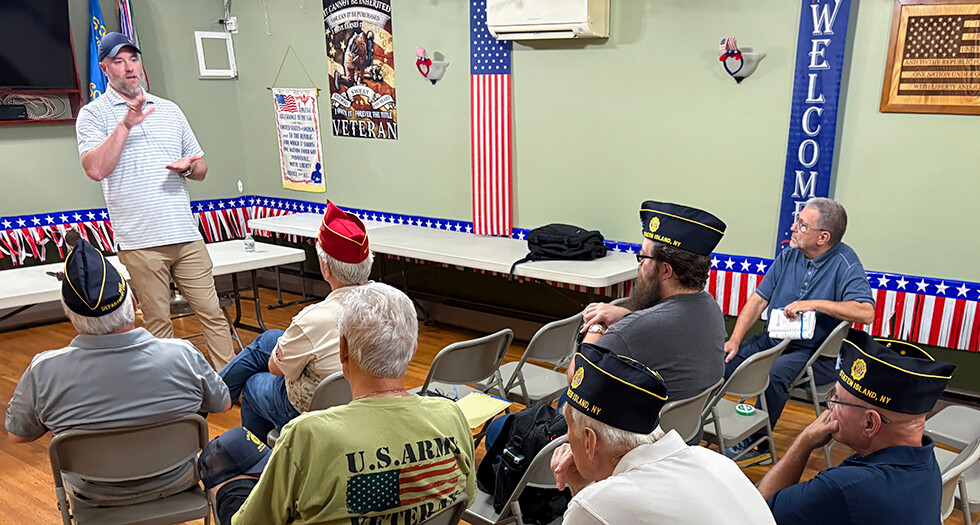
American Legion legislative experts visit Legion posts, explaining benefits of the massive expansion of veterans benefits, offering insight and answering questions.
Veterans seeking understanding about what the Take Care of America’s Veterans Act (TCAVA) does, what the legislative package does not do and what it means for the future gathered at eight American Legion town halls in eastern Pennsylvania and New York City this past week.
American Legion Legislative Director Cole Lyle and Deputy Director Bailey Bishop presented the organization’s position, provided an overview of the 550 pages of legislation and answered questions from veterans.
“Compromise is inevitable when you're dealing with Congress,” Lyle said, then addressed the disagreement among veteran service organizations. “We’re a big family, sometimes families disagree. We took a look at this legislation. We saw this legislative package as the best opportunity to pass the largest net package of veterans benefits in years.”
Among the key parts of the legislation: the Major Richard Star Act, Love Lives On Act and 60 additional bills. (Learn more on the TCAVA resources page.)
Congress is in recess right now. The House is expected to take up TCAVA again in early September. Lyle stressed the critical importance of using the Legion’s Grassroots Action Center to urge your members of Congress to approve TCAVA. So far, 65,000 messages have been sent but more is needed.
“When we’re up on Capitol Hill, we tell them we have this many voter voices, and they need that … so that they know what their constituents want,” Lyle explained.
During two-hour town halls at American Legion Post 1365 in Staten Island and Post 156 in City Island, Lyle addressed topics that were common throughout the various question-and-answer sessions. Among the most common topics that arose were:
· ‘A Compromised’ Major Richard Star Act: The American Legion has routinely advocated for passage of the Major Richard Star Act for five years, but it has not progressed in Congress. It has also been put in the NDAA but has been pulled in conference due to funding objections. “This (TCAVA) is the best chance to pass Richard Star, and it doesn’t mean we can’t come back to advocate for an increase in the future. But not taking this opportunity means veterans who would qualify see nothing for years,” Lyle said.
· The claim of taking from future veterans: Some of those opposed to TCAVA claim this legislation is robbing from future veterans due to the way that VA plans to roll out regulatory changes on ratings for tinnitus and sleep apnea. First, Lyle explained, the administration plans to proceed with the change whether or not TCAVA passes. Secondly, this talking point is not reflected in reality, even now. “When a veteran pays a VA home loan funding fee, that's one group of veterans paying for another group of veterans. When a veteran with a non-service connected disability uses the VA and pays a copay, that's one group of veterans paying for another group of veterans.”
· Using DoD funding: Some people have suggested using DoD funds to pay for Richard Starr. However, that would mean going through other congressional committees of jurisdiction: House and Senate Armed Services. “To get any sort of offset from another area of the government, we would have to get buy-in to have those funds redirected to VA from those committees’ pots of money,” Lyle explained, “so it becomes that much harder and I would say impossible in some cases given that those committees have routinely objected to doing so.”
· Increasing DIC benefit: Disability Indemnity Compensation (DIC) is a benefit that a survivor can collect after their servicemember passes away. To give an example, Lyle cited a 100% disabled veteran with a dependent, which means compensation of roughly $4,200. “The family gets used to that standard of living. They get used to that income. When the servicemember dies, they don't get that money anymore.” The compensation for DIC is only about $1,600. This bill would provide for a 3% increase “that would be a meaningful improvement for survivors.”
At stake for TCAVA is dozens of veterans friendly bills that would benefit millions of veterans, their caregivers and survivors. Time is of the essence.
“If the bill doesn’t pass in September,” Lyle said, “we’re back at square one.”
- Legislative