

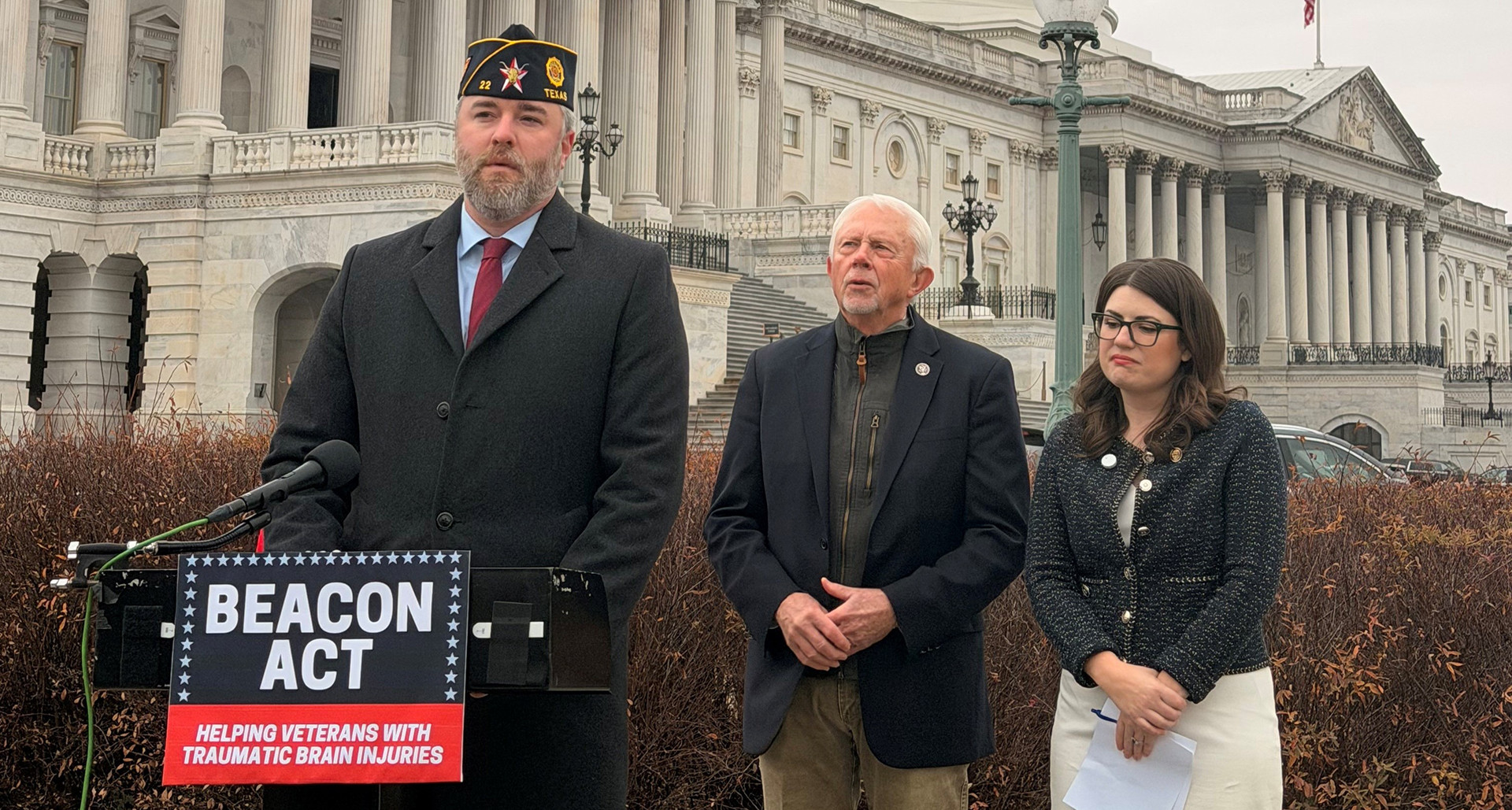
The BEACON Act would expand access to innovative, evidence-based non-pharmacological therapies supporting long-term recovery.
American Legion Veterans Affairs & Rehabilitation Director Cole Lyle was among a group representing veteran service organizations who spoke in support of pending legislation designed to strengthen care for veterans living with traumatic brain injuries (TBI).
On Jan. 9, Reps. Jack Bergman and Sarah Elfreth introduced the bipartisan BEACON Act, which seeks to modernize the U.S. Department of Veterans Affairs’ (VA) approach to TBI treatment by expanding access to innovative, evidence-based, non-pharmacological therapies that support long-term recovery and quality of life. Lyle was among those who spoke at a press conference introducing the legislation that day.
“Since the year 2000, hundreds of thousands of veterans have suffered traumatic brain injuries, many from blasts they never saw coming that changed their lives in an instant,” Lyle said. “These wounds don’t always show on the outside, but they show up around kitchen tables, in broken sleep, in strained marriages, and in moments when a veteran wonders if anyone truly understands what they’re carrying.”
Lyle said previous TBI treatment programs have fallen short for veterans. “Too often, we have asked them to navigate a system that treats symptoms instead of people,” he said. “A system that relies on pills instead of purpose. A system that, despite good intentions, has left too many veterans feeling unseen, unheard, and alone. The American Legion refuses to accept that as the best our nation can do.
“We believe veterans deserve care that reflects the complexity of their comorbid injuries, where healing does not happen with a one-size-fits-all bottle. Care that brings innovation, research, community partnerships and, above all, hope.”
The BEACON Act establishes two complementary grant programs within VA to accelerate the development, evaluation, and adoption of innovative, non-pharmacological treatments for mild to moderate traumatic brain injury:
· The TBI Innovation Grant Program supports clinical studies, clinician training, veteran and family outreach, and partnerships between community providers, academic institutions and the VA.
· An Independent Research Grant Program further advances third-party research and the implementation of proven alternative treatments, with oversight by an independent entity modeled after the VA’s National Center for PTSD to ensure scientific rigor and accountability.
“This bill represents a concerted effort by lawmakers and advocates to listen to the needs of veterans and act on their learned experience. The bill represents progress,” Lyle said. “But at its heart, the BEACON Act is about people. It’s about the Marine who survived a blast but can’t quiet their mind. The soldier who came home but can’t shake migraines or memory loss. It’s about the families praying for answers – and for tomorrow. When we invest in solutions that save lives, strengthen families, and remind veterans their country is still fighting for them, everyone wins.
“The American Legion is proud to stand up for innovation, accountability, and above all – our veterans. And we’re proud to stand here with this group of lawmakers and fellow advocates for passage of the BEACON Act. Because when America sends its sons and daughter to war, it must be just as committed to making them whole when they come home.”
Specifics for the TBI Innovation Grant Program:
· Supports the development, testing and evaluation of new treatments for mild-to-moderate TBI.
· Eligible applicants include nonprofits, academic institutions, non-VA health-care providers, and other qualified entities.
· Funds may be used for clinical studies on recovery and suicide prevention, clinician training, veteran and family outreach, and partnerships between community, VA, and academic institutions.
· Awards of up to $5 million annually are authorized, with total funding of $30 million for fiscal 2026-2028.
Specifics for the Independent Research Grant Program:
· Supports third-party research and implementation of proven alternative TBI treatments.
· Eligible applicants include academic and nonprofit institutions, health-care research and development entities, and treatment providers.
· Research is to be overseen by an independent entity modeled on VA’s National Center for PTSD.
· Up to four pilot-study grants at $625,000 each and five collaborative research grants at $1,500,000 each annually are authorized, with total funding of $30 million for fiscal 2026-2028.
“The men and women who served our country deserve access to the best care available, especially when it comes to invisible injuries like traumatic brain injury,” Bergman said. “The BEACON Act strengthens the VA’s ability to deliver modern, effective care by bringing proven innovation, academic expertise, and community partnerships to the table, while supporting the important work the VA is already doing.”
“As the granddaughter of a veteran who suffered from PTSD, I’ve seen firsthand the complex mental health challenges that our veterans and their families face,” Elfreth added. “I’ve also seen how traditional VA treatments have come up short for decades to fully address the complex challenges our veterans face – and unfortunately, my family's story is far from unique.
“I’m proud to work with Congressman Bergman on the bipartisan BEACON Act to expand veterans’ access to nontraditional, evidence-based therapies, as well as integrate civilian and academic research and expertise into VA treatment. For the hundreds of military families I have the honor of representing, this expansion of care will make a real difference.”
- Legislative