

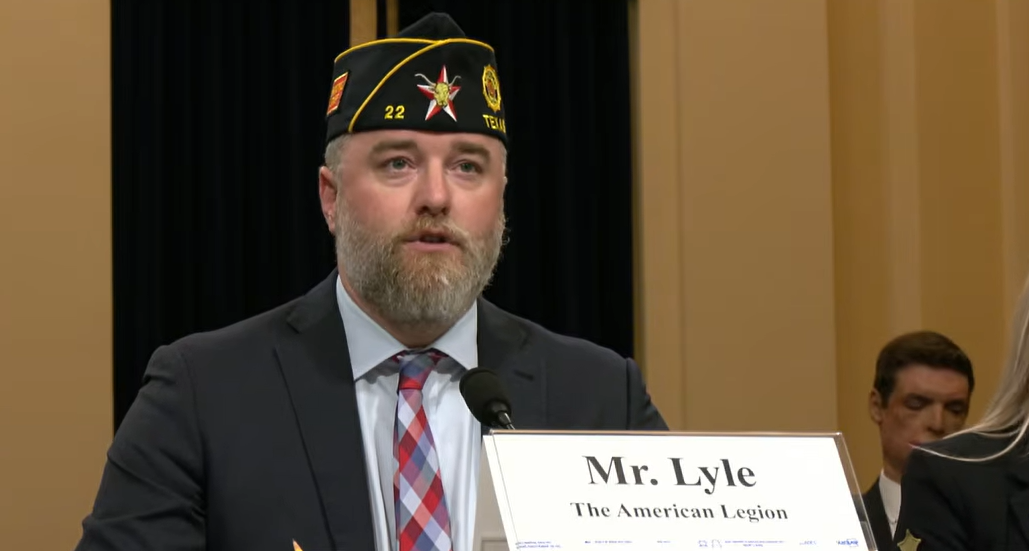
Legislative Director Cole Lyle praises federal agencies’ efforts but offers suggestions for improvements during congressional hearing.
While praising the efforts of the agencies tasked with caring for the cemeteries that are the final resting place for many of those who have worn the nation’s uniform, an American Legion representative also pointed out to Congress that those efforts could be improved.
Speaking before the House Committee on Veterans’ Affairs’ Subcommittee on Disability Assistance and Memorial Affairs Oversight Hearing on June 30, American Legion Legislative Director Cole Lyle shared areas of concern that The American Legion has regarding U.S. national cemeteries. (Read Lyle’s written testimony here)
“The American Legion has long been a champion of keeping our national cemeteries, monuments and memorials the foremost global example of how a country should honor servicemembers after death,” Lyle said during his oral remarks. “And we believe that all organizations and units within the National Cemetery Administration (NCA), the American Battle Monuments Commission (ABMC), and the Department of the Army are, by most measures, doing excellent work. NCA earned a satisfaction score in 2025 which was the highest ever recorded. ABMC meticulously maintains cemeteries and memorials across 17 countries, and Arlington (National Cemetery) continues to set the standard for dignified military honors.
“But that does not mean there is no room for improvement. Our resolutions call for expanding cemetery capacity where needed, bolstering outreach efforts, and deepening volunteer involvement so every veteran has the choice to exercise their right for burial and honors at the location they choose, in a manner befitting the honor they deserve.”
Lyle noted that the greatest challenges the families of veterans approaching the end of life occur during what he called three transitions: before death, during end-of-life care and long after burial.
“Families navigating serious illnesses are often focused on medical appointments, caregiving, and difficult conversations about prognosis. Questions about burial eligibility, military honors, survivor benefits and memorial preferences frequently receive less attention until it is too late,” he said. “VA has a valuable pamphlet, ‘Planning Your Legacy: VA Survivors and Burial Benefits,’ but anecdotally, Legionnaires report it is rarely offered in (VA medical centers). Even when it is, it does not fully address the practical steps families need before a crisis moment to establish a true continuum of planning.
“When death occurs, survivors are suddenly coordinating with funeral directors, cemeteries, military honors teams, and multiple VA offices – often without clear guidance on benefits or documentation. After the funeral, the burden shifts again to Dependency and Indemnity Compensation, CHAMPVA, Survivors Pension, probate and grief support. Too many families experience this as a series of disconnected handoffs rather than one coordinated journey.”
Lyle said The American Legion is urging the U.S. Department of Veterans Affairs to expand and integrate advance memorialization planning into routine VA interactions, including:
· A broader use of pre-need eligibility tools and better distribution of resources in VAMCs;
· Strengthening coordination between VHA, VBA, and NCA so veterans and families receive seamless support during the critical transition from end-of-life care to memorialization;
· Continue building strong partnerships with veterans service organizations, funeral directors, state and tribal cemeteries, and volunteers who often serve as the first line of help for grieving families.
“We urge this subcommittee to ensure survivors receive consistent, comprehensive assistance after burial, including full implementation and expanded future capability of the Survivor Assistance and Memorial Support (SAMS) program,” Lyle said. “The men and women in Arlington and in cemeteries the world over gave their time on Earth, and the time they’ll never spend with those they left behind, in the hope that we would, as the Constitution says, form a more perfect union.
“We honor their sacrifices by ensuring that trust in our institutions remain strong, and nowhere in the federal government is that trust more important to keep than with the families of those we’ve lost.”
Watch the complete hearing; Lyle’s testimony begins at the 1:21:00 mark.
- Legislative