

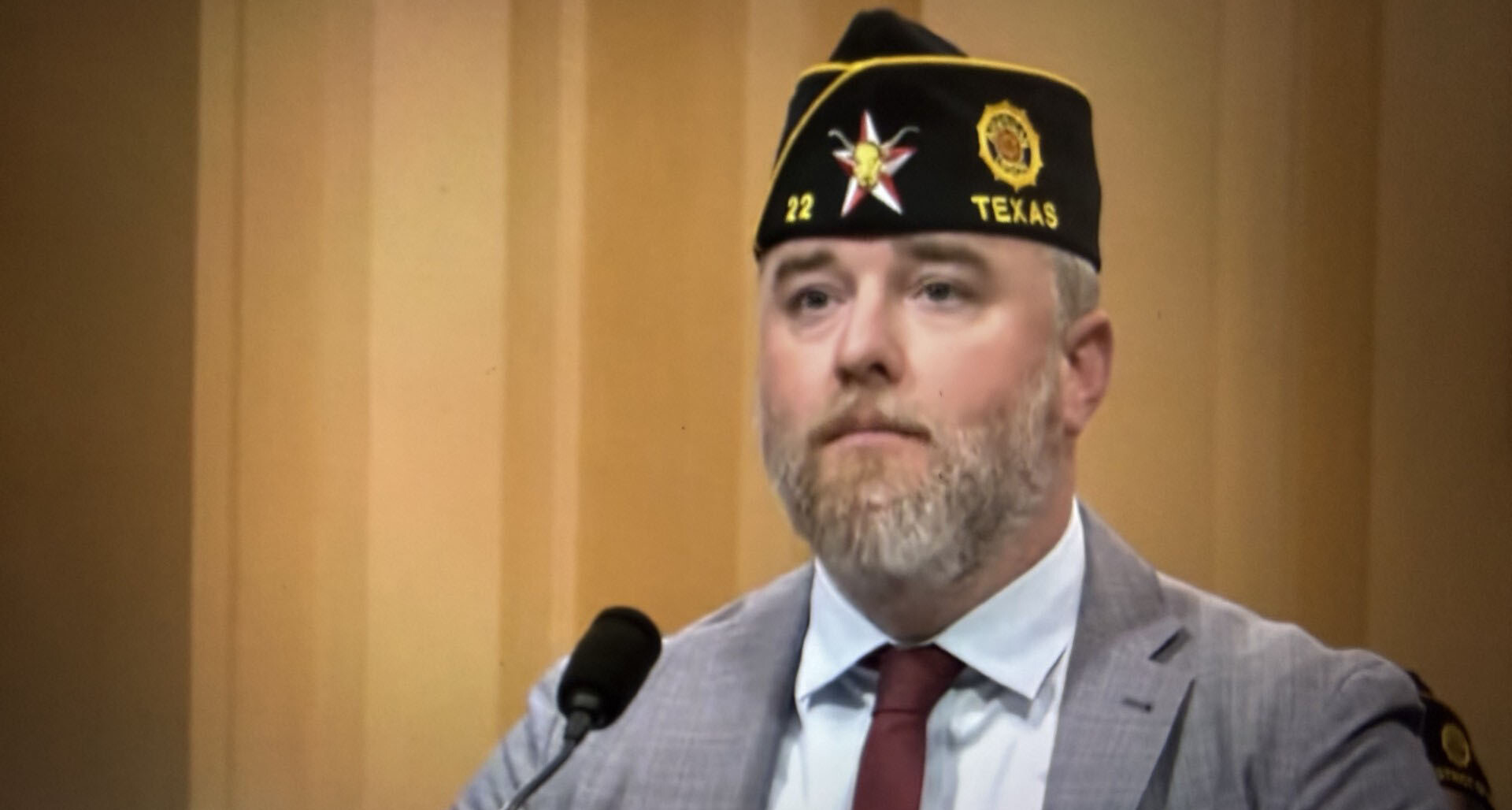
Legislative Director Cole Lyle testified on the creation of a new national cemetery in Hawaii and claims submitted during a natural disaster.
American Legion Legislative Division Director Cole Lyle testified June 25 before the House Committee on Veterans’ Affairs Subcommittee on Disability Assistance and Memorial Affairs regarding pending legislation that the Legion supports. In his testimony, Lyle answered questions from committee members regarding access to burial benefits and national cemetery burial, and the possibility of VA lowering disability ratings during a natural disaster claim.
“The legislation before us today reflects core commitments, protecting the integrity of earned disability compensation against inflation, ensuring efficient claims process for those in need, and honoring every veteran with dignity and life and death,” Cole stated in his opening remarks before committee members.
Download Lyle’s written testimony here.
American Legion supports H.R. 6588, Priority Response for Veterans Impacted by Disasters and Emergencies (PROVIDE) Act, which directs the Secretary of Veterans Affairs to expedite the processing of claims for disability compensation by veterans affected by major disasters. Legion supports the bill with amendments.
“At the post level, we have seen firsthand how disasters devastate veterans, especially when they must relocate or lose critical documents,” Cole said during his testimony. “Giving priority processing to affected claims is meaningful improvement. However, the eligibility language should be broad enough to avoid unintentionally excluding other groups of veterans. We also urge consideration of how VA or third-party contractors can conduct disability examinations in or near disaster zones. Finally, we remain concerned that expediting a claim could compound harm if the outcome reduces a veteran's rating.”
Ranking Member Morgan McGarvey, D-Ky., asked Lyle to explain the statement of how harm to veterans is compounded if the VA ends up ruling against the veteran and lowering their VA disability rating following a natural disaster.
“If a veteran (involved in a natural disaster) who is already rated has another claim that they submit to the VA, and a separate claim that is already awarded is revisited and potentially lowered as a result of the context of the situation that they're in, I think that's what we were alluding to in that particular statement,” Lyle responded.
McGarvey continued by asking how the VA can lower disability ratings and what that looks like for a veteran.
“Well, if a veteran has an existing rating for a knee injury or a back injury so there's always the potential when somebody submits a claim for an increase in a particular rating, or for a claim in another rating when a veteran goes through the CMP examination process and the DBQ (disability benefits questionnaire) is completed and reconsidered, the VA can use that based on the new examination,” Lyle said. “In some cases, it's not overly prevalent. But in some cases, they can use the new examinations to reduce an existing claim.”
The National Memorial Cemetery of the Pacific, known as Punchbowl Cemetery in Hawaii, is the burial site for 53,000 veterans, and their families, who served from World War I through Vietnam. The cemetery stopped in-ground casket burials in 1991, and its cremation operations will close by 2036 due to space. H.R. 6921, Hawai’i National Cemetery Act, requires the Secretary of Veterans Affairs to conduct a site-selection study for an additional national cemetery in the State of Hawai’i. The next closest national cemetery to Hawaii is in California, which poses a distance concern for the 115,000 veterans living in Hawaii. The American Legion supports this bill, as Lyle wrote in his written statement, “The American Legion believes that the final wishes of a veteran should be the top priority and highly support the creation of an additional cemetery to meet the needs of the Hawaiian veteran population.”
Rep. Amata Coleman Radewagen asked Lyle how important it is that veteran burial benefits are not just technically available but actually usable, and what should VA consider when applying national cemetery access standards to unique communities like Hawaii?
“I think it's extremely important in honoring the legacy and the family member of the servicemember, to your point, not just ensuring that the technical access to these benefits exists, but that they're easy to use and easy to understand instead of a kind of a disparate group of benefits through VBA or VHA or VCA that they have to navigate in one of the most difficult time periods of their lives after they lose their servicemember,” Lyle said. “I think obviously in the unique case of Hawaii, they have access to the state veterans cemeteries outside of Punchbowl, but if a family wants their servicemember to be buried at a national cemetery, they should have that access and that right in instances where it should be meaningfully easy to travel to that location to honor their servicemember that they lost.”
Other legislation The American Legion supports.
H.R. 8552, Veterans’ Compensation Cost-of-Living Adjustment Act of 2026 increases, effective as of December 1, 2026, the rates of compensation for veterans with service-connected disabilities and the rates of dependency and indemnity compensation for the survivors of certain disabled veterans, and for other purposes. “Protecting earned compensation from inflation is critical,” Cole wrote in his testimony. “Keeping pace with inflation and the rising cost of living for those, many of whom are already on a fixed income, will bring financial stability to household budgets. After all the sacrifices made, ensuring the financial stability of our nation’s disabled veterans, their survivors, and dependents is the right thing to do.”
H.R. 9006, Locating Our Unclaimed Veterans Act directs the Secretary of Veterans Affairs to establish a centralized portal within the Department of Veterans Affairs for the storage of information with respect to the unclaimed remains of veterans, and for other purposes. “The location and identification of unclaimed remains of veterans is a top priority for the organization and we remain committed to ensuring that all missing and unclaimed veterans are identified, returned home, and laid to rest with dignity.”
- Legislative