
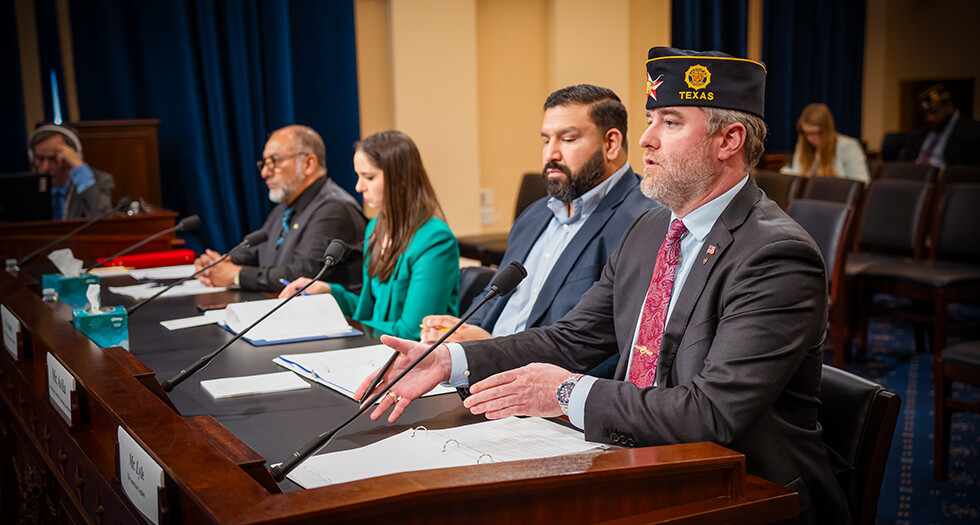
American Legion Legislative Director Cole Lyle delivers remarks to HVAC’s Subcommittee on Oversight and Investigations.
During a March 25 House Committee on Veterans’ Affairs subcommittee hearing, American Legion Legislative Division Director Cole Lyle expressed Legion support – with some suggested amendments – to pending legislation that addresses better fiscal management by the U.S. Department of Veterans Affairs, veterans data privacy and providing a clearer route for recovering bonuses from former VA employees for exhibited misconduct or poor performances.
Lyle addressed the Subcommittee on Oversight and Investigations and immediately pointed out a similarity in the pieces of legislation being considered. “Across the bills under consideration, one common theme emerges: VA must become a better steward of the resources and trust veterans have placed in it,” he said. “We see this clearly in the management of software assets. VA spent roughly $21 billion on software licenses and systems between FY 2022 and 2024. Yet a recent GAO report found the department still cannot accurately track how many licenses it uses.
“According to GAO’s written testimony, without implementing comprehensive guidance from managing the impacts of restrictive software license practices, VA is not well-positioned to identify and analyze the impact or mitigate the risks they present. The result is wasted taxpayer dollars and inefficient operations.”
A potential solution is H.R. 6654, the Veterans Affairs Management and Oversight of Software Assets Act that Lyle said takes a “practical step” toward addressing the problem through requiring a comprehensive inventory, centralized oversight and annual reporting.
“With modest amendments, we believe this bill will deliver meaningful, long-term savings that can be redirected back to veteran care,” he said.
Another piece of legislation under consideration is H.R. 7683, the VA Fiscal Management Modernization Act. The legislation would clarify and expand the authority of VA’s Assistant Secretary for Management to modernize the department’s financial oversight processes.
“Strong financial management is foundational to everything the VA does. For too long, material weaknesses in VA’s financial reporting have frustrated Congress and undermine confidence in the department’s budget requests,” Lyle said. “The VA Fiscal Management Modernization Act would give the chief financial officer the clear statutory authority and structure needed to fix these long-standing problems. We support the bill but recommend clear lines of reporting be included.”
Lyle also spoke about The VA Bonus and Relocation Recovery Act, which would clarify that VA’s existing recoupment authorities extend to former employees, closing a loophole that allows improper payments to go unrecovered solely because an employee has left the agency.
“Under 38 (U.S. Code) 721, the Secretary of Veterans Affairs can order a current VA employee to repay all or part of a bonus or award if misconduct or poor performance is later discovered. However, this authority does not clearly extend to former employees who have already left the department, either voluntarily or through termination,” Lyle said. “There is similar limited authority under 38 (U.S.C.) 723 for recouping relocation expenses, but again, it primarily applies if the person is still employed. In practice, once an employee separates from VA, the department’s ability to recover improperly paid bonuses, awards or relocation incentives becomes very difficult or impossible.
“The VA Bonus and Relocation Recovery Act is designed to close this loophole. If passed, it would explicitly authorize the secretary to recoup bonuses, awards and relocation from former employees when the secretary determines the payment should not have been made. We support the bill, also with amendments to strengthen due process and clarify the judicial reviews of major adverse actions under Title 38 … and shorten the statute of limitations, as we believe six years is too onerous on the former employee.”
During a Q&A session, subcommittee Ranking Member Delia Ramirez thanked Lyle for referencing H.R. 7280, the Veteran DATA Act, earlier in his testimony. The legislation would amend an existing law to prohibit the Secretary of Veterans Affairs from entering into any contract that allows a contractor to sell or otherwise disclose for payment veteran data to another company; would explicitly forbid contractors and their subcontractors from monetizing, selling or misusing this data; would mandate VA issue guidance to its employees and contractors on how to identify such misuse; and would require the VA Secretary to report to Congress on the implemented contract clauses, guidance and any other compliance actions taken.
She then asked what Lyle had heard from Legionnaires about their concerns about data privacy within VA – especially as VA works more with external parties as it continues to modernize.
“I think veterans across the country are rightfully concerned about how their data is used,” Lyle said. “There have been instances of identity theft (and) fraud in the veteran community as a result of data leaks in the public sector and the private sector when it relates to veteran health care data. I think one of the main concerns as technology so rapidly advances is that government protections are not keeping pace with that technological advancement.
“The VA has said that a lot of these protections are currently in place in contracts. I have not seen the specifics of those contracts, so I think (the Veteran DATA Act) is an important step to ensure that protections are in fact in place.”
In addressing the Veteran DATA Act earlier in the hearing, Lyle said a need exists for such measures. “In the era of sophisticated scams and rapidly advancing technology – including AI, that can sometimes reidentify and automize records – veterans are rightly concerned about who has access to their information and how it is used,” he said. “The Veteran DATA Act would seek to close gaps by prohibiting contractors from selling or monetizing veterans’ data, providing training to assist employees to identify this sensitive information.
“While we support the overall goal of the bill, we recommend targeted amendments to avoid unnecessary renegotiation of contracts that may already contain adequate protections.”
Read Lyle’s written testimony here. A video of the hearing also is available here.
- Legislative