

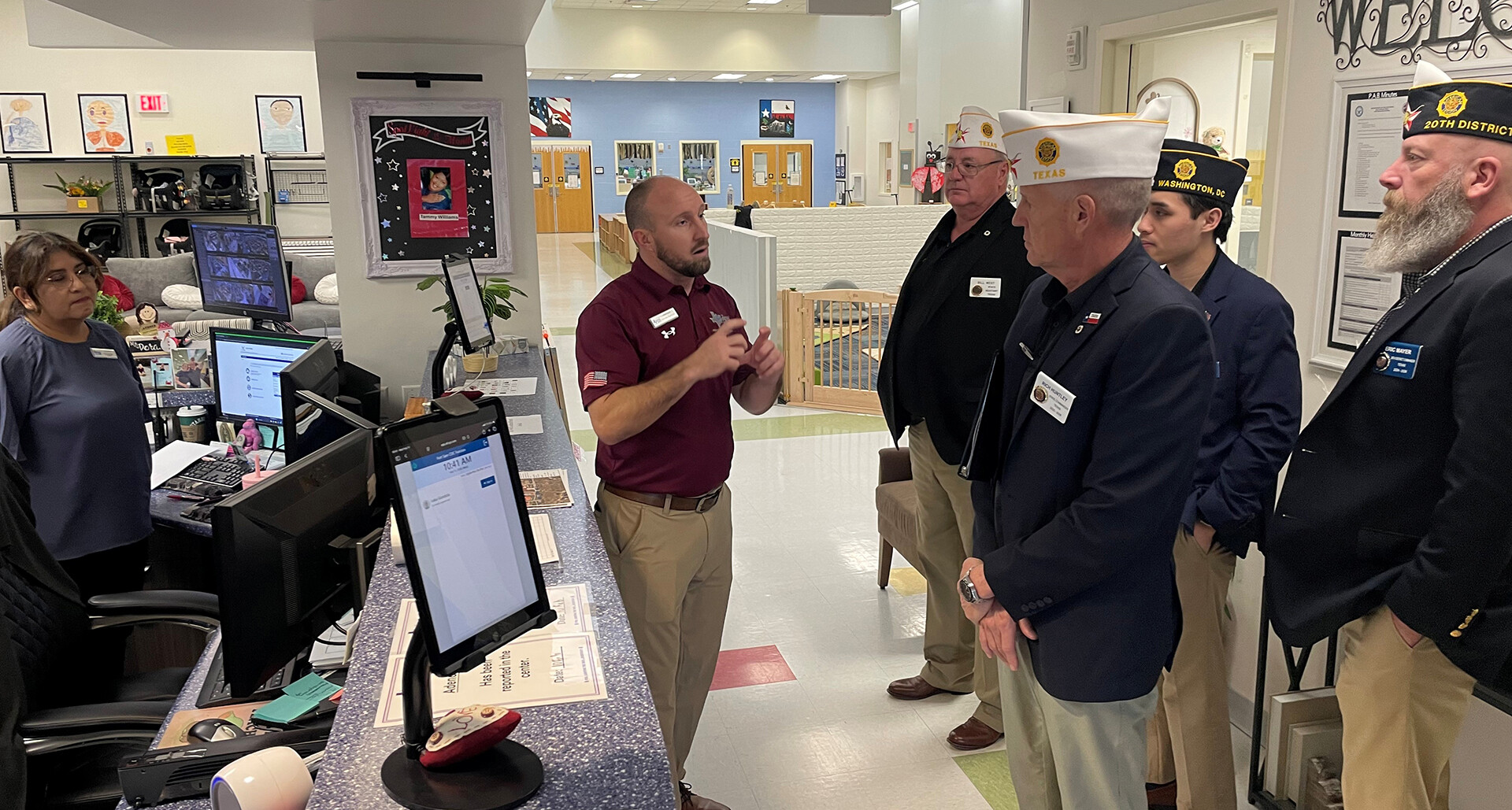
Information from recent Base Assessment and Servicemember Experience (BASE) visits cited in expressing support for investments in housing, childcare and health care.
A Statement for the Record (SFR) submitted by American Legion National Security Division Director Sean Counihan expressed support for the U.S. Department of Defense’s fiscal 2027 budget request’s quality-of-life measures. The SFR was submitted for the Senate Armed Services Committee’s Subcommittee on Personnel May 20 hearing, “To Receive Testimony on Department of Defense Personnel Policies and Programs in Review of the Defense Authorization Request for Fiscal Year 2027 and the Future Years Defense Program.”
Read the entire SFR here.
In the SFR, Counihan noted that one of the Legion’s four pillars is National Security, and that a critical part of maintaining a lethal fighting force is that its servicemembers are not distracted by quality-of-life concerns.
“To best assess the needs of servicemembers and military families, The American Legion operates the Base Assessment and Servicemember Experience (BASE) Program,” Counihan wrote. “Through this effort, the Legion visits military installations to interact with base leadership, servicemembers, and spouses to assess their quality-of-life. BASE visits conducted this year further highlighted the urgent need for sustained investments in childcare, housing, and health-care programs that directly impact the quality of life, readiness, and overall well-being of servicemembers and their families.
“We are currently finalizing reports from the various installations visited and will provide them to the Committee upon completion. These reports will offer detailed observations, findings, and recommendations to assist the committee in addressing issues related to servicemember quality of life and military readiness.”
Counihan shared The American Legion’s support on three specific issues: investments in housing and childcare, and healthcare.
Housing Investments. Counihan noted that The American Legion supports robust investment in Facility Sustainment, Restoration, and Modernization (FSRM) accounts to ensure servicemembers and their families have access to safe, healthy and modern housing.
“As Congress considers the National Defense Authorization Act (NDAA) for Fiscal Year 2027, we urge the Subcommittee to support the President’s FY budget request regarding FSRM matters,” Counihan wrote. “We firmly support the findings of the GAO’s report, ‘MILITARY BARRACKS: Poor Living Conditions Undermine Quality of Life and Readiness.’ Substandard housing directly threatens the well-being of our servicemembers and military operational readiness.
“We call for the rapid implementation of the GAO's recommendations alongside the critical updates identified by the DoD’s Barracks Task Force. Our troops deserve nothing less than a safe, healthy place to call home. While recent funding increases are a step in the right direction, consistent and protected FSRM appropriations are required to fully eliminate inadequate housing across the service branches.”
Counihan referenced previous BASE visits pointing out that inadequate housing can pose significant health and safety risks. “We urge Congress to authorize adequate funding so the DoD can prioritize the renovation and construction of unaccompanied housing, while significantly strengthening contract oversight and accountability for privatized family housing under the Military Housing Privatization Initiative,” he wrote. “We firmly believe that servicemembers and their families should never be forced to endure inadequate, hazardous living conditions while serving our nation. Private contractors must be held accountable to high standards of safety and maintenance, and the DoD must aggressively exercise its oversight authority to protect military families.
“Recent BASE visits conducted by The American Legion highlighted urgent requirements for infrastructure upgrades, housing policy reforms, and a revision of local housing stipends. At one installation, the delegation discovered a significant disconnect between local housing costs, neighborhood security, and how military housing allowances are calculated. While on-base privatized family housing provides well-maintained options, limited capacity often forces personnel to seek housing in the local community. Although housing near some installations may technically fall within local allowance calculations, concerns regarding crime, safety, and overall community conditions can drive military families to seek housing farther away at greater personal expense.”
The SFR urged passage of H.R. 7188, the Military Occupancy Living Defense Act. The intent of this bill is to improve housing for military families by addressing hazardous environmental conditions, including mold.
Investments in Childcare. The SFR stated the Legion’s support for DoD’s requested fiscal 2027 budget increase for Child Development Programs (CDP) and also noted support for increased funding for childcare centers and higher pay for the childcare workforce.
“The Child Development Program is the largest employer-sponsored childcare system operated by the United States,” Counihan wrote. “Since 2024, community childcare partnerships and childcare fee assistance programs have played a pivotal role in reducing the unmet need for quality childcare by 30 percent. Under the CDP, Child Development Centers (CDCs), the Military Child Care in Your Neighborhood (MCCYN) program and the Child Care in Your Home fee assistance program are all critical components of the military childcare system.
“The DoD’s Military Child Care in Your Neighborhood program operates as a community-based initiative that provides fee assistance when childcare is unavailable or at capacity on an installation. The DoD’s Child Care in Your Home fee assistance pilot program reimburses military families for 30 to 60 hours of in-home childcare provided by a babysitter or nanny. Continued funding for these programs is crucial to addressing the childcare needs of military families.”
Referring again to the Legion’s BASE visits, the SFR said those interactions on military installations has led the Legion to identify the Military Child Care in Your Neighborhood Program – which expands childcare access in communities surrounding military installations – as a crucial lifeline for military families. “Programs like these provide high-quality childcare options for military families who are unable to secure a CDC slot after relocating to a new duty station,” the SFR stated. “GAO report GAO-23-105518 highlighted the positive role of community-based childcare assistance programs, including the (MCCYN) Program, in improving access to affordable childcare, reducing waitlist pressures, supporting spouse employment, and enhancing overall military family readiness.”
Healthcare. Counihan wrote that the Legion is encouraged by DoD’s fiscal 2027 budget request of $45.7 billion in investments for the Military Health System (MHS), which represents an estimated 5-percent increase over the fiscal 2026 funding level and includes approximately $20.3 billion for Combat and Operational Medicine Programs (COMP), $22.2 billion for Private Sector Care Program (PSCP), $491.4 million for medical construction and infrastructure modernization, $3.1 billion for facility sustainment, restoration and modernization, approximately $2.05 billion for service medical readiness, $231 million for replacements and modernization of medical systems and infrastructure, and $78.6 million for MHS information technology modernization.
“While these investments represent an important step forward, Congressional oversight and external assessments continue to highlight ongoing concerns regarding access to care, understaffing, long wait times, and implementation challenges throughout the Military Health System. These concerns align with observations made during recent BASE visits,” Counihan wrote. “We firmly believe that health-care delivery within the MHS is inseparable from military readiness, lethality, and the overall effectiveness of our Armed Forces, and we support continued investment in and Congressional oversight of military health-care programs that directly contribute to operational medicine, force resiliency, and the well-being of servicemembers and their families.”
Counihan closed the SFR by noting that The American Legion believes that taking care of military families is a critical part of preserving the world’s finest military, and that investing in quality-of-life programs signals respect for U.S. servicemembers and their families.
“This will ensure that the all-volunteer nature of the force is a viable and attractive path for future generations of Americans,” Counihan wrote. “We urge this Subcommittee to include these quality-of-life funding recommendations in the NDAA. Observations made during recent installation visits continue to demonstrate that military readiness is directly tied to the quality of life, infrastructure, and healthcare support provided to servicemembers and their families. Prioritizing these investments in the NDAA for Fiscal Year 2027 will help ensure the force remains ready, resilient, and capable of meeting defense requirements.”
- Legislative