

Professional photographer, Legionnaire offers tips for Fourth of July, other summer events.
The next few months will be a great time for amateur and professional photographers alike. Summer is the time of year that many families take vacations or visit relatives. And this year, the Fourth of July marks the semiquincentennial anniversary of the United States. With that in mind, I thought I would share a few tips on how to take better photos.
First, a quick introduction: I am a Navy Gulf War veteran and a professional photographer and photography instructor (Princeton Photo Workshop). I published “Never Home: Remembering the Military Heroes Who Never Returned,” which honors the more than 200,000 individuals memorialized in America’s 23 overseas World War I and World War II cemeteries through photographs and short biographies (see the May 2025 edition of The American Legion Magazine).
The American Legion wants to see your celebrations
Click here to send us your Fourth of July and America 250 photos.
Photos sent will be considered for publication in American Legion media and social channels in July. Submission deadline: Midnight Eastern Time, July 7, 2026
Note that by sharing your files with The American Legion you are agreeing that they are your own original (not AI-generated) artwork, any subjects have consented to the use of their image, and you are granting The American Legion usage rights to re-publish these images. Submission of entry does not guarantee publication.
One of the things that makes photography so challenging is that we are working in a two-dimensional frame (height and width, no depth) that never changes. That means how we use the “real estate” inside the frame is very important. We have a limited amount of space to tell the viewer whatever it is we are trying to say. With that in mind, here are five suggestions to immediately improve our photography.
First, the photographer needs to decide what they want to say. With the quality of cameras – including smartphone cameras – it is easy to “shoot first and think later.” I think we are all guilty of just lifting our camera and firing away. But your chances of capturing a good photograph improve greatly if you slow down and compose your shot.
In my teaching, I tell people to think like a painter. Painters have a plan before their hands do anything. The first decision is choosing a subject and how much contextual information you want around it. Do you want the viewer to only see a person, or do you want them to see a person in a cool location? Is it a photograph of a young Marine, which could be a cool portrait, or is it of a young Marine at the site of the former Tun Tavern in Old City Philadelphia commemorating the Marine Corps’ birthday? A close-up shot (i.e., a “portrait”) that only includes the person gives little to no information about where or when it was taken. If we want the viewer to know more, we need to step back, zoom out or compose the image differently so the viewer can see the surroundings.
Second, check the background. If you are including contextual information around your subject, you must check what is lurking behind it. Just because you missed something distracting in the background doesn’t mean your viewer will miss it. Things like trash, brightly colored clothing or objects are common offenders. Returning to my “think as a painter” analogy, there is no trash in Monet’s famous “Water Lilies,” nor are there bright orange traffic cones behind “Mona Lisa.” Sometimes this means waiting until distracting things move out of the frame, or moving your body or changing your focal length (e.g., choose a different lens on your smartphone) to eliminate or minimize the distracting elements. And while you’re checking the background, make sure to get the horizon line straight. It is distracting to see a sloping horizon line. I like to tease my photography students when I see a crooked horizon line on water with “You did a great shot capturing the subject, especially since they were going uphill on the lake.”
Third, if you are taking a portrait of your family or friends – and by that, I mean you have decided to not add contextual information around them – avoid putting the eyes of the subject in the middle of the frame. This creates a weird gap of space above the subject’s head. Since all the real estate in a frame is valuable, what exactly do you want the viewer to see with half the frame showing empty blue sky above your subject? Instead, place the eyes of your subject one-third of the way below the top of frame.
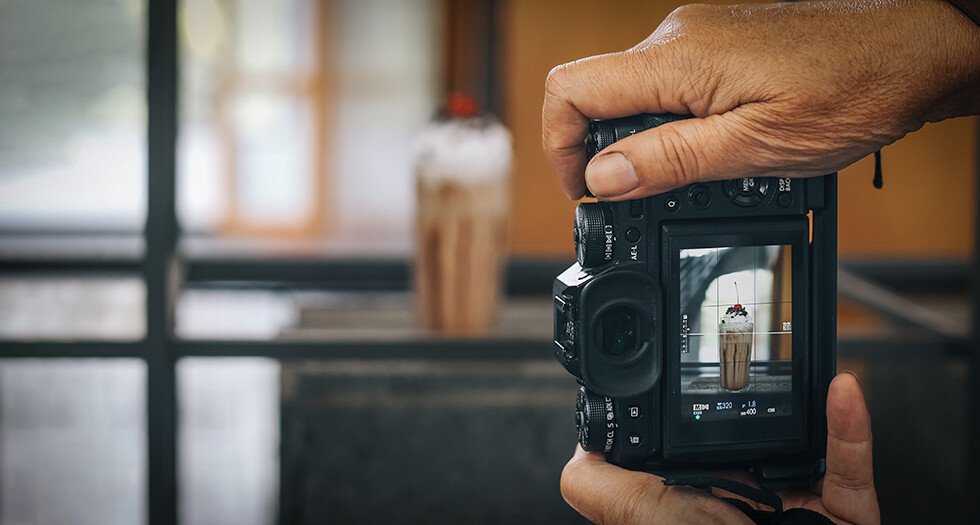
Fourth, use the “Rule of Thirds.” You can read a good explanation here, but all you need to do is turn on “gridlines” in your phone or digital camera, then just place your subject at one of the intersections on the gridlines to create a soft and pleasing asymmetry in your frame. For example, if you are taking a photo of your son at the baseball stadium, don’t put him in the middle of the frame. Instead, move the camera so he is just right of center, which leaves a bit more space to the left for a great view of the field. This works brilliantly in many situations.
Lastly, take a lot more shots, and try burst mode. When I first started in photography, I attended a presentation by National Geographic photographers. They told us that to get a handful of images into the magazine, they take an average of 20,000 photos! This is especially true when there is motion; I suggest shooting in burst mode (if you have a smartphone, there are various ways to do this that you can find online). Don’t worry about space on your card or phone; you can delete the bad ones later, but you can’t re-create an event.
So that’s it: be decisive, manage your real estate, and be kind to yourself and take a lot more photos than you think. It’s going to be a great year for America and a great year for photography.
Rich Sherman is a member of John F. Murphy Post 303 in Bonita Springs, Fla.
- Media