

New movie chronicles Jimmy Stewart’s decision to servce in combat during World War II, and how it impacted his role in ‘It’s a Wonderful Life.’
When “It’s a Wonderful Life” opened in theaters in 1946, while receiving critical praise – including five Oscar nominations – it wasn’t a commercial success. The film lost $525,000, which was a sizeable amount then and would be $9.7 million in 2026.
But over the years, love for the movie grew, to a point where it now is a holiday season staple, bringing together themes of sacrifice, self-worth and an individual’s impact on those around him.
Its iconic lead character, George Bailey, is brought to life through one of Hollywood’s most iconic and loved actors of any generation. And while many know the role played by Jimmy Stewart, they don’t know what the actor himself was going through during filming.
A movie that made its worldwide premiere in Indianapolis on Oct. 8 aims to educate the public on just what went into Stewart’s performance as George Bailey, including drawing on and dealing with his experiences as Commanding Officer of the U.S. Army Air Force’s 703d Bomb Squadron during World War II. (STORY CONTINUES BELOW)
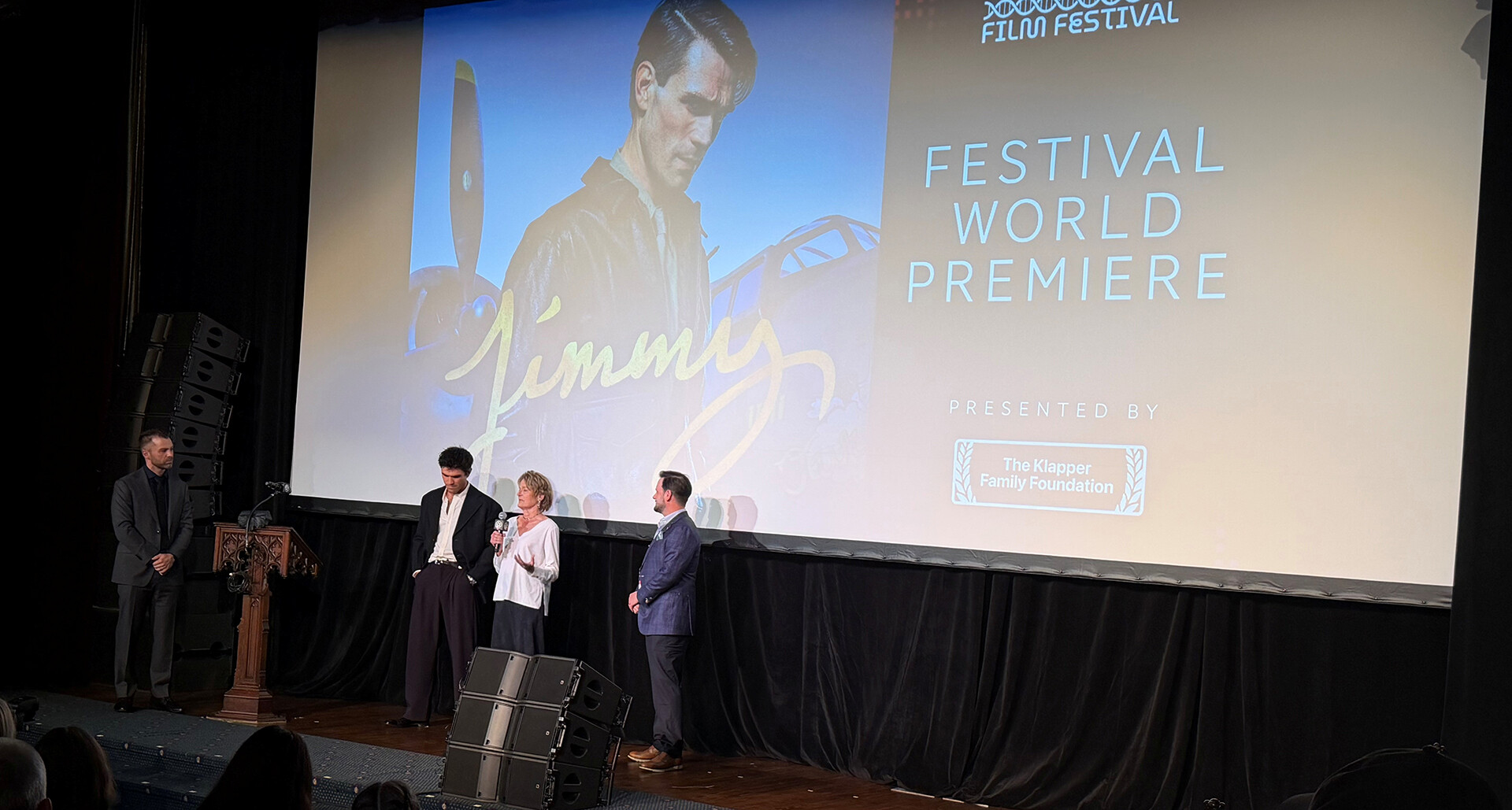
“Jimmy” premiered during the Heartland Film Festival at the Scottish Rite Cathedral Theater in downtown Indianapolis. The red carpet event included members of the cast and crew, including director Aaron Burns and executive producer Kelly Stewart-Harcourt, Stewart’s daughter.
The film opens immediately after Stewart won an Academy Award for Best Actor for his performance in 1940’s “The Philadelphia Story.” He would later receive his draft notice, but despite several opportunities from powerful individuals – including the founder of Metro-Goldwyn-Mayer Studios – for deferments, Stewart was determined to serve.
“I knew that dad had stopped being an actor to go and serve during the war. But I didn’t realize until this film how hard he had to fight to (join the military), how much resistance there was to him going,” Stewart-Harcourt said. “There’s just not that many people who would do that. But he always said he was in a partnership with his public. And so, he owed them. That’s what he felt about his country. So serving, for him, was he owed his partner, his country. He owed them something when they needed him.”
Stewart was drafted in 1941 and assigned to the Army Air Corps – which would later become the U.S. Army Air Force – and was stationed at Moffett Field, Calif. He took extension courses to gain a commission and received it a month after the attack on Pearl Harbor. After serving as a training instructor for AT-6, AT-9 and B-17 aircraft and flying bombardiers in the training school at Albuquerque, N.M., he was sent to England as Commanding Officer of the 703d Bomb Squadron, equipped with B-24s.
Stewart flew 20 combat missions during World War II, being appointed Operations Officer of the 453rd Bomb Group and then Chief of Staff of the 2nd Combat wing, 2nd Air Division of the 8th Air Force in 1944. He would remain in the U.S. Air Force Reserve for two more decades, being promoted to brigadier general in 1959 and retiring in 1968.
His World War II military service is featured in “Jimmy,” including Stewart watching his fellow servicemembers killed in action – including members of his crew while he wasn’t on one of their missions.
After coming home from the war, Stewart was offered “It’s a Wonderful Life” by director Frank Capra, who had previously directed the actor in “You Can’t Take It with You” and “Mr. Smith Goes to Washington.” Stewart’s struggles with the emotional and psychological toll of his service – and how it impacts his performance in “It’s a Wonderful Life” – are the major theme of the last third of the movie.
“This film has taught me a lot about what happened to dad and how it affected him. And how he was a changed man when he came back,” Stewart-Harcourt said. “I kind of knew that, but not how important it was. But America was different. He came back, and the films were different. Things had changed, and he had changed.”
Burns said Stewart’s story can serve as an example to others during current times.
“If you look at our world today, there’s a lot of division. There’s a lot of fear. There’s a lot of chaos. It looks a lot like the world did in the 1940s,” Burns said. “The world is tearing itself apart. And I look at a man like Jimmy Stewart, and rather than complaining about it or hiding from it, he chose to do something.
“And I think whatever your perspective on life or politics or anything, I think we all look at Jimmy Stewart and his choice to love and serve and sacrifice and can be inspired by that for our generation today.” (STORY CONTINUES BELOW)
KJ Apa, who plays Stewart, said playing the actor brought an “Incredible responsibility. I think a huge challenge, too, because of who Jimmy was and how specific he was as a person. Everyone knows the way he talks. A lot of his performances are specific. The way he moved. Obviously, the military aspect of his life and how dedicated he was to that part of his life was so important to him.
“I think that was what really hit me the most: learning about the history of his service after his winning an Oscar and then going back to film 50-plus movies while still actually being involved in the Army Reserves. So that was something that I didn’t know, and I wanted to know more about it, and it made me really inspired to play him, for sure.”
Burns said when making the film, the top priority was to capture who Stewart was. “Is anyone ever going to look exactly like Jimmy? Are we going to get every fact and detail of recreating things exactly right? No. But if we can accurately represent his heart, that’s what matters first,” he said. “So from myself, from our screenwriter, from our lead actor who plays Jimmy, that’s where we started from. And from there, we put all kinds of work into the historical research: the historical accuracies of the bombers and the uniforms and the sets and the locations and the timelines.
“But if we get Jimmy’s heart right, I think we’ll be in a pretty good place, and the audience will quickly forget you’re even in a biopic. If anything, you’ll fall into this story yourself, like you do in ‘It’s a Wonderful Life.’ We all see a piece of ourselves in that story, and I hope that’s what the movie does.”
Such a film would have been a no-go for Stewart. “When dad was alive, it was impossible to even consider making a film about him. He would have never said yes,” Stewart-Harcourt said. “This film, I think, if he had been approached with it, the idea, he would have said no immediately, first of all, because he did not mix his military career with Hollywood.
“But once he read the script and saw what it was really about and it didn’t glorify war, it didn’t Hollywood-ise war, he might have had a different feeling about whether or not he would have wanted it made. And I know that he would approve of this film.”
That kind of response to the film is what drove Apa throughout productions. “There was a lot of preparation that went into this,” he said,” “It’s great to see all the support and all the people who loved Jimmy. That’s all I really care about: Kelly approving of the movie, and people who resonated with Jimmy’s life appreciating it.” (STORY CONTINUES BELOW)
The American Legion briefly is featured during the film. When Stewart has come home from the war and is trying to figure out what to do, a welcome-home ceremony takes place just outside of American Legion Post 141 in Indiana, Pa., with the Legion’s emblem in clear view. The post is located just three blocks from the Jimmy Stewart Museum.
And in its December 1996 issue, The American Legion Magazine’s cover story was on the 50th anniversary of “It’s a Wonderful Life.” The article talks about the history of the movie, as well as its lasting and continued impact after being a box office flop.
That continued impact, Burns said, drives current filmmakers to continue to do what they do. “I think to see a film and a story last so long – last 80 years – and still has an impact, it inspires us that our work matters,” he said. “And the stories we tell are important. If you can tell a story that moves someone’s heart, you can make a difference – not just in your life and your day, but something that transcends time. Jimmy and Frank Capra did that when they gave us the gift of ‘It’s a Wonderful Life.’”
“Jimmy” opens nationally on Nov. 6. Burns & Co Productions has partnered with Vet Tix, a nonprofit organization, to give servicemembers, veterans, first responders and Gold Star families the chance to see "Jimmy" through donated tickets. Click here for more info.
- Media