

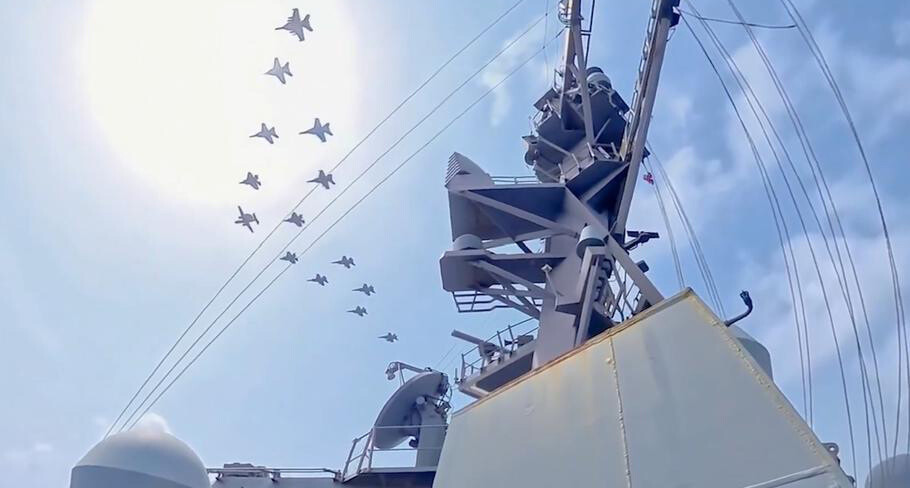
The additional strikes began just hours after President Donald Trump had warned the U.S. would 'probably hit them hard again.'
U.S. forces launched a second round of attacks against Iran, prompting retaliatory strikes from Tehran on Thursday and pushing the region back toward the brink of full-scale war.
The attack began just hours after President Donald Trump, speaking at a NATO summit in Turkey, said the ceasefire was over and warned that the U.S. would “probably hit them hard again.”
In a post on X, U.S. Central Command said the strikes were meant “to further degrade their ability to threaten freedom of navigation in the Strait of Hormuz.”
“The United States is holding Iran accountable for recent unjustified aggression against commercial shipping and civilian crews freely navigating a vital international waterway,” the CENTCOM statement added.
This marked the second day of U.S. attacks in response to Iranian strikes on tankers attempting to transit the Strait of Hormuz.
Vice President JD Vance said Iran’s actions were a direct violation of the deal made last month to end the war.
“The deal is very simple: if they shoot at ships, we’re going to knock the hell out of them,” Vance said at an event in Wisconsin on Wednesday.
Iranian state media reported explosions in several locations, including the port city of Bandar Abbas, the southern coastal city of Sirik and Bushehr, home to Iran’s nuclear power plant complex. Axios, citing a senior official, reported that the U.S. Air Force also bombed two railway bridges in Iran.
In a follow-up post on X, CENTCOM said its forces struck approximately 90 targets, including “air defense systems, coastal surveillance assets, missile and drone storage sites, naval capabilities, and military logistics infrastructure.”
Meanwhile, authorities in Bahrain and Kuwait said they were intercepting projectiles. The two nations host major U.S. installations, including Naval Support Activity Bahrain and Ali Al Salem Air Base in Kuwait.
Iranian state media claimed the country had made a direct hit against the U.S. 5th Fleet in Bahrain. U.S. Central Command did not immediately respond to a request for comment on the claim.
Iran’s parliamentary speaker, Mohammad Bagher Ghalibaf, said in a post to X that the U.S. still hasn’t learned that “bullying and breaking promises are no longer cost-free.”
“Let me put it plainly: if you strike, you’ll get hit,” he said. “The Strait of Hormuz will only open with ‘Iranian arrangements,’ not American threats.”
The U.S. has gradually ramped up the intensity and scale of its strikes in response to the Iranian attacks against tankers but has stopped short of resuming the kind of the level of hostilities seen at the start of the war, which began in late February.
On Tuesday, the U.S. struck more than 80 targets overnight, including “Iranian air defense systems, command and control networks, coastal radar sites, anti-ship missile capabilities, and more than 60 Islamic Revolutionary Guard Corps small boats in and near the strait,” CENTCOM said.
Iran in return fired on U.S. bases in Kuwait and Bahrain, though CENTCOM said no U.S. personnel were injured and there was no major damage done to facilities that day.
An interim peace deal reached last month has repeatedly been tested by attacks. Talks to fully reopen the Strait of Hormuz, halt Tehran’s nuclear program and reach a permanent end to the war that started Feb. 28 are on hold.
- Security