

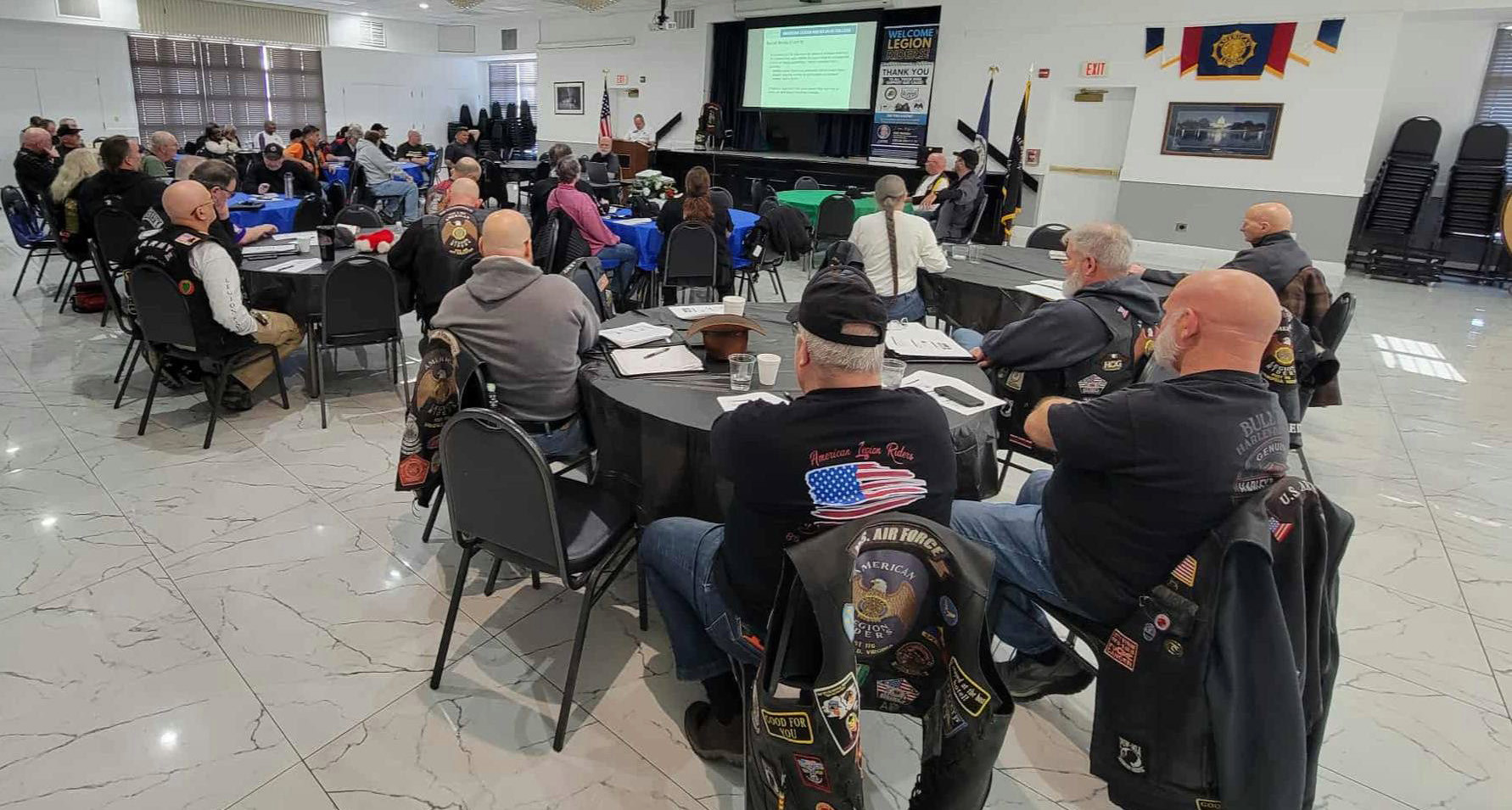
Virginia’s American Legion Riders Legion College drew 198 attendees its first year and had more than 50 attend its first session in December.
For a few years, The American Legion Department of Virginia Legion College included an American Legion Riders course taught by ALR Department Chairman Randy Gunn. But those classes were sparsely attended.
“Only five or six people would show up,” Gunn said. “The Legion College itself was a three-day event. People would have to register for $100, rent a hotel room for two nights, and they would have to drive, pay for food and other expenses. It was a $500 to $600 bill. That’s why it wasn’t working.”
So last year, Gunn – with permission from department leadership – changed the format. Instead of teaching a class at Virginia’s Legion College, he set up three regional sessions over the winter that took place at different Virginia posts. The results: nearly 200 Legion Riders attended the sessions.
That format is in place again this year and kicked off Dec. 6 when American Legion Post 176 in Springfield hosted the five-hour session. More than 50 Riders attended, including some from Maryland, Kentucky and West Virginia. Similar sessions are scheduled for Jan. 17 at Post 280 in Chesapeake and Feb. 21 at Post 3 in Salem.
“I kept brainstorming about how I could get people involved,” Gunn said. “Last year I had three sessions and ended up with 198 people graduating from the three sessions. What was impressive to me was that people took that much interest. And the other part is that I had people come all the way from Arkansas, Alabama, North Carolina and West Virginia. It was amazing to me that people would drive that far to listen to me talk. But they did.”
Subjects taught during the session include the ALR’s history, governing resolutions, eligibility, emblem usage, finances, social media and best practices.
“I don’t teach them about riding,” Gunn said. “I teach them about what the ALR can do for The American Legion, and what The American Legion can do for the ALR in their post.”
Posts who host the sessions provide lunch to attendees, while Gunn was able to acquire a sponsor to handle the cost of both pins and patches for those who complete the course.
Gunn also doesn’t start any of the sessions until 10 a.m. “I’m regional. Everyone within that region is two hours from (the host post),” Gunn said. “If they leave their house at 8 or 9, they have plenty of time. They don’t have to take time away from their family. They don’t have to get a hotel room.”
Three current department ALR chairmen from other American Legion departments also attended this year’s session: Edna Shupe of Kentucky, Dave House of Maryland and Chantel Ricketts of West Virginia.
“These are the leaders that the department has picked to run their programs,” Gunn said. “And these people are traveling and spending the night. To me, that was pretty impressive.”
Gunn said the program also is open to posts that don’t have Rider chapters, as well as those who support the Riders. That’s why Phylissa Marable, a member of Tidewater Auxiliary Unit 327 in Norfolk, attended the most recent session.
“I’ve been a supporter with the Riders for a few years. Unfortunately, I wasn’t an active supporter,” Marable said. “So, I wanted to do more to find out what the American Legion Riders are about, as well as find out ways I can better assist them in their mission.”
Michael Hill, a member of ALR Chapter 190 in Portsmouth and the Department of Virginia ALR Eastern Region assistant director, also found the session valuable.
“Coming from a brand-new chapter that’s only been around for a year and a half, you kind of find yourself trying to figure things out on the fly,” Hill said. “By coming to this course, even if you’ve been around for a while, there’s a lot of information that I didn’t know. Everything from the different articles that govern how the ALR should be done, discussions about the bylaws. I think everyone should come to this course so that they get a better understanding of what ALR really means.
“So, when you go back to your post, you can articulate that to your (membership). Because if you don’t understand what we do, it’s kind of hard for non-ALR members to understand. Taking this course gives you the tools to go back and have those discussions.”
Department ALR Chaplain Mark Grapin, a member of Chapter 72 in Warrenton, also was in attendance and saw the value in better learning how the Riders can share the Legion’s message and mission.
“The interest starts at home. It should be a very, very holistic question: What can I do to support my fellow riders? What can I do to support my post?” Grapin said. “And in all of that, how are we going to be able to say at the end of a ride, at the end of the day, at the end of whatever it is, I was the one today for somebody.
“The (ALR) vest was incidental to it. The vest might have been the theme that drew somebody to ask me a question at the supermarket. Or the bike may have been the impetus for somebody to ask me a question at the local Buc-ee’s, Love’s or wherever I pulled in for gas. Those things allow us the opportunity to share this American Legion message that we care for our veterans.”
Gunn said condensing the training into a shorter period of time – with less travel in the process – was the impetus behind his vision for the current format.
“To me, it’s important to keep doing a lot of things that don’t take a lot of time from people, and that they get a lot out of it,” Gunn said. “That’s really what made this work, in my opinion.”
To register for an upcoming Virginia American Legion Riders Legion College, call Randy Gunn at 804-271-0701.
- Riders