

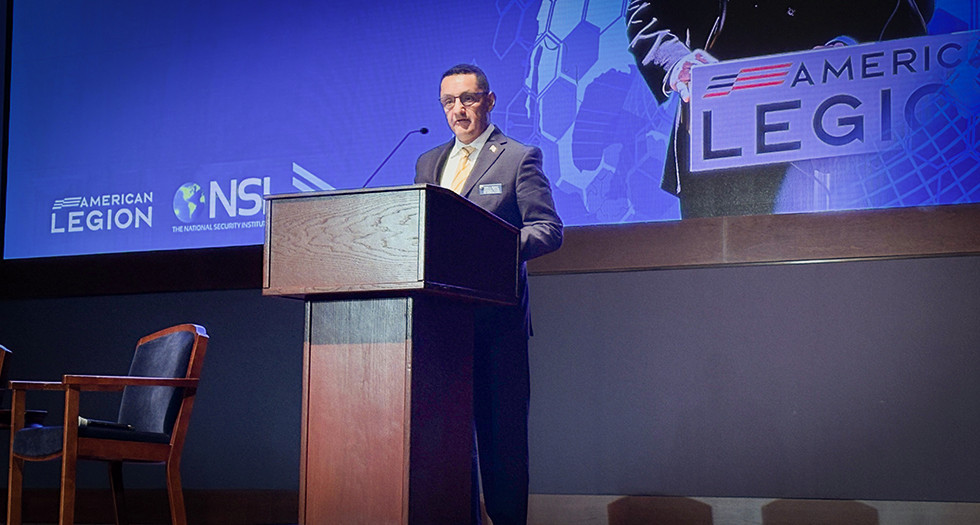
Panelists outline urgency to develop solutions, minimize reliance on adversaries and more during Critical Minerals and National Security Summit.
Minerals represent a critical priority for the United States when it comes to national security, technological innovation and more. That was the message from experts during the Critical Minerals and National Security Summit, sponsored by The American Legion, on Dec. 2 at the U.S. Capitol Visitor Center.
American Legion Executive Director of Government Affairs Mario Marquez kicked off the summit, outlining the urgency.
“Veterans understand the danger of relying on adversaries for the materials that power our aircraft, our precision weapons, our communications systems and our energy grid,” he said. “Critical minerals lie at the heart of this conversation. They are the building blocks of modern power — embedded in the technologies that enable lethality, readiness and resilience across our military.”
Designed as an executive-level forum, the summit’s central purpose was to drive the conversation toward practical and impactful solutions that enhance U.S. competitiveness, resilience and national security. The discussions focused on immediate measures the U.S. can take to expand access to critical minerals, and long-term policies to revitalize domestic capabilities for extraction, processing, and manufacturing of these essential resources.
“America cannot afford vulnerabilities in the supply chains that sustain our warfighters,” Marquez said. “We convene today at a pivotal moment. Global competition for resources is accelerating. Strategic adversaries are leveraging mineral dominance to expand influence and create dependencies. And the United States faces real risks to its national security if we fail to secure, develop, and diversify the critical minerals that underpin both our military and our economy.”
Panelists included members of Congress, entrepreneurs and others invested in the critical minerals industry. They covered a wide range of topics including recycling and reuse, the new arms race, the supply chain, fostering innovation and energy security. A common call to action was for the creation of a modern-day Manhattan Project, Project Mercury or similar strategic initiative.
Sens. Todd Young, R-Ind., and John Hickenlooper, D-Colo., found agreement during their session. They agreed that the U.S. government’s primary failure has been the absence of a formal, written national economic security strategy, which would include critical minerals. Such a plan is necessary to create stability, unlock private capital and hold government accountable.
“However we go about it, it’s nice to have a plan,” Young said. “It doesn’t mean a planned economy, it just means what we can expect the role of government to be. And then if you lay out a plan, you actually find that over a period of time that stimulates debate, thoughtful debate, critical inquiry, critical feedback around the plan. And you can iteratively improve the plan.”
Hickenlooper, whose state depends on the mining industry, pointed out that America hasn’t changed its mining laws in 150 years.
“You wonder why we have so many problems and why people have such a bad taste in their mouth,” he said. “We know basically that you want to make sure that everybody’s at the table from the beginning. We know that it’s got to be environmentally conscious and very attentive with consequences for failure.”
Retired Rear Admiral Mark Montgomery argued that the Department of Defense was dangerously and unknowingly reliant on Chinese supply chains for its most critical weapons systems. He asserted that China was willing to exploit this vulnerability and that the essential first step to mitigating this risk was for the DoD to comprehensively identify and prioritize its specific mineral needs and dependencies.
“Members of Congress do fantastic work, but they do it with exactly the quality of the information they have in front of them,” he said. “If they have terrible information, they make moderately to poor law. If they have good information, they make moderately to good law. We need to actually get good information. If you don’t know how you’re vulnerable, then you can’t possibly fix it.”
Fellow panel member Mahnaz Kahn of Silverado Accelerator cautioned against a blanket approach to stockpiling. She advocated for a more targeted strategy based on an assessment of critical needs.
“Everyone acts like stockpiling is the answer to everything,” she said. “We have to be very strategic in what we’re stockpiling, especially when it comes to defense needs.”
The last of four panels featured industry professionals and government representatives who discussed specific strategies, such as diversifying supply chains, investing in new technologies, and engaging with partners in Africa and Latin America to counter Chinese influence and build resilient, secure value chains. Comparisons were made to an “arms race” with China in areas like artificial intelligence and quantum computing.
“There is no second place in the ‘AI arms race,’” said Rep. Gary Palmer, R-Ala. “The country that wins, will not be a superpower. They will be the superpower. We’ve got about a five-year window and I think we can do it.”
Retired Army veteran Greg Bowman is now the Chief Strategy Officer and Senior Vice President, National Security Solutions, for Siemens Government Technologies.
“When I went to war and walked in the streets of Baghdad in 2003, I knew that I had the best equipment in the world,” he said. “That’s because we had a focus on national security. Do I know we have the best economy in the world? Do any of us? That’s why we need this level of planning, whether it’s copper or critical minerals or whatever our focus is, we have to treat preparedness the same way we treat security.”
In closing, Dan Wagner, principal of C2 Strategies, summarized some of the key takeaways.
“Innovation is no longer a side dish, it’s a main course,” he said. “One of our strongest threads running through today was the understanding that we cannot dig our way out of this alone. We need recycling. We need new processing technologies. We need substitutes, new chemistry, advanced metallurgy, AI-optimized exploration materials, recovery systems that treat waste streams like treasure chests. Innovation is what helps us leapfrog. Innovation is what helps us scale. Innovation is what lets us outmaneuver a country that’s spent 30 years building the world’s supply chain. We’re not catching up, we’re changing the game, and I love that part.”
Wagner thanked The American Legion for its participation as he also noted the connection to national security.
“The minerals conversation is now a defense conversation,” he said. “It’s a readiness conversation. It’s a resilience conversation, and it’s a sovereignty conversation. What we heard today wasn’t about rocks. It was about power, deterrence and economic stability. This is the moment right now when the United States is choosing whether to rebuild its mineral foundation or continue relying on rival nations for the materials that make our entire national security architecture possible.”
- Security