

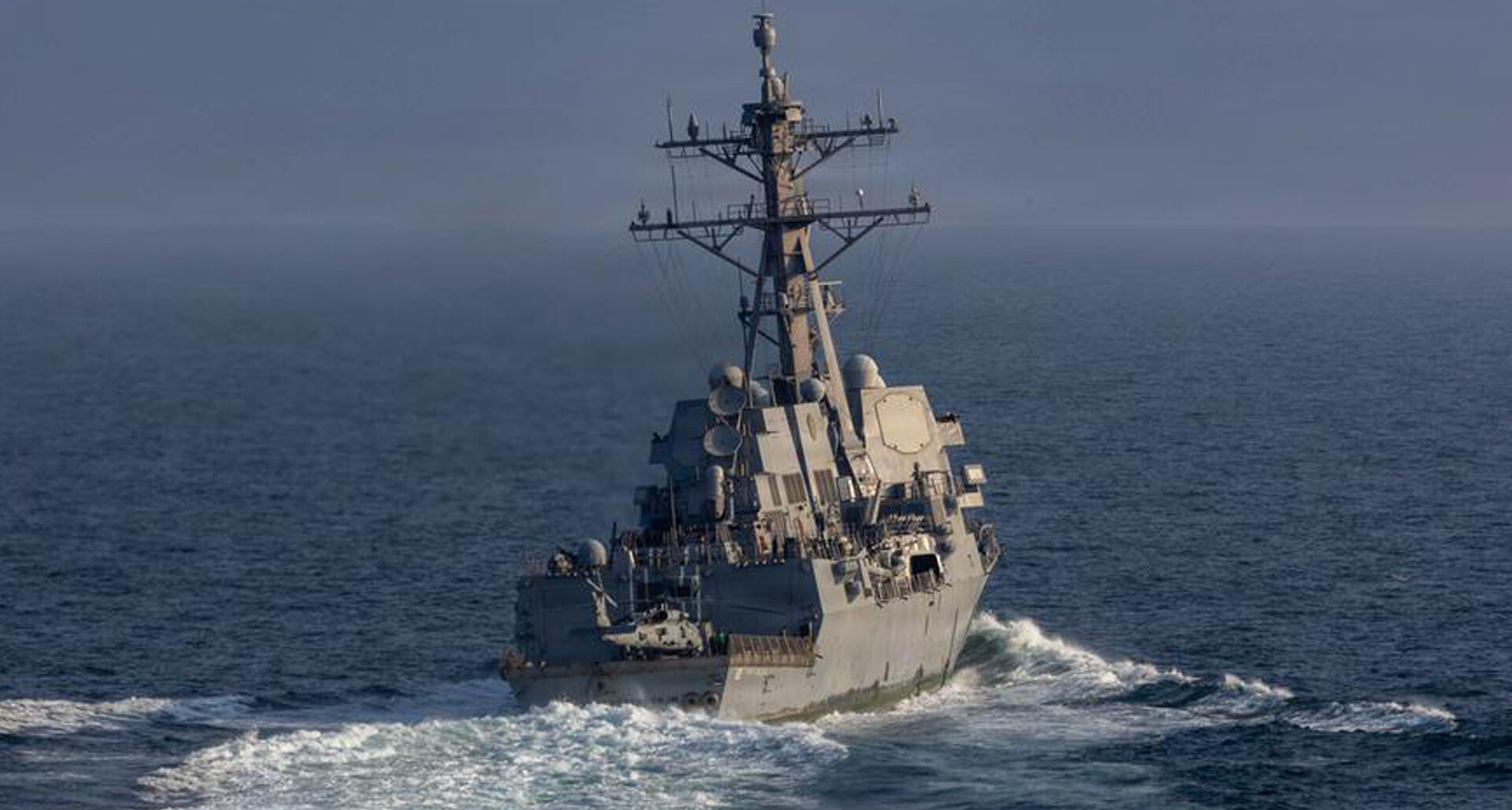
U.S. to blockade all Iranian ports, coastal areas, a move the UK said it will not support; two boats accused of smuggling drugs blown up by U.S. strikes in Pacific; and meet the Navy sailors who greeted the Artemis crew upon its return.
1. The U.S. military announced Sunday it will begin a blockade of all Iranian ports and coastal areas today, as President Donald Trump sought to pressure Iran in a move that risks driving oil prices even higher and renewing the war. The announcement set the stage for a showdown, as Iran immediately responded with threats on all ports in the Persian Gulf and the Gulf of Oman. “Security in the Persian Gulf and the Sea of Oman is either for everyone or for NO ONE,” the Islamic Republic of Iran Broadcasting reported Monday. “NO PORT in the region will be safe,” according to a statement from the Iranian military and the Revolutionary Guards. U.S. Central Command announced the blockade would begin on Monday at 10 a.m. EDT, or 5:30 p.m. in Iran, and would be “enforced impartially against vessels of all nations entering or departing Iranian ports and coastal areas, including all Iranian ports on the Arabian Gulf (Persian Gulf) and Gulf of Oman.” CENTCOM said it would still allow ships traveling between non-Iranian ports to transit the strait, a step down from the president’s earlier threat to blockade the entire strait.
2. The U.K. is “not supporting” the U.S. blockade of Iranian ports, Prime Minister Keir Starmer said on Monday, insisting that the country would not get “dragged in” to the Iran war. It came as President Emmanuel Macron confirmed France and the U.K. would, in the coming days, co-host a conference aimed at restoring freedom of navigation in the Strait of Hormuz. Macron has not explicitly ruled-out France’s involvement in the U.S. blockade but said the planned conference would create a “peaceful multinational” and “strictly defensive” mission, “separate from the belligerents.” Britain’s Starmer told BBC’s Radio 5 Live on Monday: “We’re not supporting the blockade, and all of the marshalling – diplomatically, politically and [in terms of] capability – we do have mine-sweeping capability, I won’t go into operational matters, but we do have that capability – that’s all focused, from our point of view, on getting the Strait fully open.”
3. The U.S. military said Sunday that it blew up two boats accused of smuggling drugs in the eastern Pacific Ocean, killing a total of five people and leaving one survivor, as the Trump administration pursues its campaign against alleged traffickers in Latin America while preparing a naval blockade of Iranian ports. The attacks on Saturday bring the number of people who have been killed in boat strikes by the U.S. military to at least 168 since the Trump administration began targeting those it calls “narcoterrorists” in early September. As with most of the military’s statements on the dozens of strikes in the eastern Pacific and Caribbean Sea, U.S. Southern Command said it targeted the alleged drug traffickers along known smuggling routes. The military did not provide evidence that the vessel was ferrying drugs. Videos posted on X showed small boats moving across the water before they each were engulfed in a bright explosion.
4. Sailors ran aboard the USS Harvey C. Barnum Jr. (DDG-124) as it came to life during its commissioning ceremony Saturday at Naval Station Norfolk, officially marking the destroyer’s entry into active service. The ship, named after a Medal of Honor recipient and retired Marine Corps colonel, now serves alongside the Navy’s fleet of Arleigh Burke-class guided-missile destroyers. It is the first vessel to bear Barnum’s name. He is one of the few individuals to witness the commissioning of a ship named for them. “All the hard work, the hours and hours of training, and the separation from your families was not for nothing,” Barnum told the crew. “You have prepared this warship, the newest warship in the fleet. Mission accomplished, bravo zulu, charge on.”
5. When the four-person Artemis II crew returned to Earth on Friday, they were welcomed by none other than four U.S. Navy sailors. The Artemis II crew returned April 10 following a 10-day mission of flying around the moon, predicated on better understanding life support systems, spacecraft, and preparing for future lunar surface missions to both the moon and Mars. It was NASA’s first crewed lunar flyby in 50 years. Four Navy sailors composed the dive medical team who were the first to open the Orion capsule upon its return to Earth, when it splashed down off the coast of San Diego at approximately 8:07 p.m. on Friday, April 10: Lt. Cmdr. Jesse Wang, Senior Chief Hospital Corpsman Laddy Aldridge, Chief Hospital Corpsman Vlad Link, and Hospital Corpsman 1st Class Steve Kapala.
- Security