

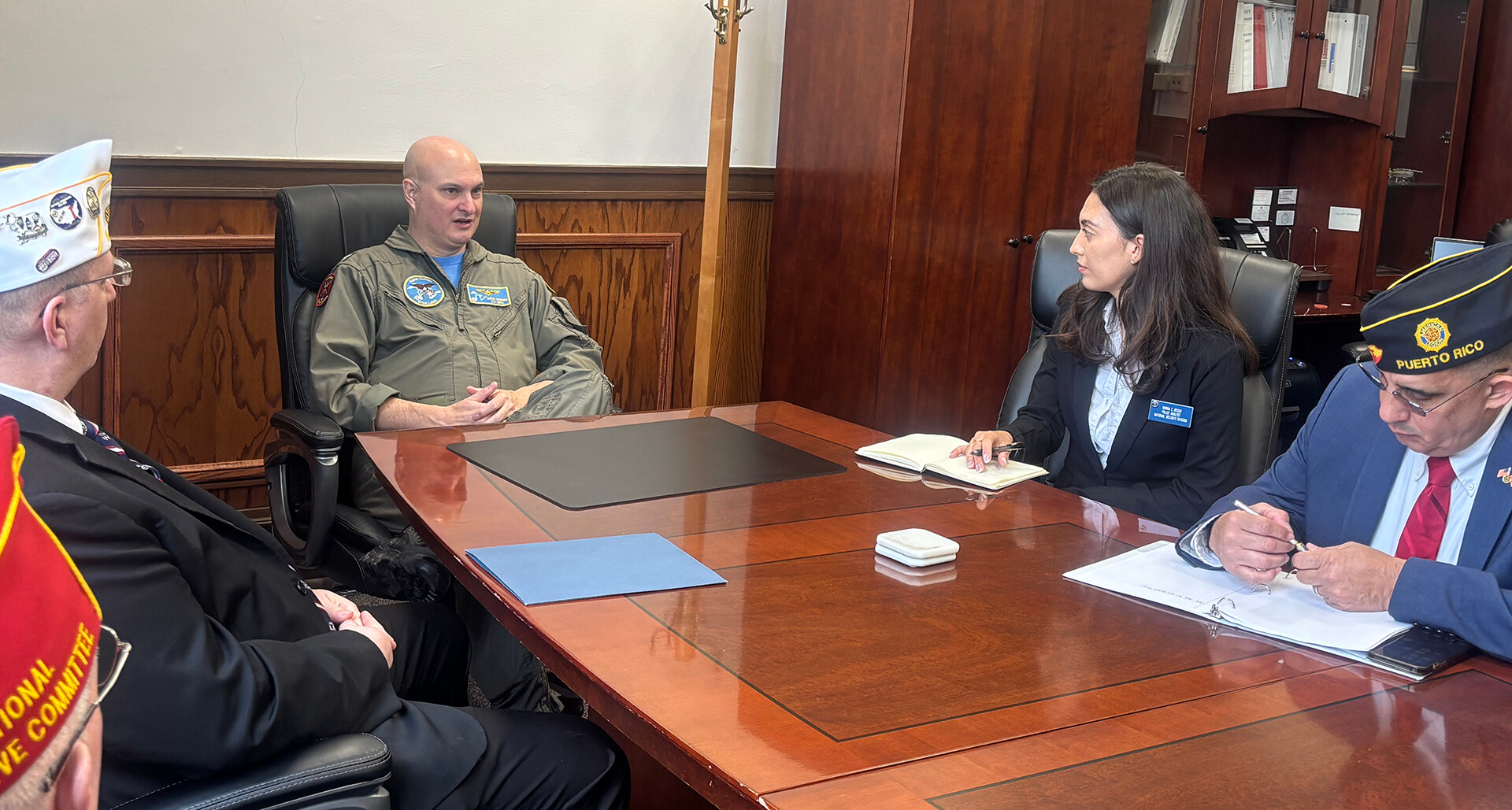
Legion staff and volunteers tour Naval Station Great Lakes, home of the service’s only boot camp, during quality-of-life visit.
Staff shortages, infrastructure deficiencies and limited meal options were among the top concerns discussed between an American Legion delegation and officials at Naval Station Great Lakes during a recent quality of life visit at the installation.
The April 15 tour was the latest visit by Legionnaires representing the Base Assessment and Servicemember Experience (BASE) program, which was established by The American Legion to address issues facing military members and their families at various installations.
Located in North Chicago, Ill., the 115-year-old base is the Navy’s largest training installation and home of the sea service’s only boot camp. “At any given time, we have 20,000 to 22,000 recruits or students. And so, we look at this as where everything starts for sailors,” said Capt. Steve Yargosz, the station’s commanding officer. “And so, we have to make sure that we get (it) done right. If we don’t have the right morale, welfare, recreation programs, if we don’t do Fleet Family Council, (if) we don’t do housing right so all the barracks are right, if we don’t do galleys and food right, if we don’t do commissaries right, it sours sailors for the rest of their lives or potentially they won’t use it out in the fleet, which is bad for everybody.”
Meeting the needs of sailors, family members and the Navy is one of the primary purposes of BASE, a point driven home by Ariel DeJesus, the Legion’s deputy director of National Security.
“The American Legion is here to advocate for you in Congress and encourage legislation for you to get what is needed in order to ensure the quality of life for everyone is met,” DeJesus told Great Lakes’ officials.
Among some of the challenges facing the installation:
· Labor shortages that can be traced to hiring freezes and certification requirements
· Lack of funding for preventative maintenance and upgrading infrastructure
· Strategic planning during periods of funding by Continuing Resolution (CRs)
· Limited dining for students training at night.
Yargosz pointed out that hiring qualified firefighters is difficult due to many of them lacking national certification and a gap in salary compared to what is offered by neighboring communities.
“Across the board we are short-staffed. Firefighting, police and public works are areas that we are very short-staffed and don’t have the ability to hire (needed) civilians,” he said.
The Legion delegation. comprised of national staff members and officers from The American Legion Department of Illinois, visited the child development center, a base gym, the dental clinic, the family support center, recruit barracks, student dormitories, the Surface Combat Systems Training Command and the Surface Warfare Engineering School.
“Visiting Naval Station Great Lakes facilities, like medical centers and barracks, helps us understand the environment and promote a comprehensive approach to military quality of life, as similar challenges may occur elsewhere,” National Security Policy Analyst Hanna Begun explained.
It was a homecoming of sorts from Department of Illinois Commander Roy Smith, a retired chief warrant officer.
“This was where I started my naval career, right here,” Smith said. “To come here and be a part of this, and to make sure the sailors get what they need, is really a wonderful experience.”
A few of the 40 barracks at Great Lakes date back to the 1970s, which creates an imbalance between personnel housed in the modern facilities and those living in rooms that are nearly the same age as their grandparents. The older barracks are less spacious and not designed with HVAC systems that draw air from the outside.
“If you put four sailors in there, you’re just circulating the same air and building up carbon dioxide,” Yargosz said of the small rooms.
Training demands at Great Lakes occur at all hours, meaning a significant population of sailors are night students and may be limited to “midnight rations” or boxed meals for six months. “The only things that’s open at midnight is actually nothing really,” said Lt. Commander Braulio Medina, Director of Students at the Surface Combat Systems Command. “So, they have no food options other than this bagged meal.”
Medina estimates that it would require about $444,000 to keep the station’s galley open at night. “This is something we can use your advocacy for,” Medina said to the Legion.
Though The American Legion team acknowledged that several quality-of-life issues must be addressed, members were impressed with the professionalism and upbeat attitude of the sailors. “”I didn’t think they asked for anything that wasn’t truly needed,” National Executive Committeeman Ron Hoffman said. “I would say that they would certainly be happy to see us again if we can have a positive effect.”
“It’s important that we can build these relationships through actions,” added Department of Illinois Adjutant Josh Thielen. “Having a facility like this here in Illinois is a big, growing opportunity for the department.”
- Security