

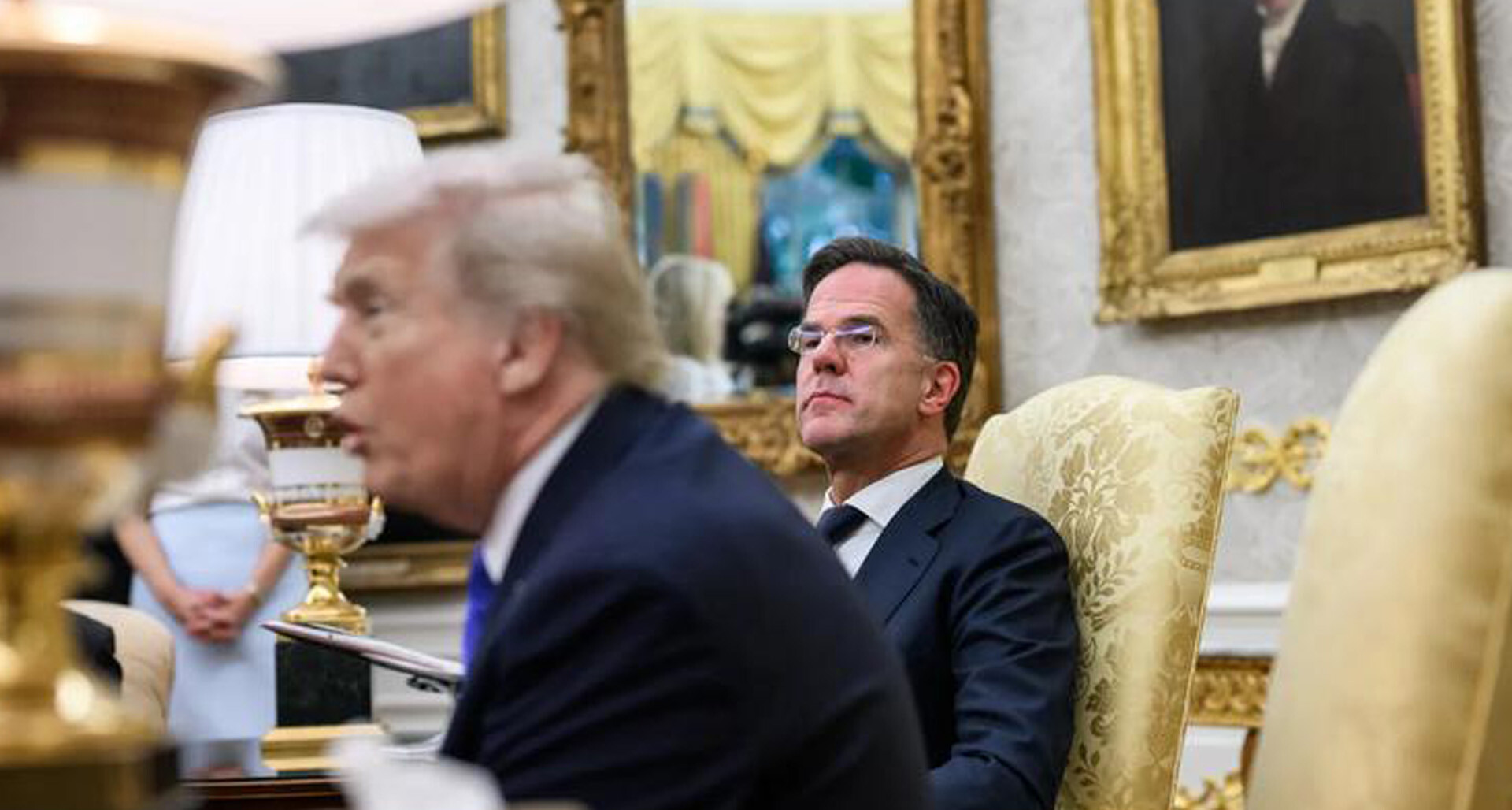
President Donald Trump again took aim at NATO after a meeting with its top official, calling the alliance unreliable as Washington weighs a plan to relocate bases in Europe to countries deemed more cooperative.
President Donald Trump again took aim at NATO after a Wednesday meeting with its top official, calling the alliance unreliable as Washington weighs a plan to relocate bases in Europe to countries deemed more cooperative.
“NATO wasn’t there when we needed them, and they won’t be there if we need them again,” Trump posted on his Truth Social platform shortly after his White House meeting with NATO Secretary-General Mark Rutte.
The talks with Rutte occurred at a pivotal time for NATO, which Trump has blasted repeatedly during both of his terms as president. The situation has raised questions about whether the large U.S. troop presence and network of bases in Europe could be used as leverage for reprisals.
Trump is considering punishing some NATO members for not supporting U.S. efforts in Iran, The Wall Street Journal on Wednesday reported.
One option involves moving some U.S. bases to countries deemed more helpful during the conflict. Poland, Romania, Lithuania and Greece are countries that could stand to gain U.S. troops, U.S. officials told the newspaper.
Besides relocations, the plan also could target a U.S. base in at least one European country, possibly Spain or Germany, for closure, officials said.
The plan is in its early stages but is supported by some top Trump officials, with the administration also considering a range of other options to punish allies, according to the newspaper report.
Trump has considered closing bases and relocating forces in Europe before. Toward the end of his first term, a plan emerged calling for the withdrawal of 12,000 troops from Germany, sending some elsewhere in Europe and others back to the U.S.
The proposal, ostensibly meant to punish Germany for not spending enough on defense, never came to fruition and was later canceled by President Joe Biden.
U.S. bases in Europe have been developed over decades and serve an array of functions, including projecting power far beyond the Continent. Making significant changes to the current arrangement would be complex.
Ramstein Air Base in Germany, for example, is the U.S. military’s most significant base in Europe, and any effort to shift comparable operations elsewhere would require massive investments in infrastructure to replicate its capabilities.
Likewise, the elaborate training areas in Grafenwoehr and Hohenfels, referred to as the “crown jewel” of the Army’s presence in Europe, would be hard to duplicate elsewhere.
Even though Poland has gone to great lengths to build up facilities for U.S. forces, they remain austere compared with those in Germany and are not designed for large numbers of permanently stationed troops and families.
While Germany has been a frequent target for Trump, Berlin has ramped up defense spending, a major point of contention. Trump and German Chancellor Friedrich Merz also are said to have a good relationship. But Merz has delivered mixed messages about the Iran war, signaling initial support before eventually saying it was not Europe’s fight.
Still, U.S. bases in Germany have factored into the Iran mission, with Ramstein serving as a logistics hub for operations.
Rutte said he recognized Trump’s frustration with some allies.
“I can see his point,” Rutte told CNN. “But at the same time, I was also able to point to the fact that the large majority of European nations have been helpful with basing, with logistics, with overflights, with making sure that they lived up to their commitments.”
One country that has taken an opposing position is Spain, which refused permission for its bases and airspace to be used for missions connected to the Iran war.
Secretary of State Marco Rubio and Trump ally Sen. Lindsey Graham, R-S.C., have said alternative basing arrangements should be considered if ally or partner countries put limits on U.S. operations.
Spain was already out of favor with Trump for refusing to support a new NATO plan calling for defense spending of 5% of gross domestic product.
That could have implications for the Navy’s base in Rota, home to several warships that play a key role in NATO’s integrated air defense system. But moving those ships and sailors out of Spain would be complicated given the limited number of alternatives.
One possibility could be repositioning the Rota mission to Souda Bay in Greece, although the move would entail giving up a strategic position at the gateway to the Mediterranean Sea.
Such a move, however, would require significant time and money to build the infrastructure needed to support five Navy destroyers, the sailors assigned to them and their families.
- Security