

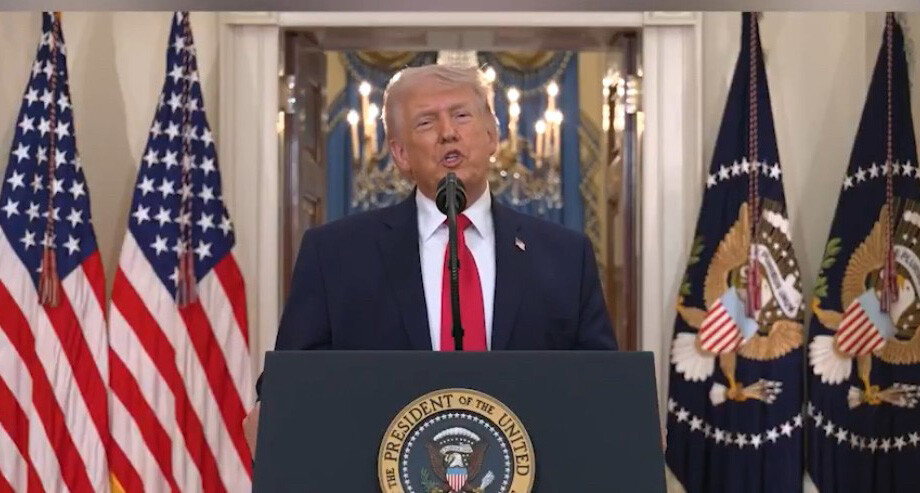
‘Tonight, I’m pleased to say that these core strategic objectives are nearing completion,’ the president said from the White House.
More than a month after launching Operation Epic Fury, President Donald Trump used his primetime address Wednesday night to declare the war with Iran is winding down.
“Tonight, I’m pleased to say that these core strategic objectives are nearing completion,” Trump said in his first address on the operation. “We’re going to hit them extremely hard over the next two to three weeks.”
Leading up to his speech, Trump had been saying that U.S. forces will wrap up in two to three weeks, though he did not provide details on how and when the U.S. will pull out of the region.
The war, now in its fifth week, has seen Trump alternate between promising a swift end to the conflict and signaling a potential expansion, as thousands of U.S. troops and military assets have surged to the region or are on their way.
The president on Wednesday morning posted on Truth Social that Iran’s “new regime president” asked the U.S. for a ceasefire.
“We will consider when the Hormuz Strait is open, free, and clear. Until then, we are blasting Iran into oblivion or, as they say, back to the Stone Ages,” Trump wrote.
Defense Secretary Pete Hegseth shared the post on X and added a saluting emoji. American forces have struck more than 12,000 targets inside Iran since launching the operation on Feb. 28, decimating much of its missile stockpile, production facilities and largest naval vessels.
Early in the conflict, Supreme Leader Ayatollah Ali Khamenei was killed. His son, Mojtaba Khamenei, is now Iran’s supreme leader.
Administration officials since the launch have said the objectives are to destroy Iran’s missile capabilities and its navy and ensure Iran never obtains a nuclear weapon.
Trump on Wednesday reminded viewers that since 2015 he has vowed to never let Iran have a nuclear weapon. He said he had addressed this during his two terms, including in 2020 when U.S. forces killed senior Iranian military leader Maj. Gen. Qassem Soleimani.
Iran’s Isfahan, Natanz and Fordow nuclear facilities sustained major damage during a joint U.S.-Israeli bombing campaign last summer, but not everything was destroyed, according to Rafael Grossi, director general of the International Atomic Energy Agency. Trump in June said the sites were “completely and fully obliterated.”
The president in his address said Iran sought to rebuild at a different location and was also building a vast stockpile of conventional ballistic missiles.
“They had some weapons that nobody believed they had. We just learned that out. We took them out. We took them all out,” Trump said.
Iran still maintains a chokehold on the Strait of Hormuz, sharply restricting traffic and allowing only limited oil shipments through. The waterway’s closure has caused oil and gas prices to surge, sparking concerns about wider implications for the global economy.
The average price of gasoline in the U.S. rose above $4 a gallon on Tuesday.
“When this conflict is over, the strait will open up naturally. They’re going to want to be able to sell oil, because that’s all they have to try and rebuild. It will resume the flowing and the gas prices will rapidly come back down,” Trump said.
Thirteen service members have been killed since Operation Epic Fury began on Feb. 28. Six U.S. soldiers were killed in a drone strike in Kuwait, and another was killed in Saudi Arabia. In Iraq, six airmen died when their refueling tanker went down over friendly territory.
The number of wounded increased to 348 as of Tuesday, U.S. Central Command spokesperson Capt. Tim Hawkins said. The majority have returned to duty.
The Wall Street Journal reported last week that the Pentagon is considering sending up to 10,000 more ground troops to the Middle East, adding to the roughly 5,000 Marines and thousands of paratroopers from the 82nd Airborne Division headed to the region.
The Okinawa-based 31st Marine Expeditionary Unit and U.S. sailors arrived March 27 in the Middle East aboard the USS Tripoli, U.S. Central Command said on X.
Trump did not address putting boots on the ground in Iran during his televised remarks but has not ruled it out, a move that could significantly escalate the war and risk more U.S. casualties, experts say.
On Tuesday, after weeks of grumbling about NATO allies’ reluctance to send forces to Iran, the president posted on Truth Social urging European allies to “build some delayed courage” and “go get your own oil!” Trump reiterated this point Wednesday night in his address to the American people.
The social media post came after U.S. strikes hit Isfahan, a city that is home to one of Iran’s main nuclear sites, sending a massive fireball into the sky, and Tehran attacked a fully loaded Kuwaiti oil tanker in the Persian Gulf, The Associated Press reported.
Hegseth echoed Trump’s message to the world to help with the Strait of Hormuz, saying that other “countries should pay attention when the president speaks.”
The secretary on Tuesday declined to reaffirm the U.S. commitment to NATO’s collective defense, saying that would be up to the president after European allies had failed to stand with the U.S. in the war against Iran.
Trump first threatened to leave the alliance at its 2018 summit. Formally withdrawing the U.S. from NATO would require a vote by the Senate.
- Security