

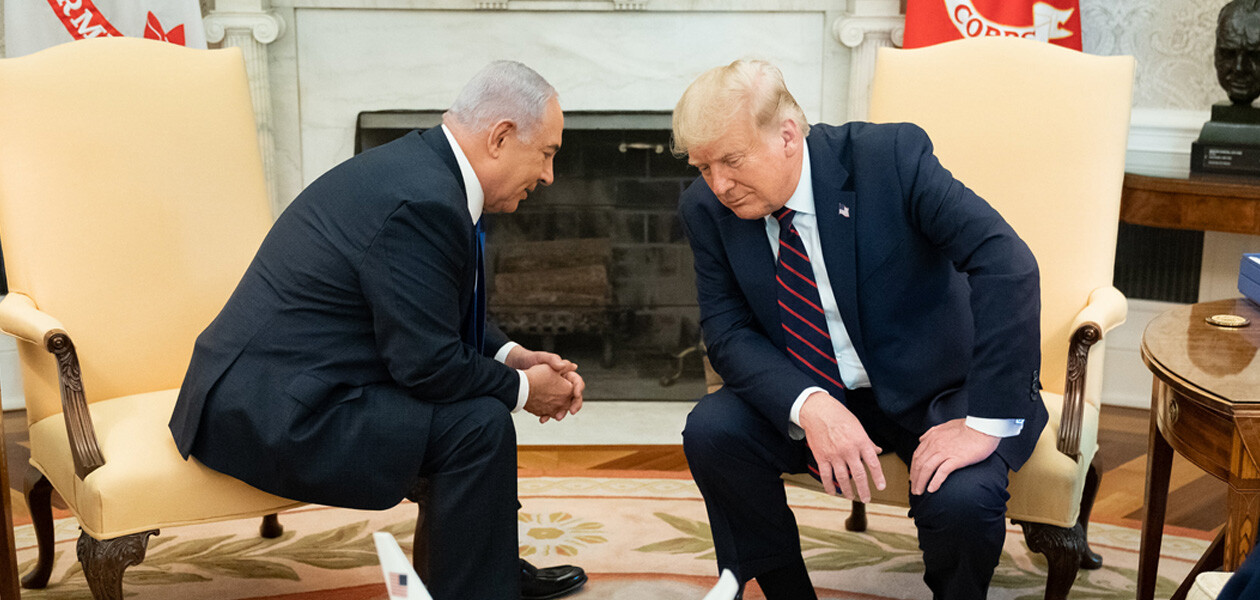
Netanyahu rejects Board of Peace’s 15-point document; Trump says U.S. ‘low-keying’ negotiations with Iran; U.S., South Korea to begin annual exercises next week to counter North Korean threat.
1. Israel will not accept the 15-point plan for Gaza set out by President Donald Trump’s Board of Peace, Prime Minister Benjamin Netanyahu said Sunday. “I want to clarify this: Israel rejects the 15-point document. I have heard people saying, ‘You didn’t say that.’ So here I am saying it again,” he told a Cabinet meeting, referring to the peace plan set out by Trump last year. “The IDF will not carry out any withdrawal until Hamas is disarmed,” he added. Trump last month touted a breakthrough in his Gaza peace plan, saying that Hamas has agreed to lay down arms. The peace plan called for a phased withdrawal of Israel’s troops from Gaza alongside the disarmament of Hamas, but Netanyahu said Israeli forces are not going anywhere until Hamas completely disarms first. “When I say Hamas must be disarmed, I mean heavy weapons, lighter weapons, all weapons. We are talking about genuine disarmament, not a fictitious one,” Netanyahu said Sunday.
2. President Trump said on Sunday that the U.S. is "low-keying" negotiations with Iran and signaled a willingness to allow economic pressure to mount on the Islamic Republic. "We are only semi-negotiating with them. We are just watching Iran with its huge inflation and the fact they have no money," Mr. Trump told Axios during a phone interview. He said Iran is in "very bad shape" and that the U.S. blockade on the Strait of Hormuz has exacerbated the country's economy. "It will work out. It always works out. It's like a chess game," Mr. Trump said.
3. South Korean and U.S. troops will begin their annual exercises next week to beef up readiness against North Korean threats, the allies announced Monday, days after North Korea resumed ballistic missile testing activities that are banned by the U.N. The Ulchi Freedom Shield is to begin next Monday for a 11-day run and its scale will be similar to previous years with about 18,000 South Korean soldiers participating in it, South Korean military spokesperson Jang Do-young told reporters. Speaking at the same news conference, U.S. military spokesperson Ryan Donald said by incorporating realistic threats including “lessons from recent conflicts,” the exercise will serve as an opportunity to further strengthen the alliance’s readiness and capabilities through combined, joint, all-domain operations. He cited North Korea’s dispatch of troops to support Russia’s war against Ukraine in recent years.
4. More than 142,000 post-9/11 veterans who screened positive for a possible deployment-related traumatic brain injury and agreed to a comprehensive VA evaluation did not ultimately receive one, according to a new Department of Veterans Affairs (VA) watchdog report. The VA Office of Inspector General found that 301,177 veterans agreed to receive a comprehensive traumatic brain injury evaluation after screening positive between Sept. 11, 2001, and March 31, 2025. Only 158,907 received the evaluation, leaving 142,270 without the follow-up assessment. The finding comes from a national review released Aug. 5, examining how the Veterans Health Administration screens and evaluates post-9/11 veterans for traumatic brain injuries, or TBIs. The review found that the VA was largely successful at getting eligible veterans through the initial screening process, but significant numbers fell out of the system before receiving the more detailed medical evaluation used to determine whether they actually had a TBI.
5. A Ukrainian drone attack Monday on the Russian city of Nizhnekamsk killed 13 people, including a child, and wounded 75 others, authorities in the Tatarstan region said. The Ukrainian military said it hit an oil refinery there. Russian officials didn’t say what the drones targeted, but the city is an important oil refining hub, home to two refineries and a petrochemical plant. Ukraine has targeted Russian oil facilities with long-range drones almost daily in recent months. The barrage has caused fuel shortages in Russia, eaten into Russian refining capacity and unsettled the Russian public. Ukrainian President Volodymyr Zelenskyy says it is a campaign to force Russian President Vladimir Putin to the negotiating table and stop his more than 4-year-old invasion.
- Security