

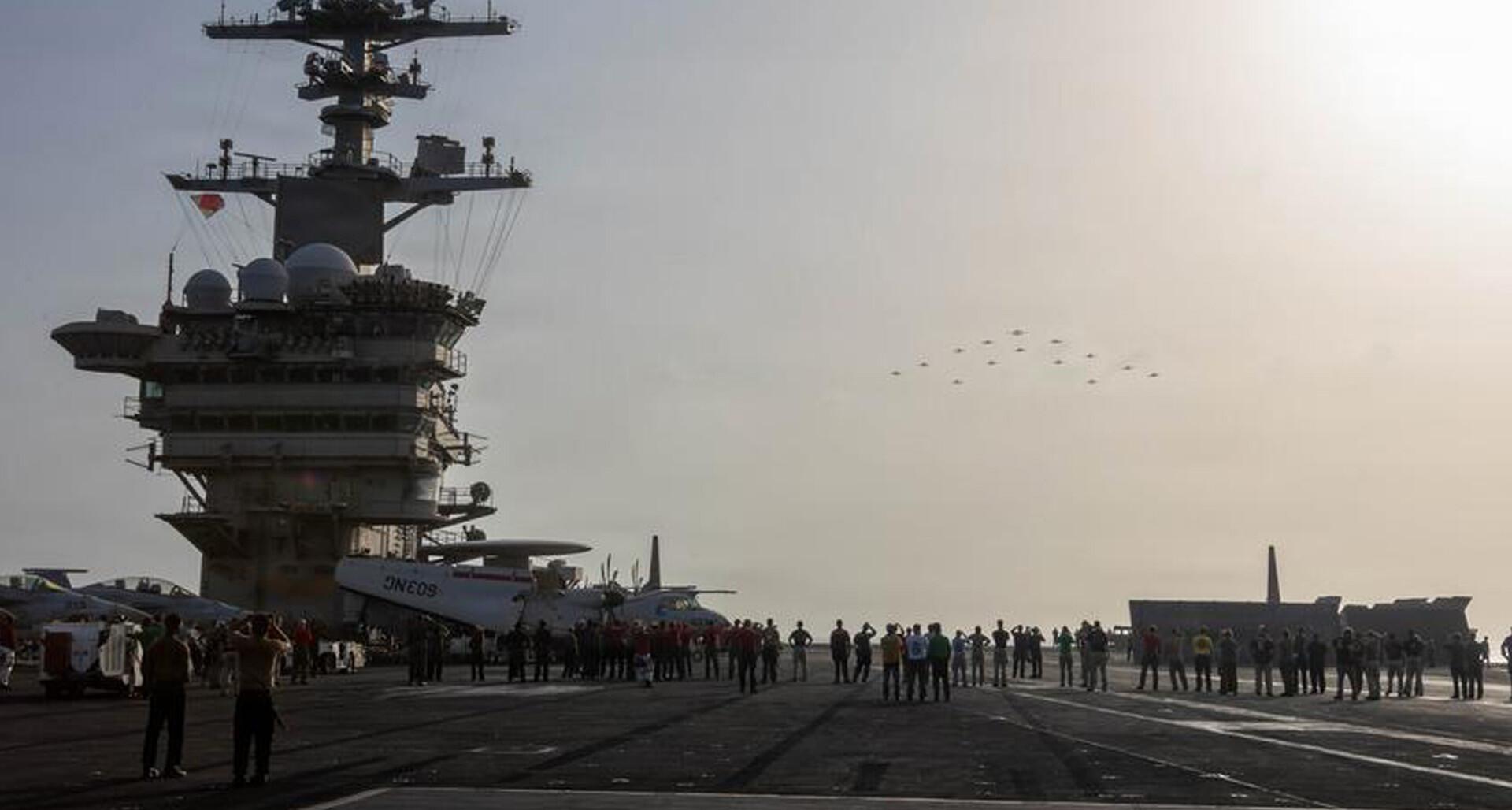
USS Abraham Lincoln heads home after demanding deployment, Iran warns that U.S. sanctions will not bring end to war, and U.S. surveillance plane flies through Taiwan Strait for first time in five months.
1. The aircraft carrier USS Abraham Lincoln has left the Middle East as it heads home to San Diego after a demanding nine-month deployment that included 200 days in a combat zone. Lincoln and its crew of about 5,000 sailors and Marines are operating in the U.S. 7th Fleet area of operations, a Navy official confirmed Saturday, speaking on background as they were not authorized to speak publicly. The fleet’s area of responsibility stretches from the International Date Line to the India-Pakistan border, and from the Kuril Islands in the north to the Antarctic in the south, according to the Navy. Lincoln’s departure from the Arabian Sea, where it supported U.S. military operations against Iran, including a maritime blockade against Iranian ports, follows the arrival of the aircraft carrier USS George Washington to the Middle East earlier this week.
2. Iran warned that U.S. sanctions set to be announced would not bring peace to the region. Iran’s Foreign Ministry spokesperson on Monday warned that Tehran would respond harshly to expanded U.S. sanctions, including measures against countries it sees as cooperating with Washington. “Any escalation of this situation will undoubtedly bring about consequences,” Esmail Baghaei said. “Our hands are not tied.” The prospect of expanded sanctions and Iran’s threat to respond come after weeks of impasse, with the United States having not yet dislodged Iran’s grip on shipping through the Strait of Hormuz. Iranian attacks and threats have severely hampered traffic through the waterway, through which a fifth of the world’s traded oil passed before the war started nearly six months ago.
3. A U.S. Navy surveillance plane has flown through the Taiwan Strait for the first time in five months, drawing scrutiny from China ahead of President Xi Jinping’s expected visit to the White House. The P-8A Poseidon — a long-range maritime patrol and reconnaissance aircraft equipped with advanced sensors — flew Friday through international airspace over the roughly 110-mile-wide waterway separating China from Taiwan, according to the U.S. 7th Fleet. The aircraft traveled southwest from the East China Sea to the South China Sea in what fleet spokesman Cmdr. Matthew Comer described as a “routine transit.”
4. Israel did not warn the United States before it struck an air base in northern Syria this week, despite fears of an escalation with the U.S. and NATO ally Turkey, the U.S. special envoy to Syria said. Israel usually closely coordinates its military actions with the U.S., its key backer. Washington has tried to use this influence to moderate attacks as Israel carries out operations in Syria, Gaza and Lebanon. Tom Barrack, who also serves as ambassador to Turkey, said the attack on Tuesday on the Abu Duhur base could have been Israel “baiting the Turks … that was the serious and worrying part.” However, Israeli Defense Minister Israel Katz contradicted the U.S. envoy's remarks about there being no warning, saying in a statement that Israel decided to alert senior members of the Syrian government. “Simultaneously, we transferred the intelligence reports to the relevant authorities in the U.S.,” Katz added.
5. European leaders joined President Volodymyr Zelenskyy in Kyiv on Monday for official celebrations marking Ukraine’s Independence Day as Russia pushes on with its 4-year-old invasion of the country. One of President Vladimir Putin’s key goals in starting a war with Russia’s neighbor in February 2022 was to place Kyiv in Moscow’s orbit. Ukrainians voted overwhelmingly for independence in 1991. With no significant changes on the front line for months and no apparent progress after more than a year of U.S.-led peace efforts, the warring countries are locked in a spiral of escalating aerial attacks that are killing civilians and smashing infrastructure.
- Security