

Iran supreme leader warns of ‘regional war’ if U.S. carries out any attacks, the impact of the government shutdown, VA’s planned reorganization and Russian drone strike in Ukraine kills more than a dozen.
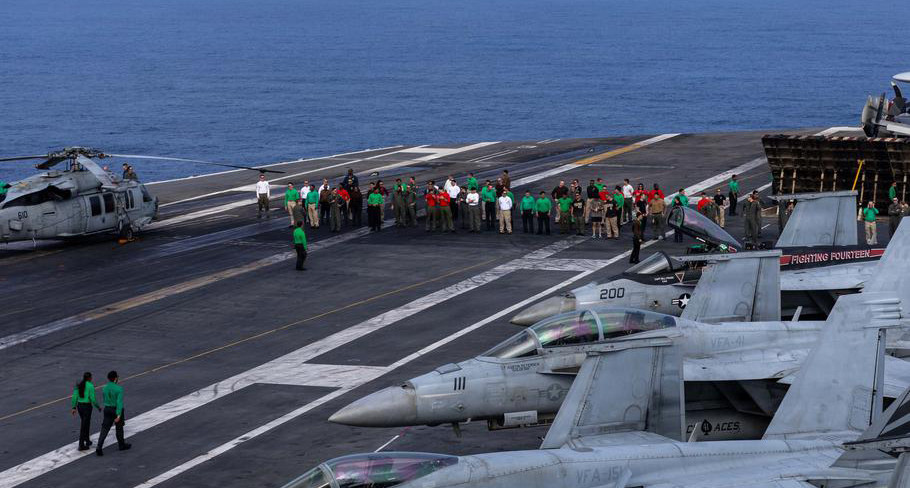
1. Iran’s supreme leader warned Sunday that any attack by the United States would spark a “regional war” in the Mideast, further escalating tensions as President Donald Trump has threatened to militarily strike the Islamic Republic over its crackdown on recent nationwide protests. The comments from the 86-year-old Ayatollah Ali Khamenei are the most-direct threat he’s made so far as the aircraft carrier USS Abraham Lincoln and associated American warships are in the Arabian Sea, sent by Trump there after Tehran’s bloody crackdown on nationwide protests. It remains unclear whether Trump will use force. He’s repeatedly said Iran wants to negotiate and has brought up Tehran’s nuclear program as another issue he wants to see resolved. But Khamenei also referred to the nationwide protests as “a coup,” hardening the government’s position as tens of thousands of people reportedly have been detained since the start of the demonstrations. Sedition charges in Iran can carry the death penalty, which again renews concerns about Tehran carrying out mass executions for those arrested — a red line for Trump.
2. The partial government shutdown is vastly different from the record closure in the fall. That is mostly because this shutdown, which started Saturday, does not include the whole of government and may not last long, even as it now drags into the new week. The House had hoped to pass funding legislation quickly when lawmakers return Monday evening, and that would have ended the shutdown. But House Speaker Mike Johnson, R-La., now says he is hoping to have the package considered “at least by Tuesday” as he scrambles to round up votes and Democrats hold out for deeper changes to immigration enforcement. Congress already has passed half this year’s funding bills, ensuring that several important federal agencies and programs continue to operate through September.
3. The planned reorganization of the Veterans Affairs health system should result in improvements to VA medical facilities, increased oversight of hospitals and clinics and better access to care at the VA and with civilian providers in the department’s community networks, VA officials said during appearances before Congress this month. In what will be the largest reorganization of the Veterans Health Administration since the 1990s, the VA plans to restructure VHA’s administration, realign staff and resources and invest in medical facilities. At the same time, the VA will award new contracts for community care — its program that covers medical care for eligible veterans at civilian facilities — using a new structure the VA hopes will give the department better flexibility to choose and change contracted provider networks.
4. A Russian drone strike on the Ukrainian city of Dnipro hit a bus carrying mineworkers and killed at least a dozen people, Ukrainian authorities said Sunday, hours after President Volodymyr Zelenskyy announced that the next round of peace talks between Russian and Ukrainian delegations will take place on Wednesday and Thursday. The strike injured several more people and sparked a fire that was subsequently put out, according to the emergency services. DTEK, Ukraine’s largest private energy company, said it owned the bus and accused Russia of carrying out “a large-scale terrorist attack on DTEK mines in the Dnipropetrovsk region,” whose capital is Dnipro. “The epicenter of one of the attacks was a company bus transporting miners from the enterprise after a shift in the Dnipropetrovsk region,” the company said in a Telegram post.
5. Tucked inside the more than 3,000 pages of the recently passed defense budget for Fiscal Year 2026 is a mandate that the secretary of defense carry out a study focused on the mental health impacts of piloting unmanned aircraft systems in combat. The rise of military drone pilots as a profession has brought with it a fair share of jeers and suspicion. In 2013, when the Pentagon rolled out a “Distinguished Warfare Medal” to honor drone operators, troops dubbed it the “Nintendo Medal.” It was canceled soon after and replaced with an “R” device — for “remote warfare” — in 2016. But research shows that the impacts of combat trauma on drone operators are real, and could be even more profound than those on pilots of manned aircraft. A 2023 literature review published in the Journal of Mental Health & Clinical Psychology found that crews of remotely piloted aircraft “exhibit greater psychiatric symptoms, in general, as compared to crews that work with crewed military aircraft.”
- Security