

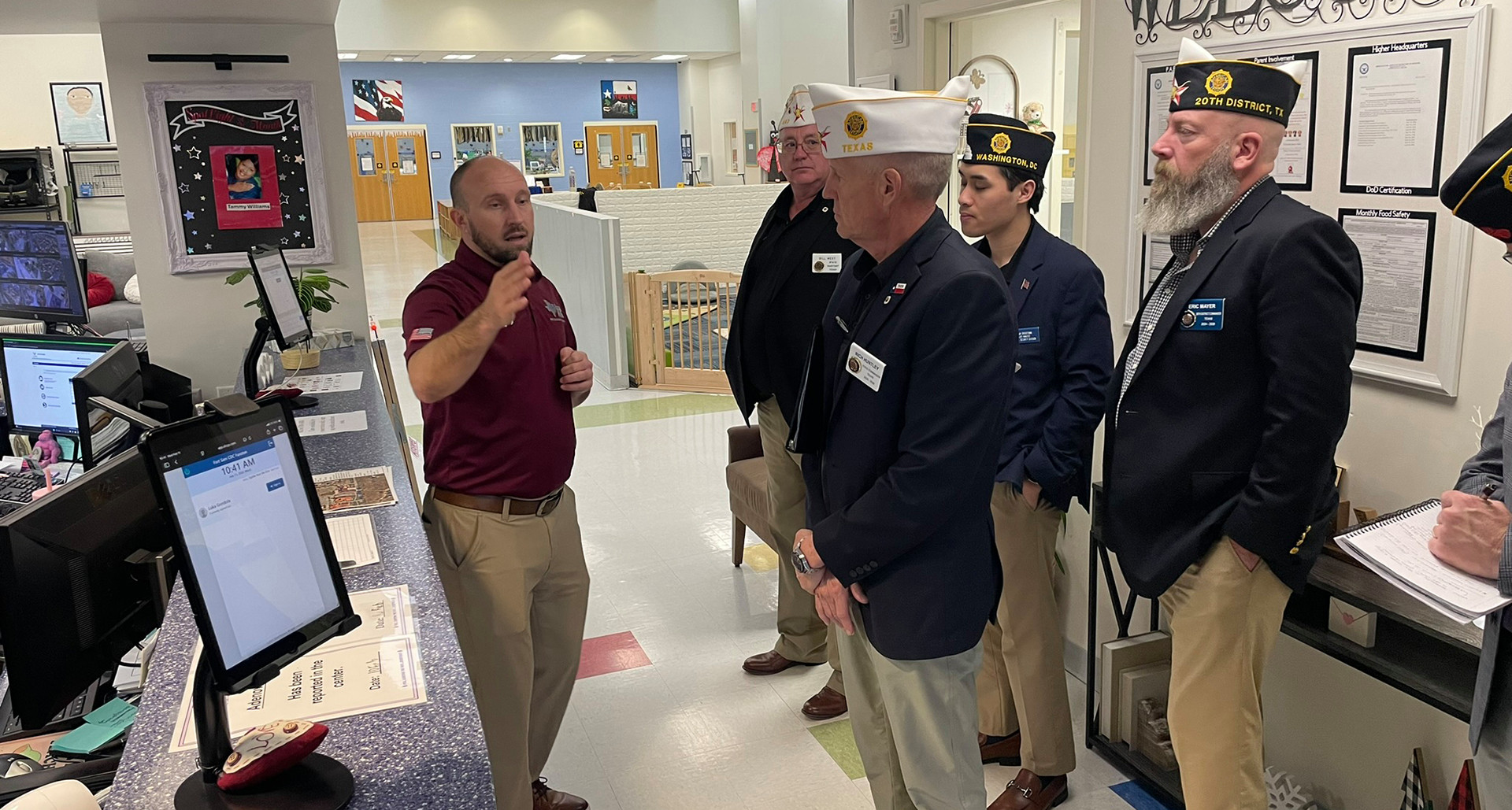
American Legion delegation makes Base Assessment and Servicemember Experience visit to Joint Base San Antonio-Fort Sam Houston.
When The American Legion planned to make a Base Assessment and Servicemember Experience (BASE) visit to Joint Base San Antonio (JBSA)-Fort Sam Houston and wanted to include Department of Texas Legionnaires, Eric Mayer wanted to be included.
Not only is JBSA in the department’s 20th District, of which Mayer is the commander, but the member of American Legion Post 10 in San Antonio also has a personal connection to the base.
“No. 1, this is in my backyard,” Mayer said. “When you look at the installations in San Antonio, this is very much our family. We have a lot of members who were part of these installations, who need the services they provide, and I have a hard time finding someone who hasn’t gotten care at BAMC (Brooke Army Medical Center) or one of the clinics.”
Include Mayer in the latter category. He spent about 30 days as an inpatient getting treatment for Non-Hodgkins lymphoma – including a bone marrow transplant – six months in intense chemotherapy and three years of maintenance. He’s now in remission, and his experience at BAMC is why he wants to be a part of solutions at the base.
“It is personal for me,” Mayer said. “My wife is a retired nurse colonel, and she retired here, so it’s personal for her, too. It’s just like the Legion is personal for me.”
Mayer was part of the American Legion delegation that visited JBSA-Fort Sam Houston Feb. 10-12 for the visit. The BASE program was created in 2022 to address quality-of-life matters that affect servicemembers and their families. Modeled after the longstanding American Legion System Worth Saving program, the mission of BASE is to work with the Department of Defense to identify strategies that will ensure a strong quality of life for servicemembers and their families.
Joining Mayer on the visit were American Legion Department of Texas Commander Richard Huntley and Department Adjutant Bill West. Coordinating the visit and also participating were American Legion National Security Division Director Sean Counihan and Joshua Crisostomo, an American Legion policy analyst and the BASE program manager.
Mayer said the BASE program is important because, “It is easy for us to focus on just veterans. But having that connection with (active-duty personnel), them understanding we’re there for them, us understanding where we’ve been and how important that is – that connection is priceless to maintain.”
Huntley, who spent most of his 30 years in the U.S. Marine Corps as a pilot, stressed to each base employee he spoke to that he wanted to take what they felt were their biggest needs and share them with members of the Texas congressional delegation when he’s is in the nation’s capital in a little more than a week for the organization’s annual Washington Conference. “That’s our job,” he said. “We’re here to collect the facts so we can go back and get you what you need.”
A member of S. Mike Lacy American Legion Post No. 554 in League City, Huntley said he wanted to be part of the BASE visit “to get a firsthand look at what the program is doing. To see how it’s actually able to gather its information. And, ultimately, see how that information is being transmitted out to everybody.”
He called the tour of Fort Sam Houston “eye-opening. Seeing the amount of effort that everybody puts in … providing a community that is good for our (servicemembers) and their families and then seeing some of the shortcomings that we need to address and be aware of.”
The group of Legionnaires started the visit with a briefing from JBSA Chief of Staff Mark Tharp, who spent 20-plus years in the Air Force before taking on civilian roles at the base. He gave some pretty impressive statistics about JBSA, including:
· The entire base spanning more than 45,000 acres.
· A personnel count of more than 88,000 servicemembers, civilian worker contractors and daily military personnel undergoing some sort of training on the base.
· The 502nd Air Base Wing, the host wing for JBSA, working with 267 mission partners.
Tharp has worked at JBSA since its inception in 2010, when it consolidated Fort Sam Houston with Air Force Bases Lackland and Randolph. “It’s been a learning curve,” he said. “It’s been interesting to see it grow and morph into what it is today. When you take three large, dynamic bases … and call them one big wing … that’s a big lift to do that. It’s not only the process and logistics of it, but also the culture of trying to incorporate the Army into what is an Air Force-led organization. But I think we’re in a good place now.”
A tour of Fort Sam Houston that included multiple stops followed the briefing. The tour provided an opportunity to both learn about what Fort Sam Houston has to offer and where issues exist.
· Housing. Tours of both the fort’s dorms and privatized housing were included, as was a look at a sample home for military families displaced because of renovations or property damage.
· Childcare/youth programs. The Legion delegation was provided a tour of the base’s main Child Development Center (CDC). A larger CDC is in the process of being constructed, which will have the capacity to provide space for 300 children. “JBSA has done a very good job at advocating and providing all the statistics for a new for childcare,” said Matt Kuhl with Fort Sam Houston Child & Youth Programs. “It’s a big expansion for us.”
· Transition assistance. Via the Army’s Transition Assistance Program (TAP), Fort Sam Houston provides many services to assist those preparing to leave the military, including transition coaches, financial counseling and access to U.S. Department of Veterans Affairs’ Veteran Readiness & Employment staff. The base also hosts monthly Employer Day events, which allow military personnel to connect face to face with prospective employers from the area. Eleven of those events are with a single employer, while the 12th includes multiple employers in a job fair atmosphere. During the TAP spot, the BASE delegation met with former Department of Labor employee Donna Balderston, a life member of American Legion Post 157 in Bandera, Texas, and currently an ombudsman for the Employer Support of the Guard and the Reserve. Balderston used part of the conversation to praise The American Legion. “You all do so much,” she said. “Everything that you are doing is fabulous. It really touches a lot of servicemembers and their families.”
· Physical fitness facilities. A stop at the 24/7 Jimmy Brought Fitness Center allowed the delegation to tour the full basketball courts, free and machine weight rooms and more.
· Brooke Army Medical Center (BAMC). The visit also included a tour of BAMC, the largest and most robust military health-care organization within the Department of Defense (DoD). With between 8,500 and 9,000 employers – 60 percent civilian, 40 percent military – BAMC provides care for more than 240,000 military beneficiaries in the area. The center also serves as a world-class burn center, the only DoD Level 1 trauma center, four Fisher Houses and the Center for the Intrepid, whose state-of-the-world technologies designed are used for rehabilitation, research, education and training.
Toward the end of Wednesday’s tour, the Legion delegation had an opportunity to spend time with a military spouse, who shared some of her concerns about Fort Sam Houston. Those included a lack of security on parts of the base where fencing can easily be climbed, base civilian security forces being drawn from the base by higher-paying jobs, a lack of on-base activities for older military children, food insecurity for some families and military families not having a voice when it comes to housing issues.
She also expressed frustration with repairs being delayed among JBSA’s three bases because of shared resources. She referred to all three installations working from the “same bucket.” Base families living in privatized housing also saw a decrease in their Base Allowance for Housing (BAH) by 2 percent this year.
During an exit briefing with Lt. Col. Misty White, JBSA’s Director of Public Affairs, Crisostomo said the visit gave the delegation “a lot of data to work with. Much more than we anticipated, which is helpful. Not only does this data enable us to effectively advocate for quality-of-life challenges that JBSA faces, it also provides us with best practices that could be shared across the force.
“What stuck out to me the most was how much everyone cared for about what they are doing, which was very warming to see. Everyone was very positive.. Many of the mission partners whom we’ve spoken with have been in their jobs for many years – in some cases decades – which is a testament to their commitment to serving servicemembers and military families.”
Mayer said the visit “was a reminder of how complex every military installation is. No matter how small they are, the amount of moving parts that go into having a well-run installation is overwhelming. It’s amazing to me that anyone can wrap their mind around it.
He came away impressed with the facility but also wanting to be able to assist with any potential shortcomings. “The housing looks like they really take their job seriously,” Mayer said. “I love seeing the passion that was displayed by the (Child Development Center) and them really wanting to help families. That’s personal for me. Also, there are certain aspects that I want to see improved. But that’s why we’re here: to help with those issues.”
- Security