

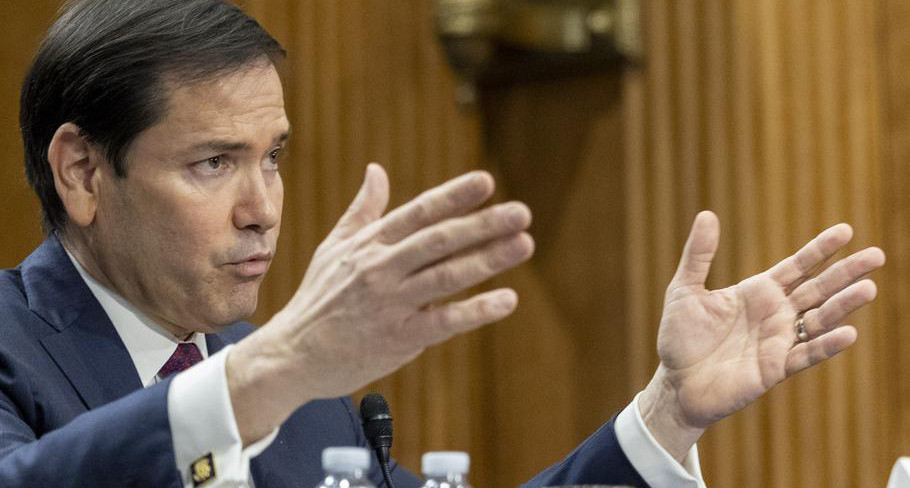
Secretary of State Marco Rubio told senators Wednesday the Trump administration does not expect to take further military action in Venezuela but reserves the right to use force to protect U.S. interests.
Secretary of State Marco Rubio told senators Wednesday that the Trump administration does not expect to take further military action in Venezuela but reserves the right to use force to protect U.S. interests.
“I can tell you right now with full certainty, we are not postured to, nor do we intend or expect to have to take any military action in Venezuela at any time,” Rubio told the Senate Foreign Relations Committee.
In written remarks he did not deliver orally, Rubio said the U.S. was, however, “prepared to use force to ensure maximum cooperation” from the interim authorities in Venezuela if other methods fail.
“It is our hope that this will not prove necessary, but we will never shy away from our duty to the American people and our mission in this hemisphere,” Rubio wrote.
His comments came nearly a month after a U.S. military raid seized President Nicolás Maduro of Venezuela and his wife, raising concerns among some lawmakers of protracted military involvement in the country. The USS Gerald R. Ford aircraft carrier remains deployed in the Caribbean, and about 15,000 U.S. troops are stationed on land and at sea in the region.
Rubio told senators that the only military presence they’ll see in Venezuela itself are Marines serving as U.S. Embassy guards.
“That is our goal, that is our expectation,” he said.
Rubio did not rule out taking military action in self-defense. If, for example, Venezuela deployed Iranian drones to threaten the U.S. presence in the region, “we most certainly will address that,” he said. “But we hope we don’t get to that point, we don’t expect to get to that point,” he said. “We’re not trending in that direction. That’s a fact.”
He noted that using military force in Venezuela would also impede the country’s recovery and hamper the administration’s goals.
“We want to reach a phase of transition where we are left with a friendly, stable, prosperous Venezuela and democratic in which all elements of society are represented and free and fair elections,” he said.
The timeline for that transition is unclear. Rubio said “it can’t take forever” and the U.S. needs to be “much further along” in Venezuela several months from now.
The hearing marked the first time Rubio faced public questioning about the administration’s actions in Venezuela and its strategy for the country’s future after months of classified briefings for lawmakers on Capitol Hill.
Lawmakers from both parties have expressed frustration over the administration’s lack of consultation with Congress as it embarked on a bombing campaign against suspected drug boats and then ousted Maduro.
Rubio said Wednesday that the Jan. 3 military raid could not have been briefed to Congress because “it wasn’t even in the realm of possible until very late in December” and the State Department deferred to the Pentagon on operational security.
Sen. Chris Coons, D-Del., urged Rubio to respect Congress’ oversight role over military engagements abroad, particularly as the U.S. is now surging military assets to the Middle East for a possible attack against Iran.
“I’m worried that the very foundations of trust are being shaken,” Coons said. “Our democracy depends on consultation with Congress that is truthful and timely. The confidence of our allies depends on them knowing where we’re going next.”
Republican John Curtis, of Utah, chairman of the Senate Foreign Relations subcommittee for the Western Hemisphere, said the State Department would not participate in a planned hearing on Venezuela last year, would not brief him on drug boat strikes and is not cooperating on a future hearing on priorities in the Western Hemisphere.
“I want to be clear, I support what’s happening with Maduro and what’s going on there, but I do think the administration could get Congress to be a better partner by informing us better,” he told Rubio. “And from my perspective, I’m struggling to see that.”
- Security