

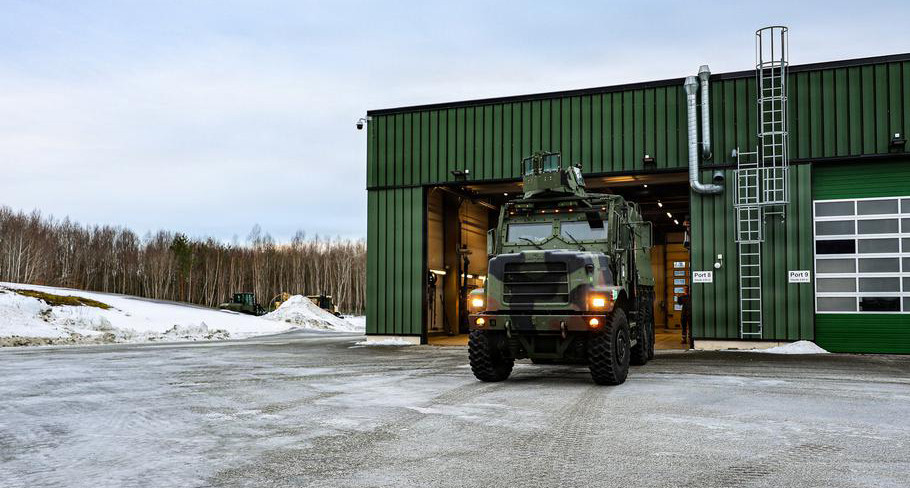
Thousands of American troops are gearing up for large-scale combat drills centered on the defense of Norway, even as the U.S. finds itself at odds with numerous allies over the fate of Greenland.
Thousands of American troops are gearing up for large-scale combat drills centered on the defense of Norway, even as the U.S. finds itself at odds with numerous allies over the fate of Greenland.
About 3,000 Marines will be joined by roughly 25,000 personnel from a dozen countries for Cold Response 26, slated to kick off in March. This month, allied militaries are doing unit-level cold weather training in preparation, Marine Corps Forces Europe and Africa said in a statement Monday.
“This exercise isn’t just about preparing for today’s threats,” Maj. Gen. Daniel Shipley, commander of MARFOREUR-AF, said in the statement. “It’s about building the capabilities and strengthening the capacity necessary to deter future aggression and safeguard our shared interests.”
In addition to Marines, U.S. special operations troops, P-8 Poseidon maritime patrol aircraft, F-35A Lightning II fighters and other aircraft are among the American military assets participating in the drills.
A major objective of Cold Response is to demonstrate the ability of a U.S.-based Marine air ground task force out of Camp Lejeune, N.C., to quickly deploy across the Atlantic Ocean to support larger NATO missions, the Corps said. Alongside the U.S. and Norway, Canada, Denmark, Finland, France, Germany, Italy, the Netherlands, Spain, Sweden and the United Kingdom are to take part.
The Norway drills come as the Arctic is in the international spotlight. In recent weeks, tensions between the United States and allies in Europe have soared over President Donald Trump’s push to take control of Greenland, a semiautonomous territory of Denmark. While the White House has not ruled out force as an option, Trump has said his aim is to purchase the territory.
Denmark, which plans to take part in Cold Response, has repeatedly rejected the idea as a nonstarter.
Some officials in Europe have warned that a U.S. annexation of Greenland would spell the end of NATO. On Wednesday, France called for more expansive NATO military exercises in the Arctic, saying that one should be held in Greenland and that the French are ready to contribute forces.
Ahead of an appearance at the World Economic Forum annual gathering in Davos, Switzerland, on Wednesday, Trump said he expects allies to come to an agreement on the future course of Greenland.
“I think that we will work something out where NATO is going to be very happy, and where we’re going to be very happy,” Trump told reporters on Tuesday. “We have a lot of meetings scheduled on Greenland, and I think things are going to work out pretty well.”
In the meantime, it appears to be business as usual among allied militaries, which continue to coordinate their efforts in Europe. Defense chiefs along with Gen. Alexus Grynkewich, NATO Supreme Allied Commander Europe, gathered in Brussels on Wednesday for a meeting to go over defense plans and the situation in Ukraine.
Italian Adm. Giuseppe Cavo Dragone, chairman of the NATO Military Committee, didn’t address the dispute over Greenland directly but said the alliances remains focused on its tasks.
“I can testify to one main point: cohesion is the key quality of this group,” Dragone said as talks got underway. “Yes, we do have differences, and that is normal in an alliance of democracies. But those differences can and do make us better.”
- Security