

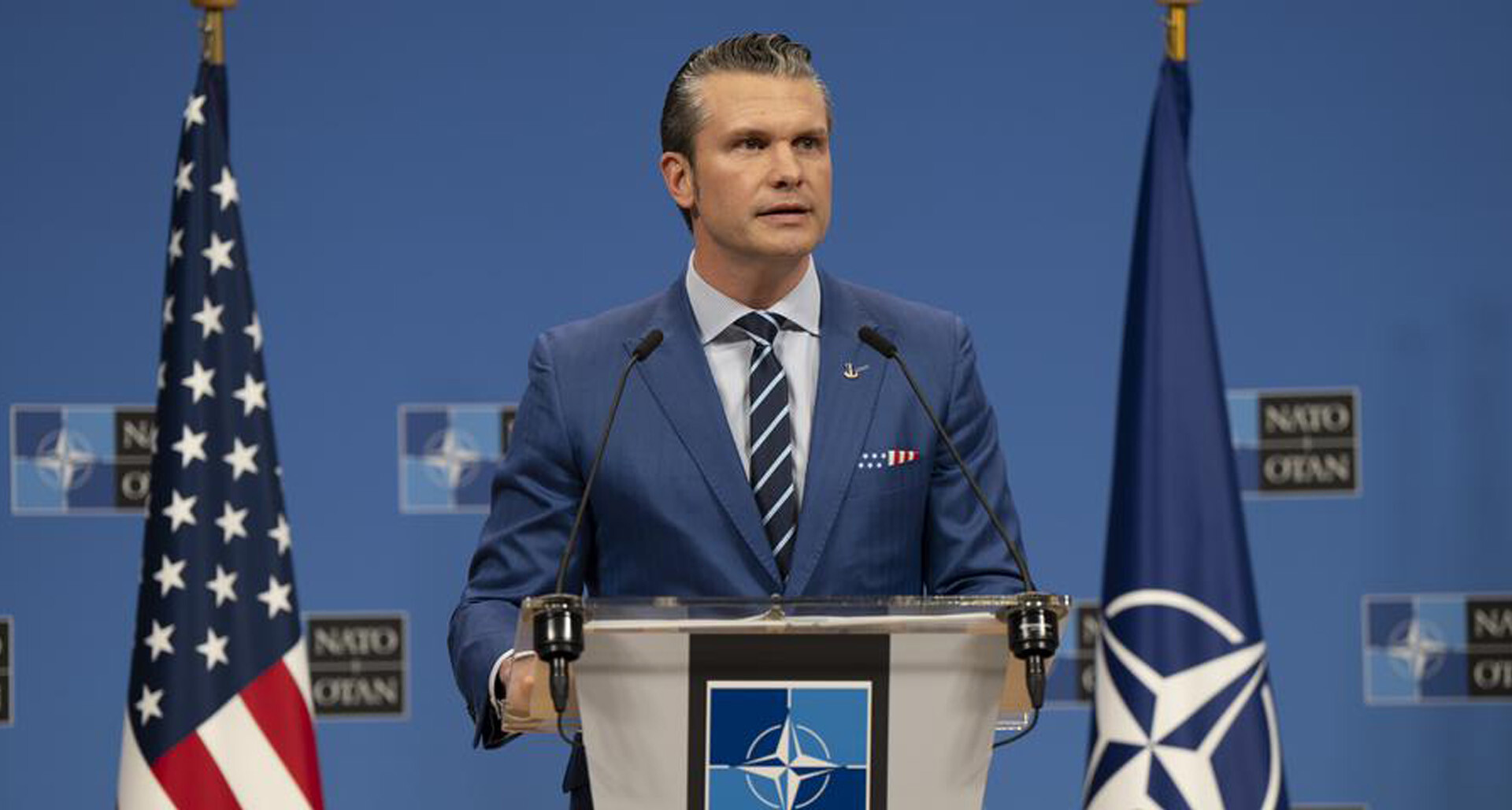
U.S. Defense Secretary Pete Hegseth on Thursday announced new review of the U.S. force posture in Europe while warning that allies who fall short on defense commitments will face consequences.
U.S. Defense Secretary Pete Hegseth on Thursday announced a new review of the U.S. force posture in Europe while warning that allies who fall short on defense commitments will face consequences.
During a meeting of NATO defense ministers in Brussels, Hegseth said future troop deployments and base locations in Europe could be altered depending on how allies align with Pentagon priorities, including the recent U.S. war against Iran.
“It’s a review that some countries will fail and others will pass with flying colors,” Hegseth said.
The announcement marks the latest potential shift in the U.S. military presence in Europe, which has undergone significant change in recent months. In May, the Defense Department announced that it was withdrawing 5,000 troops from Europe, a decision that resulted in the cancellation of an armored brigade’s deployment to Poland.
The U.S. also has informed allies that it will provide fewer forces to NATO in the event of a crisis on the Continent. Such moves are designed to force Europe to take on more responsibility for its own defense.
The future force posture aims to follow through on the Pentagon’s “NATO 3.0” concept, Hegseth said.
“It will be designed to ensure that NATO is moving fast and irreversibly toward Europe leading, stepping up to take primary responsibility for the defense of Europe,” he said.
The Pentagon analysis also will make sure that base access and overflight rights are “clearly delineated and assured,” Hegseth said, adding that “any other country would do the same.”
The review could have significant implications for where U.S. forces operate in Europe, where about 80,000 U.S. troops are currently deployed.
How allies responded to Operation Epic Fury, as the Iran war was dubbed, is likely to factor into the force posture analysis. When the U.S. sought to use bases in Europe for military flights and warship deployments directed against Iran, “too many of our allies said no,” Hegseth said.
Others “tried to drown us in arcane legal debates or criticized us publicly for doing what they aren’t prepared or able to do themselves,” Hegseth added. “It was shameful.”
Those allies “put America’s sons and daughters at risk” by denying them predictable base access and overflight rights, which “never should have been in question at all,” he said.
Hegseth did not mention specific countries during his speech at NATO, but Spain has come under heavy criticism from Washington for refusing access to its bases for operations in Iran. It remains unclear whether that could affect the U.S. presence at Rota, a key Navy base that hosts destroyers supporting NATO’s missile defense mission.
Still, many countries provided support to the U.S. war effort. Bases in Germany, Romania, Greece and the United Kingdom were among those used by U.S. forces to support Middle East operations.
One country that could stand to gain troops is Poland. After the May Pentagon decision to end an armored brigade deployment to Poland, President Donald Trump announced he was sending 5,000 troops back to the country. The Pentagon has not detailed where those troops would come from or when they might deploy. A growing military power and crucial link on NATO’s eastern flank, Poland has been lobbying for new permanent U.S. bases.
Meanwhile, Hegseth said the United States was prepared to scale back contributions to NATO in other ways.
“Annual NATO dues will be contingent on other countries meeting their defense spending targets,” he said. “Where other allies do not spend with urgency, our dues contributions will go down.”
It wasn’t immediately clear what Hegseth was referring to, but NATO operates a common fund that allies contribute to in support of a range of alliance initiatives.
Hegseth described the Pentagon’s approach to NATO as a return to the alliance’s Cold War construct, which featured European armies with larger arsenals built to counter the Soviet threat. In the post-Cold War era, instead of “tanks and fighters and air defenses, the focus has been on gender equity and climate change and defense austerity,” he said.
In recent years, however, NATO allies have significantly increased defense spending. Russia’s military seizure of Crimea from Ukraine in 2014 and its subsequent full-scale invasion of the country in 2022 helped spur a military buildup across Europe.
Allies also have agreed to Trump’s demand to increase NATO’s spending benchmark from 2% of gross domestic product to 5%.
“Some of our allies have gotten the message and stepped up,” Hegseth said. “You know who you are, and we very much appreciate it.”
- Security