

U.S. military forces to guide commercial ships through Strait of Hormuz, two U.S. servicemembers missing in Morocco, and European leaders mull President Trump’s decision to pull thousands of troops out of Germany.
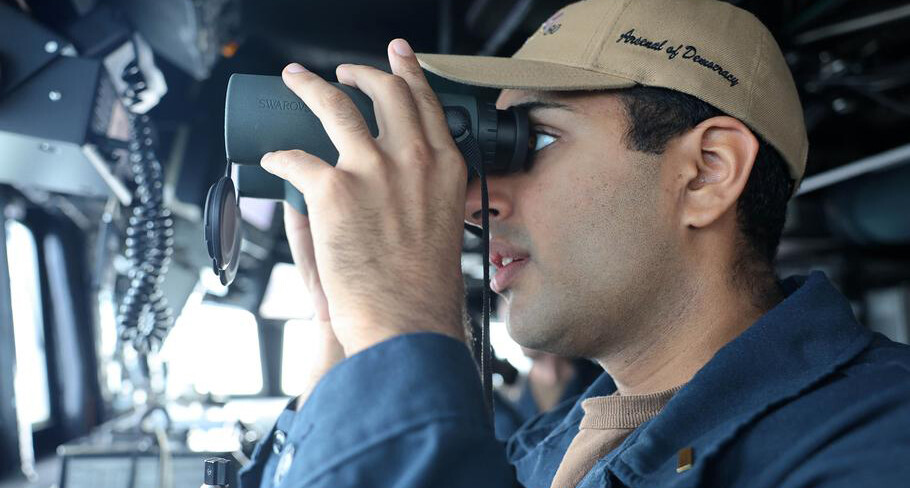
1. U.S. military forces starting Monday will guide commercial shipping from “neutral and innocent” countries through the Strait of Hormuz, according to Central Command and a social media post by President Donald Trump. “For the good of Iran, the Middle East, and the United States, we have told these Countries that we will guide their Ships safely out of these restricted Waterways, so that they can freely and ably get on with their business,” Trump wrote early Monday on Truth Social. The operation will not involve escort of vessels by U.S. warships, the Wall Street Journal reported. It is effectively a coordination cell made up of countries, insurance companies and shipping organizations that is intended to move traffic through the strait. The effort will include locating Iranian mines and passing along information to ships so they can avoid danger, the Journal reported, citing senior U.S. officials. CENTCOM did not immediately respond to questions seeking confirmation.
2. Two U.S. service members are missing in southwestern Morocco after taking part in annual multinational military exercises in the North African country, the United States Africa Command (AFRICOM) said Sunday. The service members are U.S. Army soldiers who went missing while on a hike, a U.S. defense official told The Associated Press on condition of anonymity as they were not allowed to speak publicly about the issue. “They were not actively taking part in any training. The day’s exercises had concluded, and, from our understanding, they were out on a recreational hike,” the official said. AFRICOM said the U.S., Morocco and other countries participating in the African Lion exercise have launched a search and rescue operation. “The incident remains under investigation and the search is ongoing,” it said in a statement.
3. European leaders on Monday said that U.S. President Donald Trump’s snap decision to pull thousands of U.S. troops out of Germany came as a surprise but is a fresh sign that Europe must take care of its own security. The Pentagon announced last week that it would pull some 5,000 troops out of Germany, but Trump told reporters on Saturday that “we’re going to cut way down. And we’re cutting a lot further than 5,000.” He offered no reason for the move, which blindsided NATO, but his decision came amid an escalating dispute with German Chancellor Friedrich Merz over the U.S-Israeli war on Iran, and Trump’s anger that European allies have been reluctant to get involved in the conflict in the Middle East. Asked about the decision to pull out 5,000 troops from Germany, Norwegian Prime Minister Jonas Gahr Støre said: “I wouldn’t exaggerate that because I think we are expecting that Europe is taking more charge of its own security.
4. Ukraine on Sunday launched a wave of strikes against Russian oil targets, hitting a key loading port on the Baltic Sea and two tankers that Ukraine alleges were illegally used to transport Russian crude. A nighttime drone strike sparked a blaze at Russia’s largest oil exporting port on the Baltic Sea, the port of Primorsk, according to Russian regional Gov. Alexander Drozdenko. The port, operated by Russia’s state oil firm Transneft, is capable of handling hundreds of thousands of barrels per day. Primorsk, which was targeted multiple times in March, lies over 1,000 kilometers (620 miles) from Ukraine, between the Russian-Finnish border and Russia’s second-largest city of St. Petersburg. Local Gov. Drozdenko said that the drone strike did not cause an oil spill, but gave no immediate further comment regarding casualties or damage.
5. The Pentagon said that it has reached deals with seven tech companies to use their artificial intelligence in its classified computer networks, allowing the military to tap into AI-powered capabilities to help it fight wars. Google, Microsoft, Amazon Web Services, Nvidia, OpenAI, Reflection and SpaceX will provide their resources to help “augment warfighter decision-making in complex operational environments,” the Defense Department said. Notably absent from the list is AI company Anthropic, after its public dispute and legal fight with the Trump administration over the ethics and safety of AI usage in war. The Defense Department has been rapidly accelerating its use of AI in recent years. The technology can help the military reduce the time it takes to identify and strike targets on the battlefield, while aiding in the organization of weapons maintenance and supply lines, according to a report in March from the Brennan Center for Justice.
- Security