

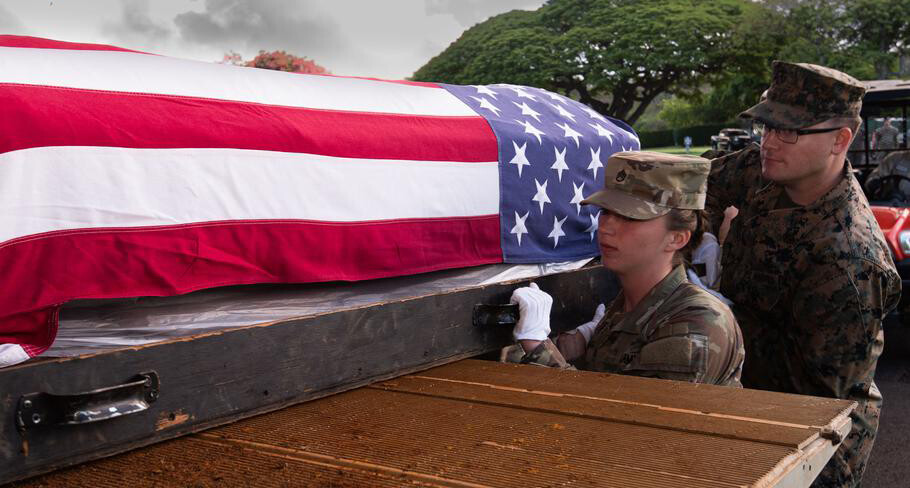
Seoul and Washington are planning a joint, nationwide search for the remains of U.S. servicemembers missing from the Korean War, according to South Korea’s Ministry of National Defense.
Seoul and Washington are planning a joint, nationwide search for the remains of U.S. service members missing from the Korean War, according to South Korea’s Ministry of National Defense.
MAKRI — the South Korean Ministry of National Defense Agency for KIA Recovery and Identification — and DPAA — the U.S. Defense POW/MIA Accounting Agency — have formed a 10-member team to look for 50 American service members killed or missing from battles involving the U.S. 2nd Infantry Division, according to a ministry news release on Tuesday.
The investigators will survey six locations: Hongcheon in Gangwon province; Yangpyeong in Gyeonggi province; Changwon in South Gyeongsang province; Mungyeong and Sangju in North Gyeongsang province; and Yeongdong in North Chungcheong province.
DPAA identified Hongcheon and Yangpyeong as potential spots tied to missing troops in January during a working-level coordination meeting by the U.S., South Korea and Australia, according to the release. Those areas are linked to battles during Chinese offensives in 1951, the ministry said.
In Changwon, search teams will focus on areas associated with the Battle of Masan Defense, while investigators in Yeongdong will examine sites linked to the Battle of Yeongdong-Gimcheon.
These locations were selected based on testimony from residents who said they witnessed U.S. casualties or helped bury soldiers during the war, according to the ministry.
In Mungyeong and Sangju, investigators are revisiting sites that MAKRI and DPAA examined last year for additional evidence connected to missing soldiers from the U.S. 25th Infantry Division.
More than 7,000 Americans remain unaccounted for from the Korean War, according to DPAA’s website.
Investigators face major challenges in South Korea, including an aging witness population, urban development that has altered or erased wartime sites and difficult, mountainous terrain, DPAA spokesman Austin Boucher said by email Thursday.
To overcome those obstacles, the agencies plan to rely on secondhand, family accounts, local archives and specialized equipment to navigate difficult terrain, he said.
South Korean army Lt. Col. Kim Sung-hwan, MAKRI’s acting director, said in the release that he hopes the joint investigation can find clues that lead to tangible results in future excavations.
Separately, DPAA and MAKRI announced a joint two-day operation, scheduled to conclude Thursday, to identify three sets of military remains, according to a separate press release from the South Korean agency Wednesday.
Ten forensic experts from both countries are making final identifications on the remains, which are presumed to be U.S. service members. They are scheduled to be transferred to the United States next week during a repatriation ceremony in Seoul.
Two of the remains are presumed to belong to soldiers assigned to 2nd ID and were excavated in Gangwon province in 2010 and 2021. Another set was discovered in Sejong City in 2012 and is believed to be connected to the 21st Regiment of the 24th Infantry Division, according to the release.
MAKRI has conducted joint identification missions roughly two to four times a year since it was founded in 2007.
- Security