

The American Legion tour involved interaction with airmen and base leadership to hear quality of life needs.
The American Legion launched its Base Assessment and Servicemember Experience (BASE) program in 2022 to address quality of life needs for servicemembers and their families, such as childcare, housing and food. To date, American Legion delegations of staff and department leadership have visited six military installations, with four of those in 2026 that included the most recent visit to Joint Base Andrews in Maryland, located outside the nation’s capital and home to Air Force One.
“These BASE visits serve as a way for us to engage our active-duty servicemembers right where they are and relay our findings not only to the Legion, but our elected leaders, so they can understand the realities in their districts and identify opportunities to improve military quality of life,” said Jonathan Copic, deputy director of the National Security Division, who was part of the Legion delegation. It also included Legislative Associate Logan Barber, Policy Analyst Erick Johnson, and Maryland Southern Region Commander Murray Hall, who retired out of Joint Base Andrews.
The Oct. 26-27 tour at Joint Base Andrews started with an in-brief with installation command teams. The American Legion’s presence was welcomed by Installation Commander U.S Air Force Col. Karl W. Seekamp, which provided an opportunity for him to share quality-of-life needs he has noticed upon arriving to the base just over three months ago.
“I’m really grateful for you being here,” he said. “We are pretty effective at our mission here. The team does a great job getting the mission done; I don’t have concerns with our mission. But quality of life is why you are here, and I do have a lot of concerns about quality of life.”
His concerns are of activities that are no longer operating on base that bring servicemembers and their families together – the pool, movie theater, bowling alley and skills shop – that he would like to see reinvestment in.
“Those things are important to bring community together. Bring some solidarity and get people to connect off duty hours,” Seekamp said.
Joint Base Andrews is home to 60,000 personnel that includes the Air Force, Army, Navy, Marines, Space Force and Coast Guard with six wings, three headquarters and 85 mission partners.
“Our quality-of-life programs here are paramount to getting the mission done at the end of the day,” said Lt. Conner Spencer, Deputy Flight Commander of Community Services, who accompanied the Legion delegation on the base tour. “Because of this relentless high profile 24/7 global mission, supporting everything from presidential airlifts to global response forces, our personnel operate under constant pressure. This tempo demands that their homefront be rock solid.”
STORY CONTINUES BELOW
Photo: U.S. Air Force Col. Karl Seekamp, 316th Wing and installation commander, speaks with American Legion national staff. Photo by Senior Airman Zachary Jakel.
Following the in-brief, the Legion delegation visited seven stops around base that resulted in best practices identified and opportunities for quality-of-life improvements.
“It was eye opening to see the work that goes into day-to-day operations at an installation like Joint Base Andrews, where so many foreign dignitaries get their first glimpse of the United States,” Copic said. “The servicemember experience here should reflect the important role they play in that equation.”
Malcom Grow Medical Clinics and Surgery Center. Personnel shortages such as physicians, nursing and front desk staff were addressed, which has been common among the Legion base visits. But best practices were identified with pharmacy and mental health. Between the four pharmacies on base, 293,000 prescriptions are filled annually for the national capital region (NCR). To create a streamline medication pickup and refill process, the base implemented ScriptCenter kiosks at two locations. The kiosks eliminate waiting lines by housing medications in a secure locker for pickup anytime. And a Q-Anywhere application allows for remote check to know when medications are ready.
The mental health clinic has about 50 personnel, including civilian providers, social workers, psychologist and psychiatrists, “so a big cluster of individuals who are really supporting those servicemembers,” said Capt. Eva Valdez, the alcohol and drug abuse prevention program manager. “We use targeted care, which means that anyone who walks into our clinic will be seen day of but then we use a targeting care model to figure out what next steps would be appropriate for them. The challenges we do have is the demand for mental health is very high.”
The En-Route Patient Staging (ERPS) dozens of patients arriving from overseas for medical needs before being transferred to their home military medical treatment facility. It’s the largest ERPS in the Air Force. Most military members arrive for mental health support. To address this need, Joint Base Andrews conducts iCOVER: Rapid Peer-to-Peer Intervention for Acute Stress with servicemembers, a six-step peer intervention for a servicemember who is having an acute stress reaction, often seen during deployments.
“We are finding ways to utilize that prevention rather than intervention after,” Valdez said.
Photo: The American Legion speaks with staff from the Military & Family Readiness Center.
Military & Family Readiness Center. Joint Base Andrews has a robust Transition Assistance Program (TAP) that serves all the installations in the NCR. TAP is conducted twice a month with about 50 retirees and separating servicemembers in each session, which estimates to about 1,200 servicemembers that each of the 14 Military & Family Readiness Center staff sees individually for an hour to identify employment, housing, peer support or financial support needs.
“The one-on-ones definitely help to set up success for everyone as they’re transitioning over to the civilian side,” said Brittany Martin, TAP program manager. “I feel like we have people who are very open, so they do let us know if they are going through struggles during those appointments. We’ve done those warm handovers where someone tells me, ‘Hey, I’m going to be homeless.’ We make sure we eliminate that before they even exit the military.”
Jason Gunnarson, flight chief for the Military & Family Readiness Center, said his staff has a customer service satisfaction of a 4.9 out of 5 for the one-one-one appointments and a 4.7-4.8 for the monthly separation workshops. “We have active facilitators who are passionate about their jobs, they really want to help,” he said. “I think having that team and then having those ratings can really show what this staff is doing and the benefits we’re giving to the community.”
Martin also “has the best and most robust TAP program in the NCR,” said Megan Ramage-White, section chief for the Military & Family Readiness Center, adding that Martin brings in outside resources for the program that are not mandatory but are valuable, like Hiring Our Heroes or VA Vocational Rehab. “Her dedication to making connections with community partners has really made us a premier program,” Ramage-White said. “And we love when you get someone in for TAP and they are just checking the box, but then you start talking with them about resources and now they’re really interested in TAP and that moment of relief you can see fall off their face is our favorite thing.”
The Military & Family Readiness Center also has a dedicated employment specialist for servicemembers and their spouses. Dr. Regina Willis, lead Department of Labor navigator, sees about six to seven servicemembers a day where she helps with resumes, interview skills, career coaching, mock interviews and job search.
“I think this team makes it look seamless, and I think the reason why it never comes up we need more is because they are passionate about their job,” Gunnarson said.
Angela Schmidt, Employment Readiness Program Manager, agreed. “I think that passion makes us have drive because we want to make sure we share every resource we can possibly share,” she said. “I’m not going to let anybody walk out the door that’s going to be homeless or doesn’t have a job. I want to help you walk this path. I’m your counselor until the end.”
Family/accompanied housing. On-base housing is managed by the privatized partner, Liberty Park at Andrews, which oversees approximately 1,100 homes. The team provides support during the application process and works with incoming servicemembers and their families throughout their move-in and tenancy. The waiting list is flexible, accommodating prospective residents based on their family size, rank and timeframe. During residency, Liberty Park provides 24/7 maintenance assistance, landscaping services and trash removal. Liberty Park also hosts resident events such as the Fall Festival, Pooch Plunge, Back to School supply giveaway, and decorating contests, and share information in the monthly newsletters. The Welcome Center includes amenities such as an outdoor pool, a 24/7 fitness center, community space and a patio for entertaining.
“As a resident on base, this is one of the better housing contractors that I’ve seen,” Spencer said. “I’ve been to four different bases and have lived on base. Liberty Park does a great job, especially in terms of maintenance. They do everything that they can to make sure that servicemembers and their family’s needs are taken care of in a timely and appropriate manner.”
Photo: The American Legion visits a child care center and meets with Director Destiny Leggett.
Child Development Centers. Joint Base Andrews has two CDCs with a third being built that will provide capacity for 163 children. Between the current two CDCs, enrollment is 455 with capacity for an additional 40 children under full staffing. “We take our jobs seriously. We love what we do,” said CDC Director Destiny Leggett. “We are here for the mission and our children and families.”
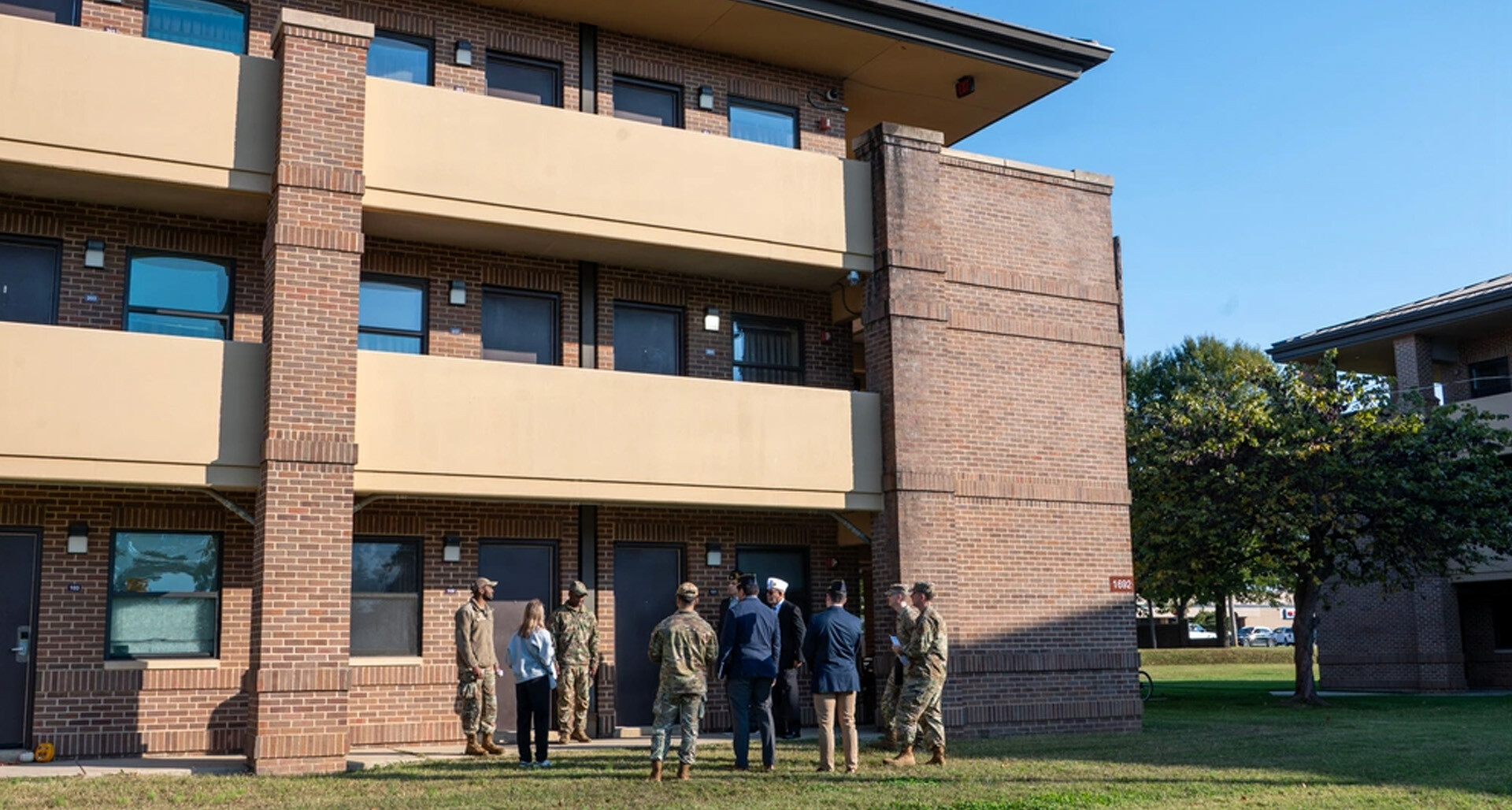
Barracks. About 350 airmen and sailors reside in dorms that are single-occupancy rooms sharing one bath and either a kitchen or a communal kitchen. One dorm is undergoing renovation with a future need for all buildings to be updated. A best practice identified is that each dorm has an airman dormitory leader (ADL) jointly staffed between the USAF and USN. They are the first contact new airmen and sailors meet once arriving to Joint Base Andrews.
“We are their first interaction to the operational side of the military. These dorms are literally their first welcome to the base,” said Staff Sgt. Shawn Etheridge, an ADL.
“We are mentors as well,” said Staff Sgt. Travion Harris, an ADL. “If they don’t feel comfortable talking with their direct leadership about something if they are going through some stuff, we are there for them. We talk about resources that we have like the military family readiness center. We are someone that they come to and confide in.”
- Security